Take a sheet of printer paper and fold it in half. Then fold it again, and again. The first few folds give no trouble. By the sixth, you're squeezing a stiff little block between your thumbs. The seventh barely closes. The doubling is part of the story. The rest hides in the curve of each fold.
Try it yourself in Fold Lab: drag the sheet longer and watch each new fold swallow more of the strip.
Why does each fold get harder?
Each fold lays the paper on top of itself, so the stack doubles. One fold makes 2 layers. Seven folds make 128. Office paper is about 0.1 mm thick, so those 128 layers stand about 13 mm tall. Paper runs from about 0.07 to 0.18 mm thick, so your sheet may differ. Wikipedia: Paper.
Doubling runs away quickly. Ten folds make 1,024 layers, about 10 cm thick. Twelve folds make 4,096 layers, a stack 41 cm tall.
The stack is only half of it. A fold is not a sharp corner. The paper has to curve around the bend, and every layer in the stack curves with it. The inside layer makes a tight turn. The outside layer goes the long way around. All that curving uses up paper that can no longer lie flat.
The first fold bends a single layer and uses about 0.3 mm of paper. The seventh wraps 64 layers around one bend, and that bend alone uses about 65 cm. Each fold costs about four times the one before. The eighth would need about 2.6 meters for its bend alone.
That is why a sheet gives up. The next bend needs more paper than the sheet has left.
How long does the paper need to be?
In December 2001, Britney Gallivan, a high school student in California, worked out the answer. Fold a strip of thickness t in half n times, always in the same direction. It must be at least L = (πt/6)(2n + 4)(2n − 1) long. Wikipedia: Mathematics of paper folding.
The length grows about four times with every fold. For paper 0.1 mm thick, seven folds need a strip about 88 cm long. A 28 cm sheet of office paper has room for six, folded one way. Twelve folds need about 880 meters, nearly a kilometer. Thirteen need about 3.5 km.
Has anyone folded paper more than seven times?
Yes. On January 27, 2002, Gallivan put her formula to the test. She folded a 1,219-meter (4,000-foot) strip of toilet paper in half 12 times, all in the same direction. At the time, folding paper in half more than eight times was considered impossible. Guinness World Records: Most times to fold a piece of paper.
She had already managed 12 folds with gold foil before she moved on to paper. Wolfram MathWorld: Folding.
In December 2011, a math teacher and students from St. Mark's School in Massachusetts went further. In MIT's Infinite Corridor, they used about 16 km (54,000 feet) of toilet paper and reported the equivalent of 13 folds. No single strip that long exists, so they taped pieces together and stacked the first layers. The record is unofficial. NPR: Record folders.
Would 42 folds really reach the Moon?
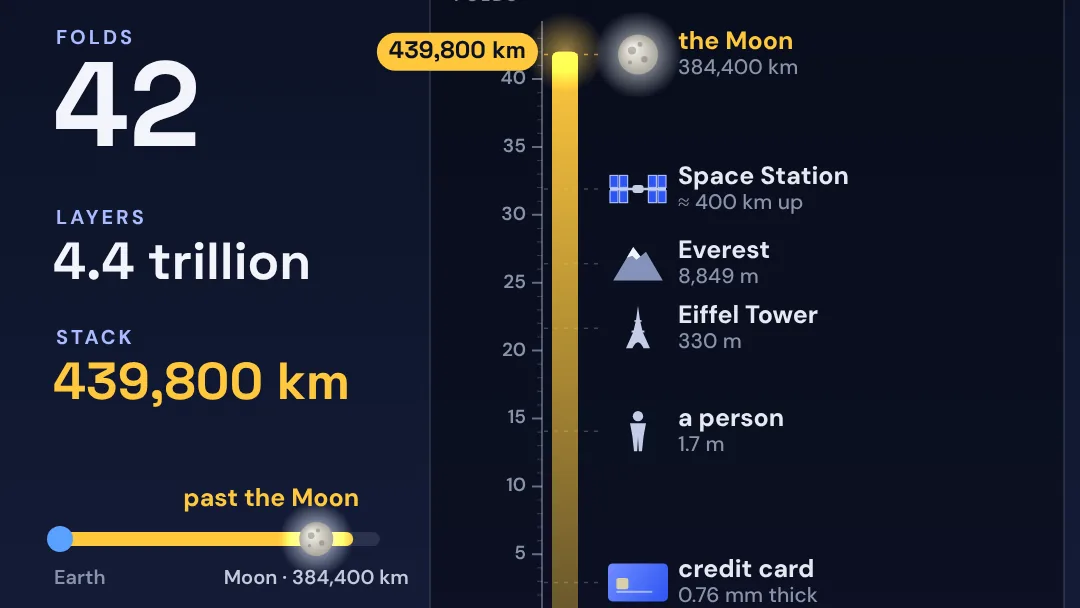
On paper, yes. Forty-two doublings turn 0.1 mm into about 439,800 km. The Moon is 384,400 km away on average, and never much more than 407,000 km. NASA: Moon Fact Sheet.
The catch is the strip. By Gallivan's formula, 42 folds in one direction would need paper about 107,000 light-years long. Light itself would take more than a hundred thousand years to run its length. The stack doubles with each fold, but the paper it needs grows about four times.
What does the model leave out?
Fold Lab uses Gallivan's one-direction model with ideal paper. Its numbers come from geometry alone. They are not a forecast for your sheet. Real folding adds more:
- Alternating folds. Most people turn the sheet between folds. Gallivan worked out a second formula for that. By it, a letter-size sheet manages about seven folds. In one direction, it allows six.
- Real paper. The model's paper never squashes, stretches or tears. Its bends are tight half circles, with no air between the layers.
- Effort. The model ignores friction, and how hard you have to press.
The side view is drawn to scale, except that the first few folds show the layers thicker so you can see them.
Can you beat seven folds at home?
A hallway and a roll of toilet paper make a good test. These steps are a suggestion, so adapt them to the child beside you.
Predict. Start with one sheet of printer paper. Ask your child how many times it will fold in half. Then unroll about 10 meters of toilet paper down the hallway. Will the long strip fold more times, fewer or the same?
Try. Fold the sheet until it won't close, and count. Then fold the long strip in half, always in the same direction. Line up the ends each time, and go gently so it doesn't tear.
Explain. The sheet ran out of length for its bends. In Fold Lab's model, a 10-meter strip of 0.1 mm paper has room for eight folds. A ninth would need a strip about 14 meters long. Toilet paper varies, so measure your folded stack with a ruler. Divide by the number of layers to estimate its thickness, then set it in Fold Lab.
Back in Fold Lab, load Gallivan's roll and drag the paper thickness down to tissue, half as thick. Predict first: do you gain a fold? Then drag it up to card stock, five times thicker, and count what you lose.
Fold Lab is an ExplainerTools Original. Its concept was inspired by Britney Gallivan's How to Fold Paper in Half Twelve Times (2002).


Sources & further reading
Make the next question an experiment.
Browse independent creators who make big ideas visible.
Find an explainer