Standing keeps weight over the feet. Walking deliberately moves the body forward into a fall, then swings a foot out to catch it—again and again.
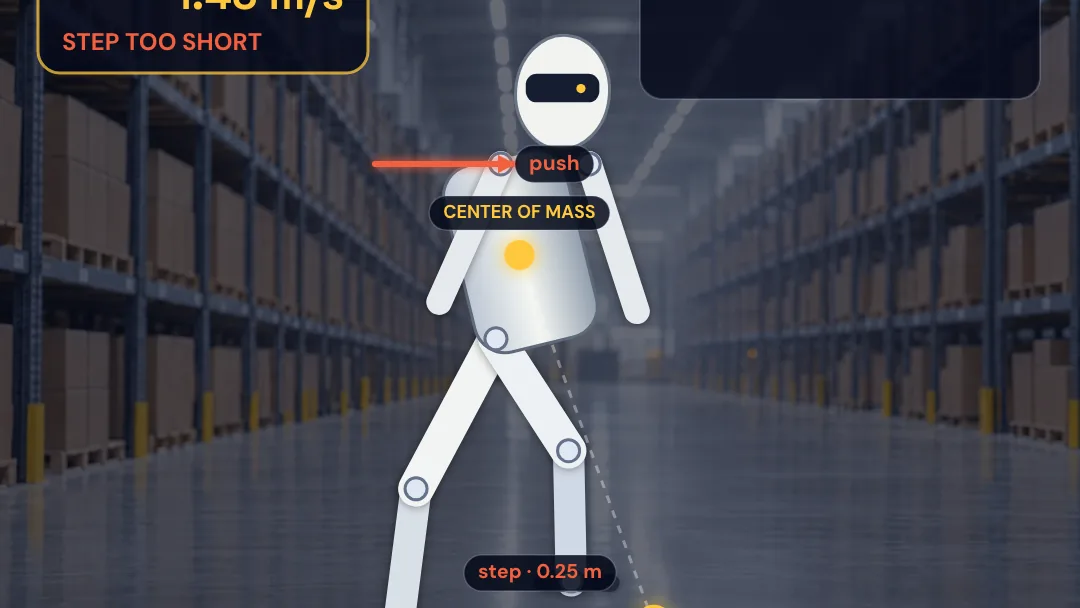
Try it yourself: push the robot and move its next step.
What is the capture point?
The model treats the body as a constant-height inverted pendulum. With center-of-mass position x, speed v, height h and natural frequency √(g/h), the one-step capture point is x + v/ω.
A harder push raises forward speed and moves that target farther ahead. In this reduced model, a foot that lands short of the target topples; a step beyond it is recoverable.
What does 1,000 times a second mean?
It refers to fast balance and joint-control loops, not a claim that every robot recomputes a complete footstep plan at 1 kHz. Higher-level perception and planning can run more slowly.
The model leaves out three-dimensional motion, foot size, terrain, slipping, compliance, torque limits, swing time, arms and multi-step recovery.
Sources: Pratt et al., Capture Point; Kajita et al., 3D Linear Inverted Pendulum; PAL Robotics, Kangaroo.
Sources & further reading
Make the next question an experiment.
Browse independent creators who make big ideas visible.
Find an explainer