Robots · interactive
Why do walking robots fall over?
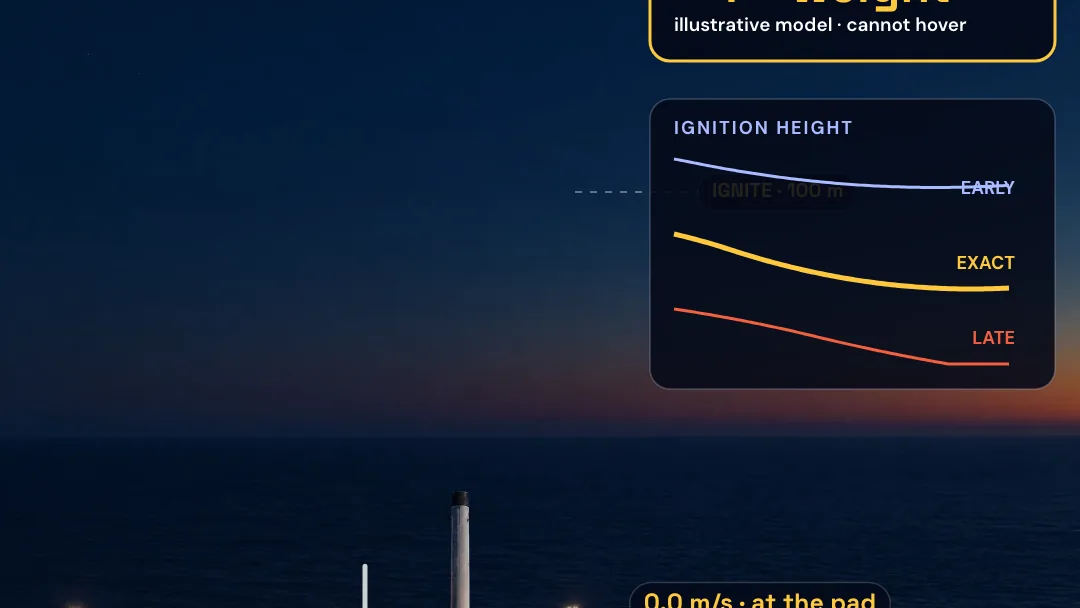
The yellow ring marks where an ideal step could stop the fall. Slide the push, next step and center-of-mass height.
1 See
Walking deliberately moves the body's weight beyond its support, then catches that fall with the next foot. A push moves the catch point.
2 Change
3 Understand
Model notes and sources
Model. A constant-height linear inverted pendulum with center-of-mass position x, forward speed v and height h. Its natural frequency is ω = √(g/h), and the one-step capture point is ξ = x + v/ω. In this reduced model, landing the next support at ξ can bring the body to rest; a harder push raises v and moves ξ farther ahead.
What the foot means. The tool compares the selected step with the capture point. The display uses a 0.04 m teaching tolerance: a margin below −0.04 m is labeled “step too short”; a margin from −0.04 m to less than +0.05 m is labeled “just catches”; a longer step is labeled “step can catch.” These labels compare reach in the reduced model, rather than predict the result of a real foot landing. Real humanoids have finite feet, knees, arms, angular momentum, multiple future steps and actuator limits, so their capture region is wider and more complicated than one point.
The film. The film's robot is the same model with its center of mass at z = 1 m, so √(z/g) = √(1 m ÷ 9.81 m/s²) ≈ 0.32 s: the capture point sits the distance the body travels in about a third of a second. It walks by setting each foot slightly behind the capture point (about 0.6–1.1 m/s), is pushed by +0.45 m/s and paused at 1.29 m/s, when the capture point is 1.29 m/s × 0.32 s = 0.41 m ahead of its center of mass. As in the original capture-point definition, the paused step lands instantly. A foot 0.19 m short leaves the body falling past it; once the center of mass passes the toe, the film switches to a rigid body tipping over the toe until it reaches the floor. A foot on the capture point brings the center of mass to rest over it within about 1.5 s. Slow-motion and paused segments are labeled on screen. The drawn robot's pelvis dips a few centimeters on long steps so its legs can reach; the model keeps z = 1 m. The robot, the lab and every number in the film are drawn from the model; the tool's background picture is a stylized illustration.
Update rate. The film's “up to 1,000 times a second” refers to fast balance and joint-control loops, not a claim that every humanoid recomputes a complete footstep plan at 1 kHz. Published humanoid platforms span different rates; PAL Robotics lists a 2 kHz EtherCAT control loop for its Kangaroo biped. Higher-level perception and planning usually run more slowly.
Not modeled. Three-dimensional motion, foot size and pressure distribution, terrain, slipping, compliance, joint torque limits, swing-foot travel time, arm motion and multi-step recovery are omitted. The default view uses an illustrative 3D joint rig, not a dynamics engine. If WebGL is unavailable, the page falls back to the original schematic drawing. Its long links allow the full control range, its posture shifts with the selected step, and its whole-body center of mass is not calculated. The yellow modeled point remains x = 0 at height h; the capture target and chosen foot follow the stated two-dimensional equations. Three-dimensional lighting and camera projection change the view, not those equations.
Footage. The film uses three short excerpts of real video, picture only, each credited on screen while it plays: a humanoid robot collapsing on stage at a Qualcomm Dragonwing IQ10 demo, by @techniahqrobot (about 3.7 s); and a Unitree G1 being kicked, then taking a long catching stride and stopping, from @UnitreeRobotics (about 1.2 s and 3.7 s). The clips show real robots; they are not measured against the model, and the capture point drawn in the film comes from the equations above, not from the footage.
Sources: Pratt et al. (2006), Capture Point: A Step toward Humanoid Push Recovery; Kajita et al. (2001), The 3D Linear Inverted Pendulum Mode; PAL Robotics, Kangaroo biped platform (2 kHz control loop).
An ExplainerTools Original.