A crescent Moon can look like a small piece of a much larger object. A week later, more of it seems to have appeared. The useful starting point is simple: the Moon remains round. What changes is how much of its sunlit side we can see from Earth.
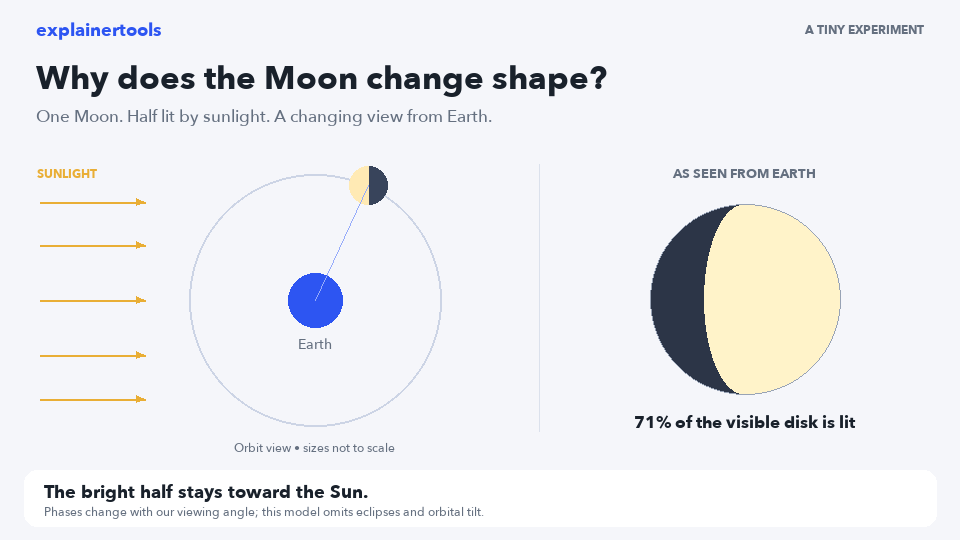
Our original animation separates two views. On the left, you can follow the Moon around Earth. On the right, you can see the illuminated part of the disk as it would appear from Earth. Pause at any point and compare them.
Keep track of the light
The Moon's ordinary glow is sunlight reflected from its surface. Apart from events such as a lunar eclipse, roughly half of the Moon is directly illuminated by the Sun. As the Moon travels around Earth, we see different portions of that illuminated half. A phase describes that appearance, rather than a change in the Moon's physical shape. NASA: Moon Phases.
Move the slider to put the Moon on the side of Earth facing the sunlight. The Moon's bright half faces mostly away from us: the new-Moon arrangement. Move it around to the opposite side. Its sunlit face now points toward Earth, giving the full-Moon arrangement. Between those positions, the visible bright area changes gradually.
Try a prediction before moving the slider
Choose a full Moon in the model. Ask your child what they expect after moving it a quarter of the way around the orbit. Will the visible disk still look fully bright? Let them decide, then move the slider slowly and watch the right-hand view.
Next, stop at a crescent. Ask them to point toward the Sun in the orbit view. Which side of the little Moon is bright there? The two pictures show the same object from different places. Switching between those viewpoints is the main idea to explore.
Why do we call a half-lit disk a quarter Moon?
The phase names track progress through the cycle. At first quarter, the Moon is about a quarter of the way through its cycle from new Moon, and about half of its visible disk looks bright. Third quarter is the corresponding stage later in the cycle. The name does not mean that one quarter of the visible disk is illuminated. OpenStax: Phases and Motions of the Moon.
The complete phase cycle lasts about 29.5 days. The Moon completes an orbit relative to the distant stars in about 27.3 days; the phase cycle takes longer because Earth and the Moon are also moving around the Sun. For a first conversation, noticing a repeating pattern matters more than memorizing both numbers. NASA: Top Moon Questions.
What about Earth's shadow?
Earth's shadow explains a lunar eclipse. Ordinary phases come from viewing the Moon's sunlit half at different angles. The Moon's orbital plane is tilted relative to Earth's path around the Sun, so the three bodies do not line up for an eclipse every month. Our flat diagram deliberately leaves that tilt out, which is why it should not be used to predict eclipses. NASA: Eclipses and the Moon.
Take the question outside
When the Moon is visible, make a quick sketch together. Record the date and time, then compare another observation a few days later. Ask whether the bright portion has grown or shrunk. Your drawing can be rough; the interesting part is the change you notice.
Return to the model and look for a position that resembles your sketch. Then open Moon by Bartosz Ciechanowski to explore a richer model of motion and viewing position. Keep the child's question in view: where is the light coming from, and what part can we see?
Sources & further reading
Make the next question an experiment.
Browse independent creators who make big ideas visible.
Find an explainer