Phones · interactive
Why does airplane mode matter?
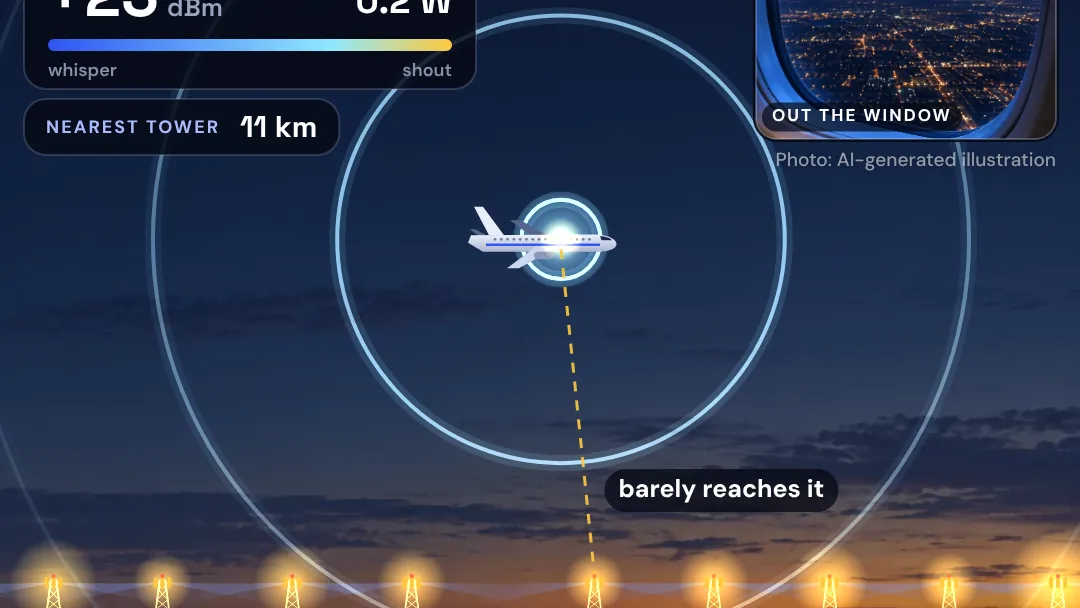
Side view: the phone (or the plane carrying it), the cell towers below and how far its signal carries. Inset: what you would see at that altitude.
1 See
On the ground your phone barely whispers to the nearest tower. So why does it matter whether it’s on during a flight?
2 Change
3 Understand
Model notes and sources
An illustrative uplink budget at 1.8 GHz. The phone adds just enough power for its best tower to receive −110 dBm: P = −110 dBm + Lpath − Gtower, limited to −40…+23 dBm (an LTE power-class-3 phone; 23 dBm ≈ 0.2 W). A tower “hears” the phone when the signal arrives above −115 dBm, roughly the noise floor of one 180 kHz LTE resource block (−174 dBm/Hz + 52.6 dB + about 7 dB receiver noise figure); for that reach, every tower is assumed to see the phone through the same part of its antenna pattern as the nearest tower does. The rings show that reach.
Path loss: on the ground, 128 + 35 log10(d/km) dB, a suburban slope like the Hata model; above about 100 m the path is clear, so free space: 97.5 + 20 log10(d/km) dB. Towers: 30 m masts with 15 dBi antennas whose 10°-wide beam is tilted 6° down; above the beam the gain falls by up to 30 dB (the side-lobe floor used in 3GPP’s 3D antenna pattern). Towers sit 3–5 km apart in one row, and the drawing shows them much taller than scale. The film’s plane drifts 0.3 km sideways per km of climb.
Fixed values and results are illustrative, not measurements: real networks use closed-loop power control, many frequency bands, varied antennas and terrain. The model leaves out the aircraft’s metal skin (which weakens signals), Earth’s curvature, handovers, timing-advance limits and other phones. 5G phones use the same 23 dBm class; older GSM phones could transmit up to 2 W, in bursts once per 4.615 ms frame (≈217 Hz), which is the source of the familiar “dit-dit” buzz in speakers and headsets. Airplane mode switches the cellular radio off; Wi‑Fi and Bluetooth can be turned back on separately. Rules differ by country: the US FCC bars airborne use of cellular phones, while Europe allows in-flight mobile service through on-board cells. The photos are AI-generated illustrations; every number comes from the model.
Sources: Mobile phones on aircraft; GSM (handset power, TDMA frame, TDMA noise); 3GPP TS 36.101 (UE maximum and minimum output power); 47 CFR § 22.925; Hata model; CBS News: a pilot on the headset buzz.
An ExplainerTools Original.