Home tech · interactive
Why does Wi-Fi slow down through walls?
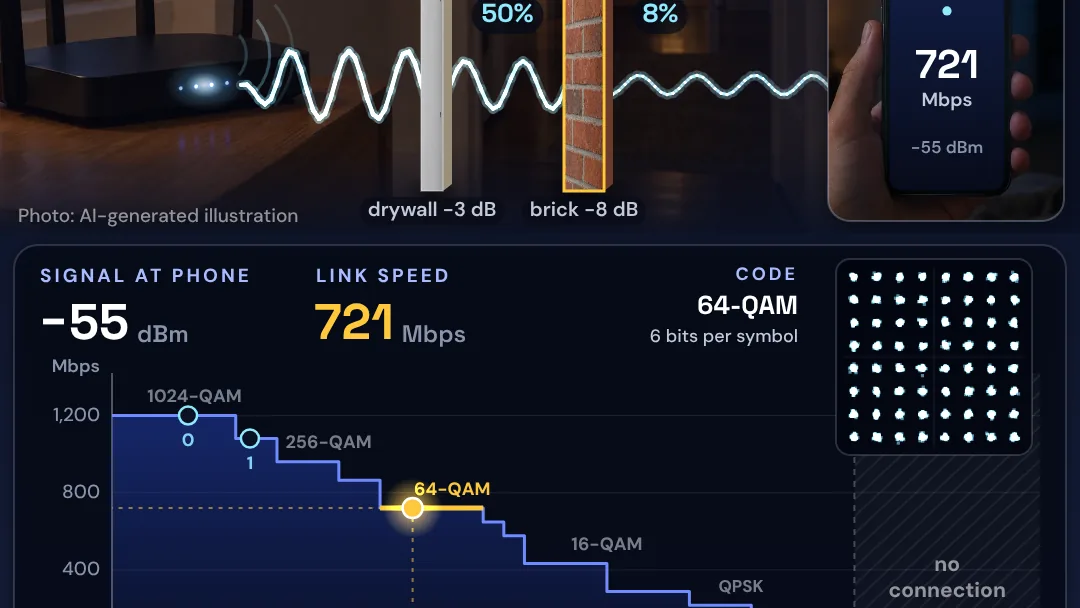
Top: the router's signal on its way to your phone, 7 m away, through the walls you add. Bottom: the link speed Wi-Fi can use at that signal strength, and the code it picks.
1 See
Next to the router your phone gets the top speed; one room over it can be a fraction of that, while still showing Wi-Fi. What do the walls do to the signal?
2 Change
3 Understand
Model notes and sources
Signal. The phone receives P = Ptx − FSPL(d) − ΣLwall (in dBm). The router sends 20 dBm (100 mW, antenna gain included) on a 5 GHz channel 80 MHz wide, centred on 5,210 MHz, and the phone is 7 m away. Free-space path loss is FSPL = 20 log10(d in m) + 20 log10(f in MHz) − 27.55 dB, which is 63.7 dB at 7 m. With nothing in the way the phone gets −43.7 dBm.
Walls. Each wall takes off a fixed loss. Drywall: 3 dB, so about half the power gets through. Brick: 8 dB (about 1/6); published values run from about 8 to 12 dB. Concrete: 15 dB (about 1/30); 12–16 dB is typical, and heavy or reinforced concrete can take 20–40 dB or more. Every 10 dB is a factor of 10 in power, so a wall of 10 dB or more lets through a tenth or less. The film's floor plan and wall cards use the same three values.
Speed. Router and phone use the fastest modulation and coding scheme (MCS) the signal supports, and step down as it weakens (link adaptation). The thresholds are the minimum receiver sensitivities in the 802.11ax (Wi-Fi 6) spec for an 80 MHz channel: from −46 dBm for MCS 11 (1024-QAM, rate 5/6) down to −76 dBm for MCS 0 (BPSK, rate 1/2). Link speeds are the 802.11ax data rates for 2 spatial streams, 80 MHz and a 0.8 µs guard interval: 1,201, 1,081, 961, 865, 721, 649, 577, 432, 288, 216, 144 and 72 Mbps. Below −76 dBm the model shows no connection. In the film, drywall takes the link from 1,201 to 1,081 Mbps, brick to 721 Mbps and concrete to 216 Mbps, at −69.7 dBm, still 6 dB above the floor.
Codes. The constellation shows the chosen modulation's points (2 to 1,024 of them) with noise for the current signal-to-noise ratio. The noise floor is −85 dBm: thermal noise in 80 MHz (−95 dBm) plus a 10 dB receiver noise figure, the assumption behind the spec's sensitivity table. Denser codes carry more bits per symbol but need a cleaner signal, so a weak signal forces a slower, sturdier code.
Not modeled. Reflections and multipath (real signals also bounce through doorways and around rooms), interference from other networks, the angle at which the signal crosses a wall, beamforming and antenna patterns, and the 2.4 and 6 GHz bands. Link speed is not download speed: protocol overhead means real throughput is lower, roughly 70% of the link rate by a common rule of thumb. Real phones usually beat the spec's minimum sensitivities by several dB, so their steps come at weaker signals, but in the same order. The photos are AI-generated illustrations; every number drawn on them comes from this model. In the film, a wall sliding in adds its loss gradually so the steps show one by one.
Sources: Free-space path loss; NHS England, Wireless infrastructure building guidance: building factors to consider (transmission loss of building materials at 2.4 and 5 GHz); W. C. Stone, NIST, Electromagnetic Signal Attenuation in Construction Materials (NISTIR 6055, 1997); IEEE 802.11 TGax, spec text for 11ax receiver requirements (doc. 11-16/1406r1, receiver minimum input sensitivity); Wi-Fi 6 (MCS data rates); Cisco, 802.11ac wireless throughput testing and expectations (data rates and the 0.7 throughput rule of thumb); Link adaptation.
An ExplainerTools Original.