Space · interactive
Why does the Moon change shape?
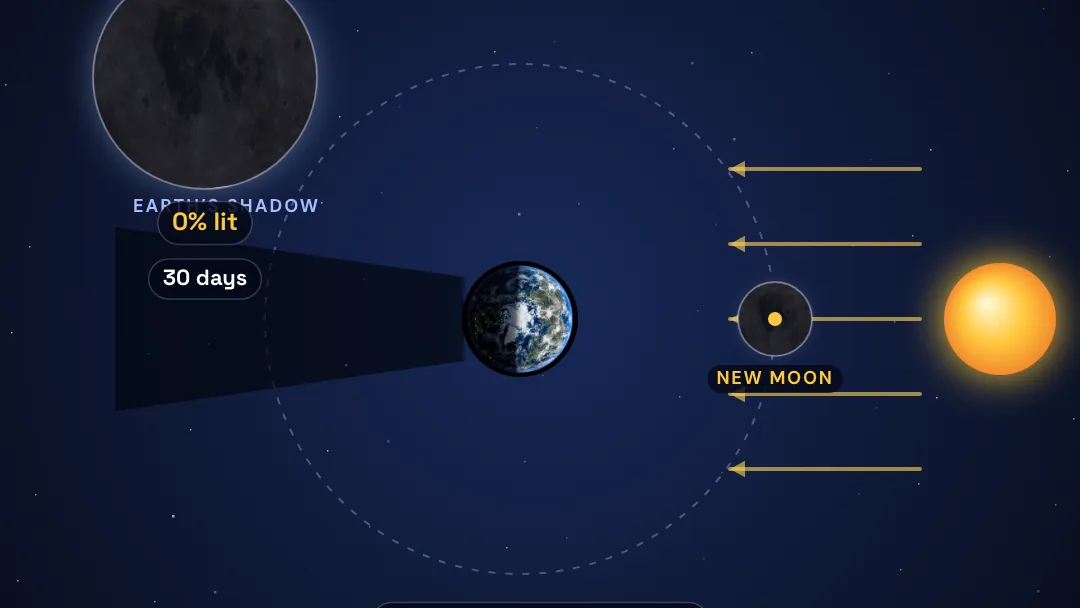
Sunlight always lights half the Moon. Move it around Earth to change how much of that half faces you.
1 See
The Moon does not change shape. From Earth, we see a changing share of the half that sunlight always illuminates.
2 Change
3 Understand
Model notes and sources
Phase model. Elongation ε is the angle between the Sun and Moon as seen from Earth. The illuminated fraction visible from Earth is f = (1 − cos ε) / 2: 0 at new Moon, 0.5 at either quarter and 1 at full Moon. The terminator is rendered from that geometry over a real lunar texture.
Time. The phase cycle is the synodic month, 29.53 days from new Moon to new Moon. The tool maps one circular orbit to 29.5 days. The Moon's sidereal orbit is shorter, about 27.3 days, because Earth also moves around the Sun.
Earth's shadow. The shadow cone is drawn pointing directly away from the Sun. Ordinary phases are not caused by that shadow. A lunar eclipse happens only when the full Moon also crosses the shadow; the Moon's orbit is tilted about 5°, so that does not happen every month.
Not modeled. Elliptical orbits, libration, the 5° orbital tilt except for the shadow note, changing distance and size, Earthshine, surface relief in the terminator and the Sun's finite angular size. The landscape and Earth are AI-generated illustrations; the Moon texture is derived from NASA LRO imagery and the phase shading and numbers come from the model.
Sources: NASA, Moon Phases; NASA, Eclipses and the Moon; NASA Scientific Visualization Studio, Moon Phase and Libration.
An ExplainerTools Original. Lunar texture: NASA LRO.