Animals · Light · interactive
Why do deer freeze in your headlights?
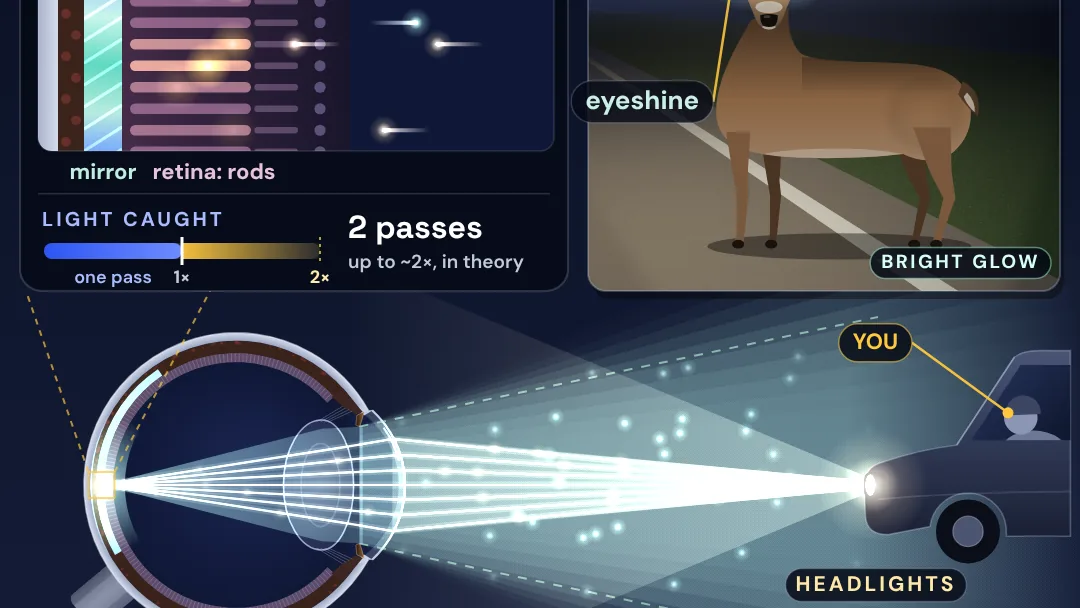
Top left: the back of the eye, magnified. Bottom: the eye in cross-section and the headlights; the distance is drawn shorter and the angles larger than life, and the readouts give the true angle. Top right: what you see. Drag “you” up and down.
1 See
In your headlights, a deer’s eyes blaze silvery green, and often the deer just stands there. Where does that glow come from?
2 Change
3 Understand
Model notes and sources
Why the eyes glow. Many night-active animals, including deer, cats and dogs, have a tapetum lucidum: a reflective layer just behind the retina, in the choroid. In cattle, sheep, goats and horses it is a fibrous layer of collagen (a tapetum fibrosum), and white-tailed deer have the same type. Light that passes through the retina without being caught hits the mirror and goes back through the retina, giving the light-sensitive cells “a second opportunity” to catch it. The eye’s lens focuses the headlights onto that layer, so the light that makes it back out of the eye leaves the way it came in, toward the light source, like a road reflector. You see the glow only when your eyes are close to the light, as a driver’s are to the headlights. Humans and other haplorhine primates (monkeys, apes and tarsiers) have no tapetum; the red-eye in flash photos is light from the blood-rich back of the eye (see Red-Eye Lab).
Model. Mirror strength r runs from 0 to 1. If one pass through the retina catches a share a of the light, a second pass raises the catch to 1 + r(1 − a) times a single pass. That is always below 1 + r, so at most just under twice as much light, in theory. The real gain is lower and hasn’t been measured in deer; a is unknown, and the animated photons use a = 0.4 for illustration. The angle between you and the headlights, seen from the animal, is θ = arctan(s / D) for a sideways distance s and an animal at distance D. The share of the returning beam’s peak that reaches you is F = 2−(θ/ψ)⁴, with ψ = 3°. That width is illustrative, chosen so that the glow is bright from the driver’s seat (about 0.7 m from the lights) and gone a few metres to the side; it hasn’t been measured for deer. The glow you see is G = r·F. Levels: Bright for G ≥ 0.45, Faint ≥ 0.15, Very faint ≥ 0.04, otherwise None.
Fixed values and drawing. The film puts the deer 40 m away and the driver’s eyes 0.7 m from the headlights. The eye is schematic, not a measured deer eye: its layers are drawn much thicker than life, the mirror is drawn over the back and upper back of the eye, and the same eye is reused for every animal. The eye-to-car distance is drawn shorter and the angles outside the eye larger, with one smooth map, so “you” sit inside the drawn beam exactly when θ is small enough in the model. Eyeshine colours follow published descriptions: deer silver-white to light silvery green or yellow; adult dogs yellow-green; adult cats anywhere from light orange to green. Eyeshine is iridescent, so real colour also shifts with the viewing angle, and it varies with age, between animals and, in white-tailed deer, between regions. The tool uses one colour per animal.
Not modeled. Dimming with distance, the headlight beam pattern, pupil changes, the exact shape of the tapetum, how sharply the eye is focused on the headlights, the faint return from eyes without a tapetum, and how the deer itself sees the scene. Deer see differently from us: their retinas have many more rods than cones; they have two cone types, peaking near 450–460 nm (blue) and 537 nm (green), and no red cone, plus a rod pigment near 497 nm; their cones and other retinal cells are concentrated in a horizontal visual streak; their acuity is under 6 cycles per degree; and their pupils are horizontally elongated.
Why deer freeze. The mechanism is still unclear. One idea is that bright light swamps eyes tuned for the dark; another is that two bright lights don’t look like a threat. The evidence is mixed: one study judged it unlikely that vehicle lighting overwhelms a dark-adapted deer visual system, and in a 2025 trial many deer stayed in a vehicle’s path whatever the lighting, with responses that seemed to depend more on the individual deer. On the road: deer usually travel in groups, so if you see one, slow down and expect others; use high beams when there’s no oncoming traffic; and brake rather than swerve.
Sources: D. L. Ollivier et al. (2004), Comparative morphology of the tapetum lucidum (among selected species), Veterinary Ophthalmology 7:11–22; Tapetum lucidum; Retroreflector; Texas Parks & Wildlife, Eyeshine; Wild About Utah, Eyeshine; B. A. Newman & G. J. D’Angelo (2024), A review of Cervidae visual ecology, Animals 14:420; G. H. Jacobs et al. (1994), Electrophysiological measurements of spectral mechanisms in the retinas of two cervids, J. Comp. Physiol. A 174:551–557; B. A. Newman, B. R. Hammond & G. J. D’Angelo (2025), Potential spectral tuning of the tapetum lucidum in a broadly distributed ungulate, J. Exp. Zool. A 343:905–910; Penn State Deer Research, The eyes have it; M. S. Banks et al. (2015), via UC Berkeley, pupil shape and ecological niche; B. F. Blackwell, T. W. Seamans & T. L. DeVault (2014), White-tailed deer response to vehicle approach: evidence of unclear and present danger, PLOS ONE 9:e109988; Pakula et al. (2025), UGA Savannah River Ecology Laboratory, Headlights and hesitation; Delaware Fish & Wildlife (2019), watch out for deer crossing roadways.
An ExplainerTools Original.