Light · interactive
Why is a rainbow always a circle?
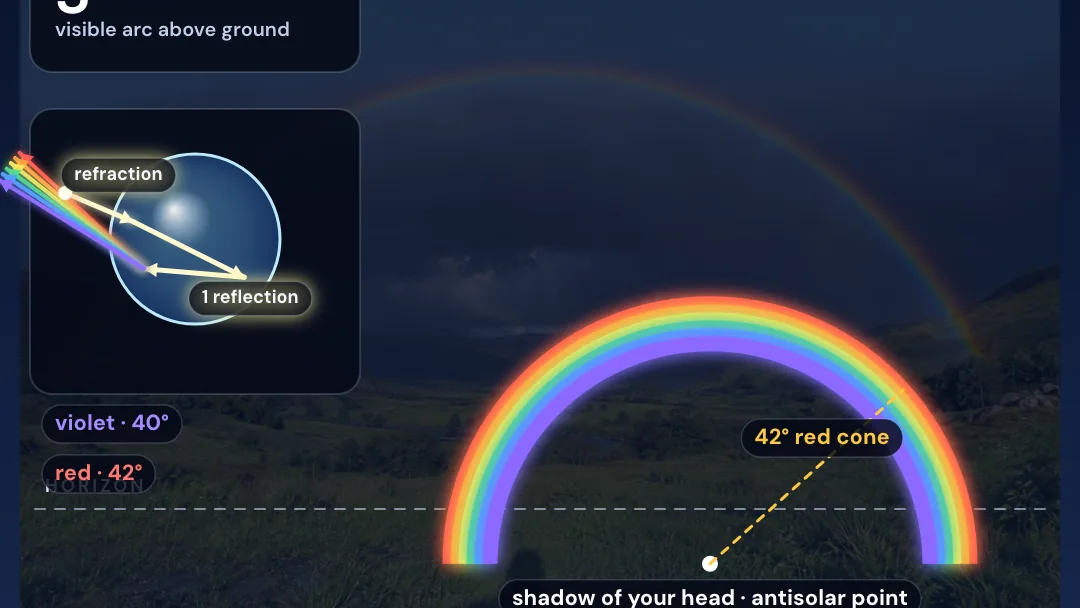
Every bright drop lies on a cone around the line opposite the Sun: about 42° for red and 40° for violet.
1 See
A rainbow seems to sit in the landscape, but its center moves with you. The real shape is set by an angle around the shadow of your head.
2 Change
3 Understand
Model notes and sources
Model. A primary rainbow ray refracts into a spherical water drop, reflects once at the back, then refracts out. Dispersion makes violet’s refractive index slightly larger than red’s, so the strongest outgoing rays appear about 40° from the antisolar line for violet and 42° for red. Rotating that fixed-angle ray around the antisolar line makes a cone; its intersection with the curtain of drops appears as a circle.
Views. In ground views, the antisolar point is as far below the horizon as the Sun is above it; color is clipped at the horizon, and at 42° or higher the primary bow is suppressed as fully below it. The plane preset is a separate elevated-view diagram that places the antisolar center and full 42° ring inside the stage, representing drops below the observer.
Not modeled. Secondary bows, supernumerary bands, polarization, non-spherical drops, terrain, patchy rain and finite-distance perspective. The photos are AI-generated illustrations.
Sources: NOAA educational material on rainbow optics; standard geometric-optics derivations for the primary rainbow’s one internal reflection and approximately 40–42° scattering angles.
An ExplainerTools Original.