Nature · interactive
Why do sunflower seeds form spirals?
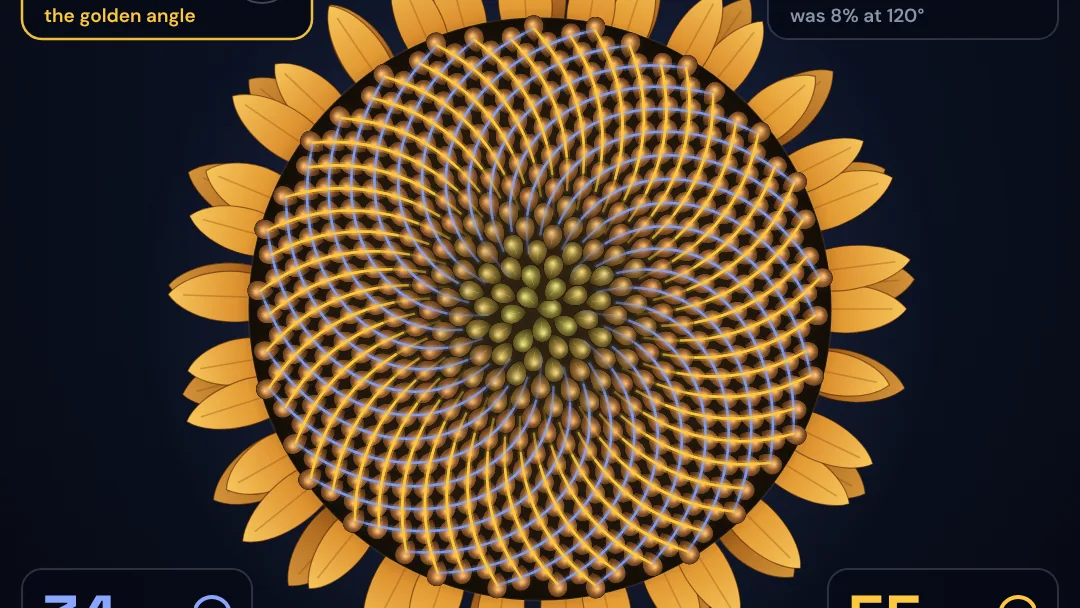
Each seed sits a little farther out than the last and is turned by the same angle. Blue and yellow trace the two sets of spirals you can count at the rim. Tap a seed to follow its own two spirals.
1 See
A sunflower’s seeds line up in two sets of spirals, winding opposite ways. Where do the spirals come from, when every seed follows the same simple rule?
2 Change
3 Understand
Watch the full 44-second film for the longer story.
Model notes and sources
The rule. Vogel’s model of a sunflower head: seed i (counting from 0 at the center) sits at radius r = √(i + ½) and is turned i × θ from the first, where θ is the turn per seed. The square root gives every seed the same area, π square units, so the head keeps the same density as it grows.
Why angles repeat. If θ is an exact fraction p/q of a turn, every q-th seed lands on the same line, and the seeds stack into q straight arms: 120° = 1/3 gives 3 arms, 135° = 3/8 gives 8. The golden angle, θ = 360° × (1 − 1/φ) ≈ 137.508°, with φ = (1 + √5)/2, is irrational, so no seed ever lands exactly on another’s line. Its best near-repeats come every Fibonacci number of seeds and miss by less each time: 34 seeds → 4.7°, 55 → 2.9°, 89 → 1.8°. An angle typed with decimals is technically a fraction (137.3° = 1373/3600), so the tool reports an exact repeat only when it happens within the head.
Spiral counts. The spirals you can count at the rim are the two shortest steps from the outermost seed to its nearest older neighbors. For the golden angle that pair is 21 and 34 up to about 226 seeds, 34 and 55 from about 227 to 570, then 55 and 89 to about 1,460, then 89 and 144. The film uses 500 seeds, where the rim shows 34 one way and 55 the other. Strands are drawn only where that step really joins near neighbors.
Space filled. The share of the head (a disc of area π × seeds) covered when each seed is a disc of radius ½ × √(2π/√3) ≈ 0.95, the size that would exactly tile a perfect honeycomb at this density. A perfect honeycomb of round seeds covers π/(2√3) ≈ 90.7%. With 500 seeds: 120° fills 8%, 135° fills 20%, the golden angle fills 85%.
Not modeled. This is geometry, not plant biology. A real sunflower forms its florets from the rim of the head inward, and the angle comes out of how new buds crowd in between older ones near the growing tip; the model just numbers seeds from the center out. Real seeds vary in size and shape, and real heads are not perfect: in a citizen-science survey of hundreds of sunflowers, 74% of the 768 spiral counts were Fibonacci numbers; the rest were near misses, other number sequences, or heads with no clear spirals. Seeds are drawn as teardrops a little larger than those discs so the head looks packed, each adds a faint glow so seeds piled onto one line shine, and the petals are decoration.
Sources: H. Vogel, “A better way to construct the sunflower head”, Mathematical Biosciences 44, 179–189 (1979); J. Swinton, E. Ochu and the MSI Turing’s Sunflower Consortium, “Novel Fibonacci and non-Fibonacci structure in the sunflower: results of a citizen science experiment”, Royal Society Open Science 3, 160091 (2016); S. Douady and Y. Couder, “Phyllotaxis as a physical self-organized growth process”, Phys. Rev. Lett. 68, 2098 (1992); Golden angle (Wikipedia).
An ExplainerTools Original.