Phones · interactive
How does it close flat?
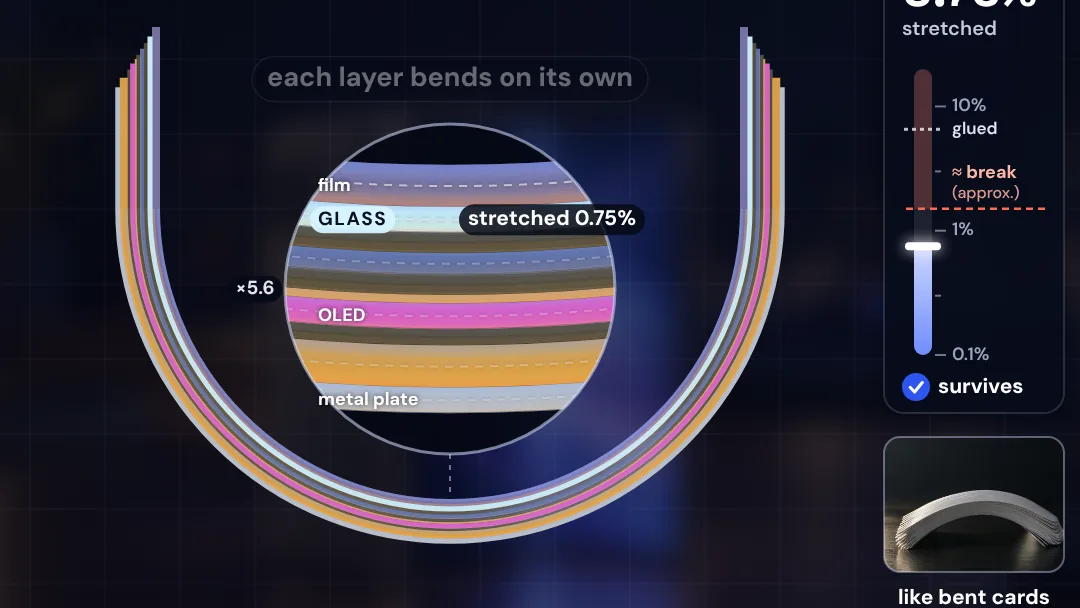
The fold seen end-on (a slice across the hinge). The bright band is the screen; its colour warms where the glass is bent tightest. Drag the top half, or use the Fold control, and switch hinges to compare.
1 See
A folding phone's two halves shut flat against each other, yet its screen never folds flat. Where does the fold go?
2 Change
3 Understand
Model notes and sources
Bending strain. Bend a sheet of thickness t around a radius R and its outer face stretches by ε = t/(2R). For the 30 µm ultra-thin glass in a folding screen: pressed flat, the tightest bend is about the screen's own thickness, R ≈ 0.1 mm, so ε ≈ 0.03 ÷ 0.2 = 15%; in a U of radius 1.5 mm, 1.0%; in a teardrop whose bulb is 3.85 mm across (R = w/2 ≈ 1.93 mm), 0.78% (0.79% with R rounded to 1.9 mm). The break line is drawn at ≈ 1.5%, the same approximate limit as the Folding Screen Lab, which shows why ultra-thin glass and gliding layers matter. Real limits depend on the glass, its strengthening, its edges and flaws, and how many times it is folded.
The three hinges. Flat fold: the screen is pressed onto itself, like folding paper; the halves close flat, but the glass cracks and the crease is permanent. U-loop (2019-style): the screen bends in a U of radius r at the fold, which is 2r tall and sits between the halves, so they can't close flat: a wedge-shaped gap of about 2r stays at the hinge (the 2019 Galaxy Fold had a visible gap). Teardrop (2026 iPhone Duo-style): closing opens a pocket in the hinge; the middle of the screen drops into it and curls into a round bulb, and a neck pinches it shut, so the halves close flat. Samsung says its 2023 Flex Hinge closes with “virtually no gap”, “virtually eliminating the gap” of earlier models.
How the shapes are drawn. The screen keeps its length. Each hinge fixes the screen's curvature profile when closed (a hairpin, a semicircle, or a bulb plus a neck), and that profile scales with how far the phone is folded, so the screen always turns by exactly the angle between the halves. The bend radius in the readouts is the tightest one, measured at the glass. Illustrative, not measured: the 4.5 mm thickness of each half, the 0.3 mm screen, the U's 1.5 mm radius, the neck's two reverse curves (drawn at 1.1× the bulb's radius, so they are gentler than the bulb), the shape of the hinge cover and pocket, and how the halves slide as they turn. The U-loop's wedge assumes halves 70 mm long whose free ends touch. The model ignores the screen's layers, the hinge's support plates and the glass's fatigue.
What's in the hinge. Apple says the hinge has more than 100 parts. HTX Studio's teardown shows paired hinges on a central shaft, gears that make both halves turn together, and springs and cams that hold the phone open anywhere from 15° to 165°; below about 5°, magnets pull it shut. REWA's teardown counts four sets of springs. The secondary panel draws these as a schematic, not the real part layout.
The pictures. The phone, the paper and the hinge close-up are AI-generated illustrations of a generic foldable, not Apple imagery, with no Apple marks. Every shape, radius, strain and gap comes from the model.
Sources: HTX Studio, iPhone Duo Review: After 3,000 Folds… (CT scan of the closed teardrop, about 3.85 mm across: 6:26–6:52; hinge sections: 5:11–6:25); Apple, Introducing the new iPhone Duo (more than 100 components: 1:33–1:43); REWA Technology, iPhone Duo teardown (four sets of springs: 9:10–9:14); Marques Brownlee, The Broken Galaxy Folds: Explained! (the 2019 U-shaped hinge and its gap); Samsung, Discover the new hinge technology for the Galaxy Z Flip5 and Fold5 (“virtually eliminating the gap”); Apple, iPhone Duo.
An ExplainerTools Original.