Forces · interactive
How could a car stick, then flip?
Why it changes
A fan presses a car onto a ramp. A jet pushes it along. Two more jets turn it over in mid-air. What does each one actually push on?
Suction: the car sits on a flat test plate set into a curved ramp, at the angle you choose, and its weight always points straight down. The near side is cut open to show the sealed space under the floor, the fan and the air tank. The skirt gap is drawn 8× taller than it is. The jet's arrow starts at the centre of mass, on its line of action; its plume is drawn longer as it pushes harder, not to scale. The small map shows the whole ramp. Flip: the camera follows the car, while the dashed arc and the height scale stay fixed to the room. Arrows: 1 m = 10 kN. A dashed grip arrow is grip the tyres would need but can’t give.
What changed
More to try
Model notes and sources
Suction. A lumped, steady model with illustrative numbers, not Tesla data: a 1,500 kg car and a 4 m² plenum under the floor, sealed by skirts with an 8 m perimeter. The fan curve is Δp = Δp₀u²[1 − (Q/(Q₀u))²], with Δp₀ = 5 kPa and Q₀ = 4 m³/s at full speed. Here u is the fan’s speed as a fraction of full speed, not its electrical power. Air leaks back under the skirt gap h at Q = CdPh√(2Δp/ρ), with Cd = 0.6 and ρ = 1.2 kg/m³. Where the two meet, Δp = Δp₀u² / (1 + 2Δp₀Cd²(Ph)²/(ρQ₀²)), so the pressure difference goes as u² and the flow as u. The air around the car presses it toward the surface with D = Δp × 4 m². With n pointing from the surface toward the car, the tyres must supply N = m a·n − (gravity + jet)·n + D: mg + D on the ground, D − mg on a ceiling. Tyres cannot pull, so a negative N means the car falls. Once the seal leaves the surface, the model sets D to zero. Straps hold the car on any slope until 0.5 s. A fall stops 0.45 s in, or sooner, before the car would meet the ramp below. Fan speed and the seal gap are the suction’s own two controls, under More to try.
Ramp angle. A static test at one point, not a drive. The angle θ picks a point on the ramp: 0° is the floor, 90° a wall, 180° upside down. There the surface runs along t = (cos θ, sin θ), and n = (−sin θ, cos θ) points from it toward the car. Gravity always points straight down, (0, −mg). The air presses along −n with D, so the tyres must push back with N = D + mg cos θ, and friction must hold mg sin θ along the surface. The air adds nothing along the surface. A negative N (below −10⁻⁷ N) means the tyres would have to pull: the car falls off, the seal opens and D drops to zero. Otherwise braked tyres can hold up to μsN, with an illustrative μs = 0.6, not a measured tyre. If mg sin θ is larger, the car slides. The model shows where a slide starts but not the slide, because no sliding friction is chosen. With the jet off, at full fan speed and a 2 mm seal the car holds up to 72°, slides from 73° to 169° and holds again from 170°: pressed on is not the same as held. On the wall it would need μs ≥ 0.77. No fan setting here holds it at every angle: near 121° it would need 28.6 kN, more than the 20 kN a perfect seal gives.
Ramp jet. An illustrative cold-gas test jet, not a Tesla thruster. A matched pair of nozzles on the rear flanks blows backward, so the car is pushed toward its nose with a prescribed force T, from 0 to 20 kN, a little more than its weight. On the ramp that force is T t, along the surface. Its line of action runs along the car through the centre of mass, so it adds no turning moment. The balance becomes N = D − (gravity + T)·n = D + mg cos θ, unchanged, because the jet has no part across the ramp, and the tyres must grip f = mg sin θ − T along t. So the jet never presses the car on; it takes over part of the slope’s pull. Past T = mg sin θ the grip needed reverses and must hold the car back, still within μsN. On the wall at full fan and a 2 mm seal the car slides with the jet off; from about 3.3 kN of jet it holds. On the floor and upside down the jet can only push the car along, so too much of it slides the car toward its nose. Whether the tyres would have to pull does not depend on the jet. If they would, the test rig cuts the jet the instant they leave, and the car falls exactly as before; a fall with the jet still firing is not modeled. The jet is a steady prescribed force for the 2.2 s test: no gas supply, burn-out or tank pressure is modeled. For scale, it spends T newton-seconds of impulse every second, so at 10 kN the Flip’s 20,000 N·s tank would last 2 s. With μs = 0.6, the friction’s turning effect about the centre of mass only shifts load between the axles and never needs a tyre to pull; that would take μs above about 3.2 with these axle and centre-of-mass positions. Axle loads themselves are not computed.
Each angle is a separate test, started from rest with the car strapped to a flat test plate set into the curve. It is not a car driving up the ramp: there is no speed, no v²/R, and no reattaching after a fall. The plate is the one flat patch the model tests. The curved ramp around it, about 27 m tall, is drawn for context. Its shape is inspired by the curved ramp at a Tesla Roadster demonstration, but it is an original drawing, not that structure’s engineering or performance.
Flip. A side-view pitch model, not a three-dimensional barrel roll or a stunt reconstruction. Pitch inertia is 2,500 kg·m². Two 4,000 N cold-gas jets (each a matched pair of nozzles, one per flank) push in opposite directions, square to the car’s long axis, at ±a from the centre of mass. That is zero net force and a torque of 2 × 4,000 N × a: 12 kN·m and 4.8 rad/s² at the full 1.5 m. The schedule never changes: a 1.144 s pulse, √(2π/4.8), then an equal counterpulse, which turn the full arm 2π and stop it. A finite budget is spent at Σ|F| = 8,000 N·s every second while firing, and both jets stop the instant it runs out. The centre of mass follows a declared launch: 3.0 m up at 12 m/s, 75° above level. The trial ends at 2.4 s, while the car is still clear of the floor. No landing is modeled. The ramp jet is part of the ramp test and is not used here.
Left out. Fan losses, stall and fan-exhaust thrust; skirt and suspension dynamics; air drag; tank thermodynamics and refills; changing mass. On the ramp: sliding friction and any motion along it, the curve under the test plate, the skirt’s fit to a curve, axle loads and tipping (each tyre arrow carries half). For the ramp jet: its gas supply and burn-out, any push of its exhaust on the ramp, and a fall with it still firing. The skirt gap is drawn 8× taller than it is, and the gas puffs are slowed so you can follow them.
Sources. Tesla’s official Roadster page: manufacturer claims of a fan and ground-seal system, of rear cold-gas thrust and of perimeter thrusters, read through the official site’s search index because a direct request returned only footnotes or HTTP 403. They are not independent hardware data. McMurtry’s upside-down driving demonstration: a maker’s report on a different fan car. NASA Glenn on pressure forces, thrust, torque and thrust and impulse. OpenStax University Physics on Newton’s second law, forces on a slope, friction, curved motion (left out here), rotation and Bernoulli’s equation. RMIT Learning Lab on forces on slopes. The US DOE fan sourcebook on operating points and leakage. The fan curve, the leak coefficient, μs and the jet’s size are teaching choices, not values from these sources.
An ExplainerTools Original. The car, its hardware and the ramp are original illustrations, not Tesla designs.

Learn more
Forces and motion
Pressure that adds grip, thrust that needs no traction, and torque that turns. Generic physics, with Tesla’s claims labeled as claims.
- Topic guideHow could suction and thrusters help a car grip and launch?Tesla’s Roadster page describes optional suction and rear cold-gas thrusters. Here is the generic physics: pressure that adds grip, thrust that needs no traction, and torque that turns.
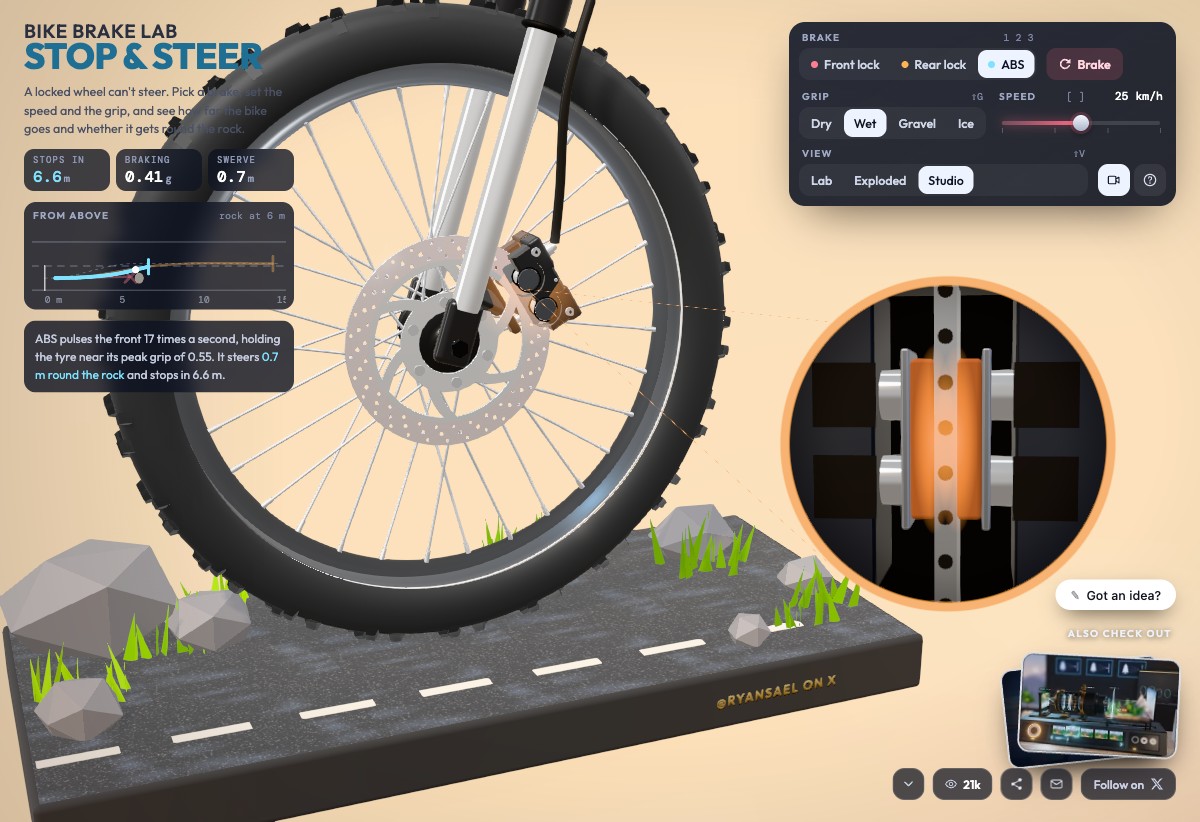 Interactive demoBike Brake LabCompare a front lock, a rear lock and ABS while you change speed and road grip.by Ryan Sael · Opens on the creator’s site
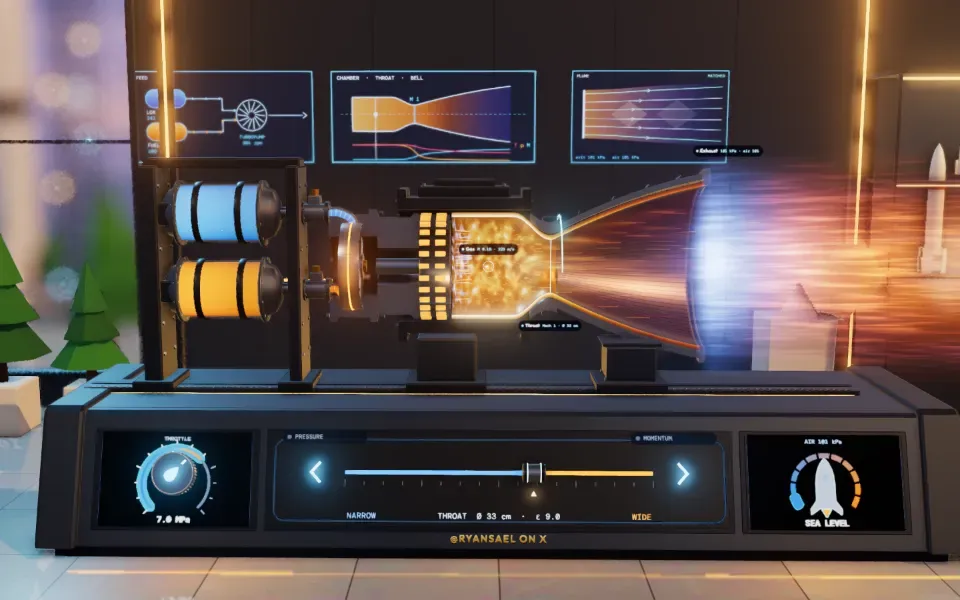 Interactive demoRocket Nozzle LabChange a nozzle’s throat, throttle and surroundings to see how hot gas makes thrust.by Ryan Sael · Best on a larger screen
 Interactive demoSiphon LabRaise the outlet, prime the tube or let air in, and follow the flow.by Ryan Sael · Opens on the creator’s site