Topic guide · Batteries and energy
Why does EV charging slow down after 80%?
Because a nearly full battery cannot take lithium ions in as fast. Elon Musk compares it to a parking lot. When it is empty, ions “zip right in.” When it is nearly full, each one has to “hunt around for a spot.” Pushing hard near full can plate lithium metal inside the cell, so the car turns the power down. EVKX measured a Tesla Model Y Long Range charging from 10 to 80% in about 32 minutes. The last 20% took about 31 more.
- 10 → 80%
- ≈ 32 min
- 80 → 100%
- ≈ 31 min
- Miles added, 10 → 80%
- ≈ 196
- Miles added, 80 → 100%
- ≈ 56
Model · Model Y-like curve Times measured by EVKX for a Model Y Long Range. Miles assume 280 miles of highway range.
Interactive · ExplainerTools
Charge Curve
Fill a battery and watch the charging power fall. Then plan a 600-mile trip with long stops or short ones.
Model · illustrative charging curve
Why does a fuller battery charge slower?
Elon Musk offered a picture for this on The Joe Rogan Experience #2054, on October 31, 2023. As Yahoo Finance reported, he described lithium ions as “trying to find a parking space.”
When the lot is empty, they “zip right in.” The charger can push hard, so the power stays high. As the lot fills, each ion has to “hunt around for a spot.” Musk said 80 to 100% takes about as long as 0 to 80%.
The lot stands for the battery’s anode, where ions are stored as it charges. Fewer free spots make each new ion harder to place.
What is the car protecting?
Pushing ions in fast near full has a cost. With little room left, some lithium can deposit as metal on the anode’s surface. That is lithium plating. It costs capacity and can be a safety risk.
Heat matters too. Fastned, a charging network, says speed drops near 80 to 90% to protect the cells from overheating.
So the car’s battery management turns the power down. A fast charge first holds the current steady while the cell’s voltage climbs. Near the top voltage, it holds the voltage steady instead, and the current falls. Less current means less power. Charge Curve’s model notes give the details.
Why do short stops beat filling up?
On EVKX’s chart, a Tesla Model Y Long Range charges from 10 to 80% in 32 minutes. The last 20% takes about 31 more. The first stretch adds 70% of the range. The second adds 20%, in about the same time.
So on a long drive, the slow end of the curve is the part to skip. Arrive low, charge while it is fast, and drive on.
Charge Curve plans a 600-mile trip on a Model Y-like curve. Filling to 100% at every stop costs about 78 minutes of charging. Leaving at 80% costs about 57. Its fastest plan charges to about 42%, over four short stops, for about 44 minutes. Each stop’s time includes 3 minutes to pull in and plug in.
Tesla’s Supercharger page agrees: charging above 80% is “rarely necessary.”
Try it: fill the battery, then plan the trip
- 1 See
Open Charge Curve and drag State of charge from 10% to 80%. Charging power falls from 250 kW to about 44 kW.
- 2 Change
Tap Fill to 100% every stop, then Arrive 10%, leave 80%. Road-trip charging drops from 78 to 57 minutes.
- 3 Understand
Now tap Old 50 kW charger. The time from 10 to 80% roughly doubles. The time from 80 to 100% stays at 31 minutes. Near full, the car asks for less than 50 kW anyway.
Does every electric car slow down the same way?
No. The curve depends on the car, the battery’s temperature, the charger and software. On EVKX’s chart, a Porsche Taycan goes from 10 to 80% in 17 min 40 s. The last 20% takes about 29 minutes more.
Some new batteries charge far faster. CATL says its third-generation Shenxing LFP battery charges from 10 to 80% in 3 min 44 s. It says 10 to 98% takes 6 min 27 s. Those are launch claims, and we have not tested them. Even there, the last 18% takes almost three-quarters as long as the first 70%.
Charge Curve draws one illustrative curve, fitted to EVKX’s Model Y times. Its parking lot is a picture of the idea, not a model of how ions move. Treat its numbers as a teaching example, not a trip plan.
Explore by question
An empty battery takes charge fast. A nearly full one does not. Each card answers one part of why.
Charge Curve
Model · illustrative charging curve
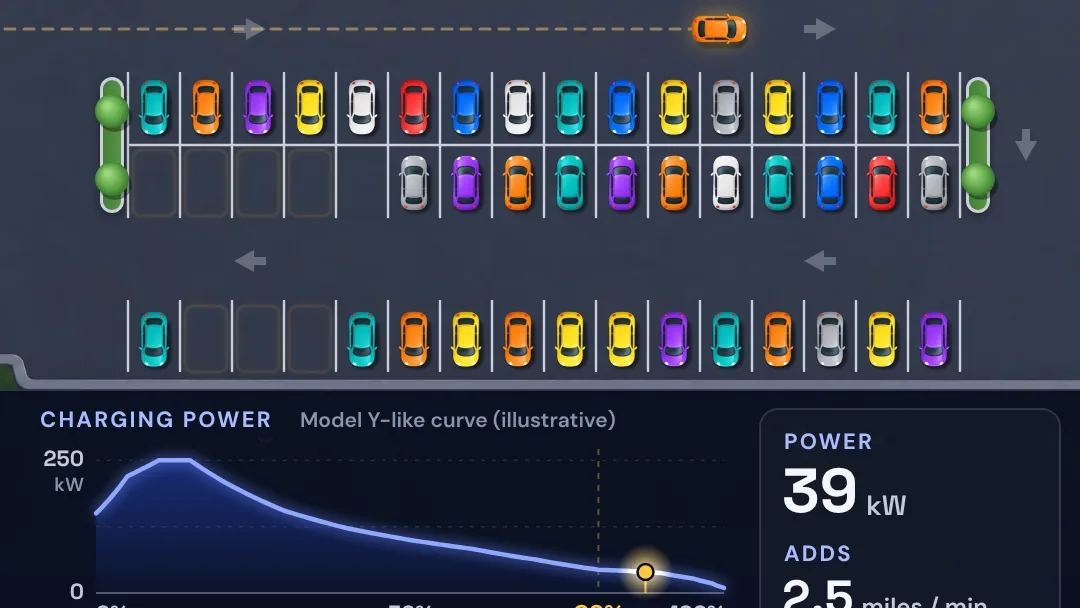 Interactive · Charge CurveWhy does an electric car charge fast to 80%, then crawl to full?Fill a battery and watch charging power fall, then plan a 600-mile trip with long stops or short ones.
- Short · 47 secondsWhy does an electric car charge fast to 80%, then crawl to full?The parking-lot picture and the Model Y curve, narrated and captioned.
- JournalWhy does an electric car charge fast to 80%, then crawl to full?Near empty, lithium ions slot into the battery easily and the charger runs flat out. Near full, pushing them in fast risks plating lithium metal, so the car turns the power down, and the last 20% takes about as long as the first 70.
What is a lithium ion?
Charging moves lithium ions into the anode. An ion is an atom with an electron missing or added.
- Interactive demoBuild an AtomBuild lithium from three protons and three electrons. Take one electron away to make the ion a battery moves.by PhET Interactive Simulations
Current and voltage
A fast charge holds the current steady, then the voltage. These circuit models show both, in simple circuits rather than a battery cell.
- Interactive demoCircuit Construction Kit: DCBuild a circuit with a battery and a bulb, then measure the current and voltage.by PhET Interactive Simulations
- Interactive demoCircuit SimulatorSwitch circuit parts and watch moving dots and colors show current and voltage.by Paul Falstad · Opens on the creator’s site
Common questions
Should I charge to 100% on a road trip?
Usually not at a fast charger. The last 20% is the slowest charging you can buy. Tesla’s Supercharger page says charging above 80% is “rarely necessary.” Filling up can still make sense before a long stretch with no chargers.
Is it the charger or the car that slows down?
The car. Its battery management asks for less power as the battery fills. In Charge Curve’s model, a 50 kW charger doubles the time from 10 to 80%, to about 63 minutes. From 80 to 100% the time does not change, because the car already asks for less than 50 kW.
Do all electric cars slow down after 80%?
Most taper, by different amounts. On EVKX’s chart, a Porsche Taycan charges from 10 to 80% in 17 min 40 s. The rest takes about 29 more minutes. The shape depends on the car, the battery’s temperature and the charger.
What does “200 miles in 15 minutes” mean?
It is Tesla’s claim for its Superchargers, and it says “up to.” The fast part of the curve comes early, when the battery is low. So a stop that starts near empty gets closest to that pace.
Is the parking-lot picture literally true?
It is an analogy. Lithium ions do move into the anode as a battery charges, and the room left shrinks as it fills. They do not drive around looking for spaces. Charge Curve draws the lot as a picture of the idea, not a model of how ions move.
Sources and credits
- Yahoo Finance · Elon Musk explains why charging tapers off Musk’s parking-lot analogy on The Joe Rogan Experience #2054, October 31, 2023, and his point that 80 to 100% takes about as long as 0 to 80%.
- EVKX · Tesla Model Y Long Range charging curve 10 to 80% in 32 min 1 s. About 31 more minutes to 100%, from its 10 to 100% time.
- EVKX · Porsche Taycan charging curve 10 to 80% in 17 min 40 s, and about 29 more minutes to 100%.
- Fastned · Everything you always wanted to know about fast charging A charging network’s explainer: speed drops near 80 to 90% to protect the cells from overheating.
- Tesla · Supercharger Up to 200 miles of range in 15 minutes, and charging above 80% rarely necessary. Claims and advice are Tesla’s.
- CarNewsChina · CATL unveils 3rd-gen Shenxing LFP battery April 21, 2026. CATL’s launch claims: 10 to 80% in 3 min 44 s, and 10 to 98% in 6 min 27 s.
- Charge Curve · model notesThe fitted curve, lithium plating, constant current then constant voltage, and the road-trip assumptions behind the model numbers here.
Every creator named here made the work we link to. Listing it does not imply a partnership or endorsement.