Topic guide · Sound and fire
Can sound put out a fire?
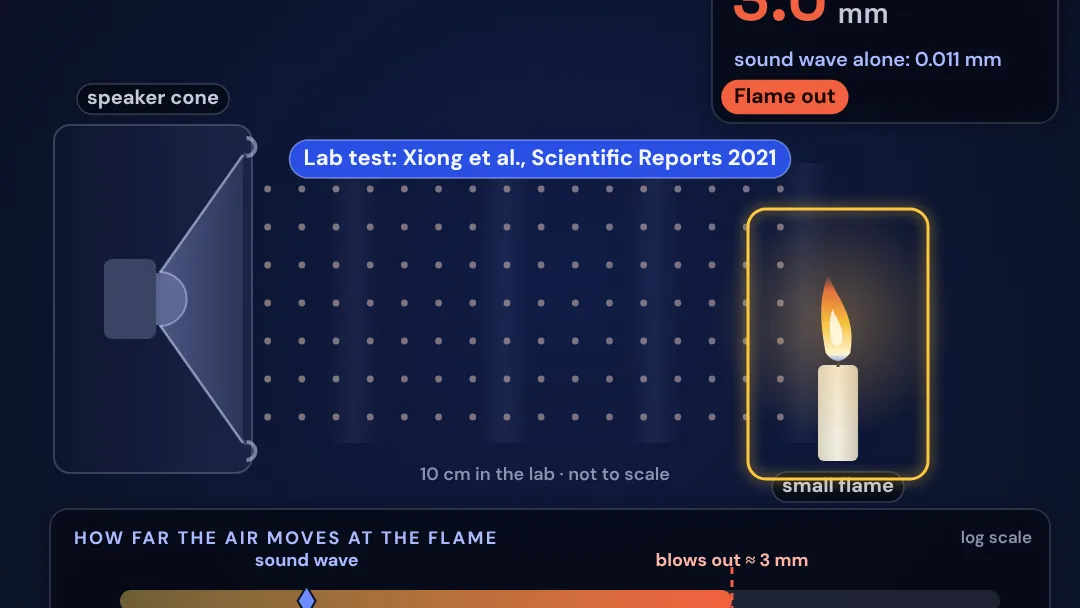
Yes, a small one, up close, but it isn’t really the sound that does it. A sound wave barely moves the air: at 60 Hz and 99 dB, about a hundredth of a millimeter back and forth. The speaker’s cone shoves the air in front of it far more, and in a 2021 lab test a small propane flame 10 cm from the speaker went out once it swayed about 3 mm. For the same sound level, half the pitch gives four times the push, so a flame that needs 99 dB at 60 Hz needs only about 87 dB at 30 Hz. That is why the extinguisher a student in Mexico took to a gold medal in Indonesia in October 2026 hums instead of squealing.
- Sound wave alone
- ≈ 0.01 mm
- Speaker push, flame out
- ≈ 3 mm
- Half the pitch
- 4× the push
- 30 Hz vs 1,000 Hz
- ≈ 1,100× the push
Model · calibrated to one lab test At 60 Hz and 99 dB (1.8 Pa), 10 cm from a 460 mm speaker. The model scales one measured point, a 15 mm propane flame in Xiong and colleagues’ 2021 test, by sound pressure ÷ pitch².
Interactive · ExplainerTools
Sound Extinguisher Lab
Change the pitch from 2,000 Hz down to 20 Hz and the sound level from 80 to 120 dB. Watch the cone’s push grow until a small flame tears and goes out, then tap the flame to relight it.
Model · calibrated to one lab test
How does a speaker put out a flame?
In three steps. The sound wave the speaker makes plays almost no part.
- Push
A speaker’s cone moves back and forth many times a second. Close to the speaker, the air in front of it moves with the cone, like air in front of a piston.
- Swing
A flame sitting in that air swings back and forth with it.
- Tear
A candle or gas flame burns in a thin sheet where fuel meets air. Swing the flame far enough and that sheet stretches, cools and tears. The flame lifts off its fuel and goes out.
In a 2021 study in Scientific Reports, Xiong and colleagues held small propane flames 10 cm in front of a speaker 460 mm across, playing 50 to 70 Hz. The flame swung as far as the speaker’s cone moved, about 100 times further than the sound wave moved the air. Each flame blew out when its swing reached a set size, the same however the sound was made, and a little larger for taller flames. For a 15 mm flame it was about 3 mm.
What do 99 dB and 60 Hz mean?
Sound is a small, fast swing in air pressure. Hertz count the swings each second, so 60 Hz is 60 back-and-forths a second. Decibels measure how big the swing is against 20 micropascals, the faintest sound people hear. Every 6 dB doubles the pressure, and every 20 dB multiplies it by ten. At 99 dB, the level that put out the lab flame, the swing is about 1.8 pascals, less than two hundred-thousandths of the air’s own pressure.
As a sound wave passes, each bit of air shuffles back and forth without being carried along. At 60 Hz and 99 dB the shuffle is about a hundredth of a millimeter. A flame does not notice that. A second 2021 study, by Xiong, Wang and Huang in Fire Safety Journal, measured both near a candle at 100 dB. The sound wave moved the air at about a centimeter per second. The cone’s own wind reached about half a meter per second, and it was the wind that put the flame out. A tube in front of the speaker made that wind stronger and helped.
Could the sound wave do it on its own? The Scientific Reports team estimated it would take 100 to 300 pascals, about 134 to 144 dB, for their small flames: around a hundred times the pressure their speaker made at the flame.
Why does a lower note push harder?
To make the same sound level, a speaker playing a low note has to move much more air with each stroke. For a compact speaker, the air it moves goes as one over the pitch squared. Halve the pitch and the push goes up four times. That is why subwoofers are big and their cones visibly pump. At 30 Hz the same sound level shoves about 1,100 times as much air as at 1,000 Hz, because (1,000 ÷ 30)² ≈ 1,100.
Turn that around and you get the sound level a flame needs. Halve the pitch and a quarter of the pressure gives the same push, and a quarter of the pressure is 12 dB less. In the model, which is calibrated to the 60 Hz lab test, the flame that needs 99 dB at 60 Hz needs about 87 dB at 30 Hz, and about 148 dB at 1,000 Hz, far louder than any ordinary speaker. That is why sound extinguishers hum instead of squeal. George Mason University students found the same in 2015: 30 to 60 Hz put out their test flames, and very high frequencies had little effect.
Who has built one, and what can it put out?
Ángela Karime Hernández Venegas, a student at CETis 78 in Altamira, Tamaulipas, built a portable one she calls VortexTech: a 12-volt battery, a frequency generator set to 30 Hz, an amplifier and a speaker, aimed through a modified bucket, Mexico News Daily reports. Each push leaves the bucket as a vortex ring, a spinning doughnut of air like a smoke ring. She and her team report more than 100 tests on small fires, including wood, flammable liquids, electronic equipment and cooking oil, and she says the rings cut the fire off from its oxygen. In October 2026 the project won gold at ISIF 2026, an international science and invention fair in Indonesia, Tamaulipas’s education department says. Sound Extinguisher Lab is not a model of her device; it shows the mechanism the lab experiments point to.
She was not the first. In 2015 George Mason University seniors Viet Tran and Seth Robertson built a portable version from an amplifier, a power source and a cardboard tube that focused the push on the fire. Before that, DARPA’s Instant Fire Suppression program put out a flame with speakers on either side of a pool of fuel. DARPA’s 2012 summary said the program could suppress and manipulate small flames, but that it was not clear how to scale the approach up.
None of them replaces a fire extinguisher. The push is a puff, not a hose: it spreads out within a short distance, so these devices work on small fires, up close. It does not soak or cool the fuel the way water does, so a fire can come back once the sound stops. Mexico News Daily calls the technology experimental.
Try it: drop the pitch
- 1 See
Open Sound Extinguisher Lab and tap Lab test: 60 Hz, 99 dB. Sound wave alone reads 0.011 mm and Speaker push 3.0 mm, about 261 times more. The flame tears and goes out.
- 2 Change
Tap A high note: 1,000 Hz. At the same 99 dB the push falls to 0.011 mm, no more than the 60 Hz sound wave moved the air. The flame holds Steady, and Level to blow it out reads 148 dB.
- 3 Understand
Tap Lab test: 60 Hz, 99 dB again and drag Pitch down to 30 Hz. Half the pitch, four times the push: 12 mm, and Level to blow it out falls to 87 dB. Then tap VortexTech’s 30 Hz: at 95 dB the push is still 7.6 mm.
Where does this model stop?
Sound Extinguisher Lab scales one measured point: a 15 mm propane flame, 10 cm in front of a 460 mm speaker, that blew out at 60 Hz and 99 dB. The lab measured only 50 to 70 Hz. The model carries the result to other pitches with the one-over-pitch-squared rule, and inside that range it agrees with the researchers’ own fit to about 25%.
Above a few hundred hertz, 10 cm is no longer close to the speaker compared with the length of the wave, and the push shrinks toward the sound wave’s own motion. There the model overstates the push, which only flatters high notes. Real woofers can travel only a centimeter or two, so the biggest pushes at very low pitches are out of reach.
The flame is a small lab flame. A real fire is bigger and hotter and can reignite, and none of the model’s numbers apply to it. The motion on the stage is slowed down and exaggerated so a hundredth of a millimeter and a centimeter both show. The film uses short, credited excerpts of the student’s own videos (Karime vortex on YouTube), a woofer at full travel by barevids and a pan fire from George Mason University; the speaker, air, flame and numbers come from the model.
Explore by question
A speaker makes a sound and a push at the same time. Each card answers one part of the question.
Sound Extinguisher Lab
Model · calibrated to one lab test
 Interactive · Sound Extinguisher LabHow can sound put out a fire?Change the pitch and the sound level, and watch the cone’s push grow until a small flame tears and goes out.
- Short · 42 secondsHow can sound put out a fire?A 30 Hz extinguisher, the 3 mm sway, and half the pitch for four times the push. Narrated and captioned.
- JournalHow can sound put out a fire?A student in Mexico put out small fires with a 30 Hz hum and won gold in Indonesia. It isn’t really the sound: the speaker’s cone shoves air, and a lab flame blows out when it sways about 3 mm.
What a speaker cone does
The cone makes the sound and the push at once. This explainer connects its motion with the pressure waves it sends out.
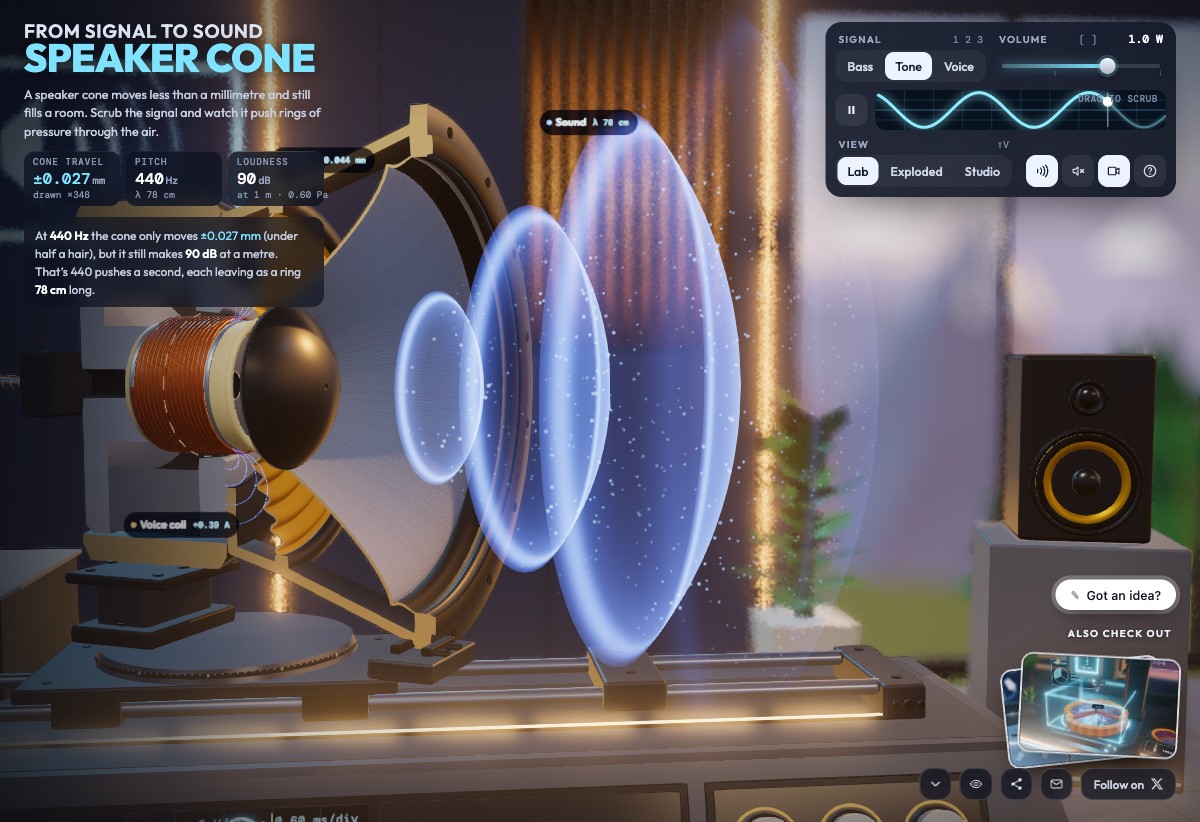 Interactive demoSpeaker Cone LabScrub a waveform and change the signal and power to see how a cone’s motion becomes pressure waves.by Ryan Sael · Opens on the creator’s site
What a sound wave does to air
The sound wave is the part that barely moves a flame. This article shows how a vibration travels through air as sound.
 Interactive articleSoundPlay tones and change visual models to see how a vibration travels through air as sound.by Bartosz Ciechanowski
Common questions
Is it the sound or the air that puts the flame out?
The air. At 60 Hz and 99 dB, the sound wave moves the air only about a hundredth of a millimeter. The speaker’s cone shoves the air right in front of it about 3 mm, and that push tears a small flame. A 2021 study that measured both near a candle found the speaker’s wind, not the sound wave, put it out.
Why do sound extinguishers use such low notes?
For the same sound level, a lower note makes the cone move more air: half the pitch, four times the push. At 30 Hz the push is about 1,100 times what it is at 1,000 Hz. In the model, a 1,000 Hz note would need about 148 dB to blow out the lab flame, beyond any ordinary speaker.
Can a sound extinguisher replace a fire extinguisher?
No. It sends out puffs, not a stream, so it works only on small fires up close. It does not cool the fuel the way water does, so a fire can come back. The devices built so far are prototypes tested on small fires.
What is a vortex ring?
A spinning doughnut of air, like a smoke ring. Push a puff of air out of a hole and its edges curl back into a ring that holds together and travels. VortexTech’s bucket turns each 30 Hz push into one, so the push reaches a little further, but a ring still spreads out within a short distance.
Could the sound wave alone ever do it?
Only at far higher levels. The Scientific Reports team estimated that a sound wave with no speaker wind would need 100 to 300 pascals, about 134 to 144 dB, to blow out their small flames. That is around a hundred times the pressure their speaker made at the flame.
Concepts in this guide
Each one has a plain one-line definition in Concepts A–Z, with every model, film and post where it comes up.
Sources and credits
- Scientific Reports · Fluctuation and extinction of laminar diffusion flame induced by external acoustic wave and source (Xiong, Liu, Fan, Huang and Nakamura, 2021) Propane flames 10 cm from a 460 mm speaker at 50–70 Hz and 92–104 dB: a constant swing at blow-off, about 3 mm for a 15 mm flame, matching the cone’s own motion; sound alone would need 100–300 Pa.
- Fire Safety Journal · Acoustic flame extinction by the sound wave or speaker-induced wind? (Xiong, Wang and Huang, 2021) At 100 dB the sound wave moved air at about 0.01 m/s and the cone’s wind at about 0.5 m/s. The wind put the candle out, and a tube made it stronger.
- Tamaulipas Secretaría de Educación · ISIF 2026 gold medal (in Spanish) October 19, 2026: Ángela Karime Hernández Venegas of CETis 78, Altamira, wins gold in Indonesia with her acoustic extinguisher.
- N+ · Vortex Tech: cómo funciona el extintor acústico (in Spanish) The device: a 12-volt battery, a 30 Hz frequency generator, an amplifier and a speaker; vortex rings; more than 100 tests on wood, liquids, electronics and cooking oil.
- Mexico News Daily · A Tamaulipas teen built a fire extinguisher that puts out flames using sound October 15, 2026: the modified bucket, and the caveat that the technology is experimental and works on small, nearby flames.
- TechXplore · Students build sound-wave fire extinguisher (2015) George Mason University’s Viet Tran and Seth Robertson: 30–60 Hz put out small alcohol flames, and very high frequencies had little effect.
- ScienceDaily · To extinguish a hot flame, scientists studied cold plasma (DARPA, 2012) DARPA’s Instant Fire Suppression program: speakers on either side of a pool of fuel put out a flame, but it was not clear how to scale the approach.
- Wikipedia · Particle displacement How far air moves as a sound wave passes, the formula behind the model’s “Sound wave alone” reading.
- Sound Extinguisher Lab · model notesThe equations, the one calibration point at 60 Hz and 99 dB, the 50–70 Hz measured range and what the model leaves out.
Every creator named here made the work we link to. Listing it does not imply a partnership or endorsement.