Original film · Space
Why don't satellites fall down? Newton's cannon, explained
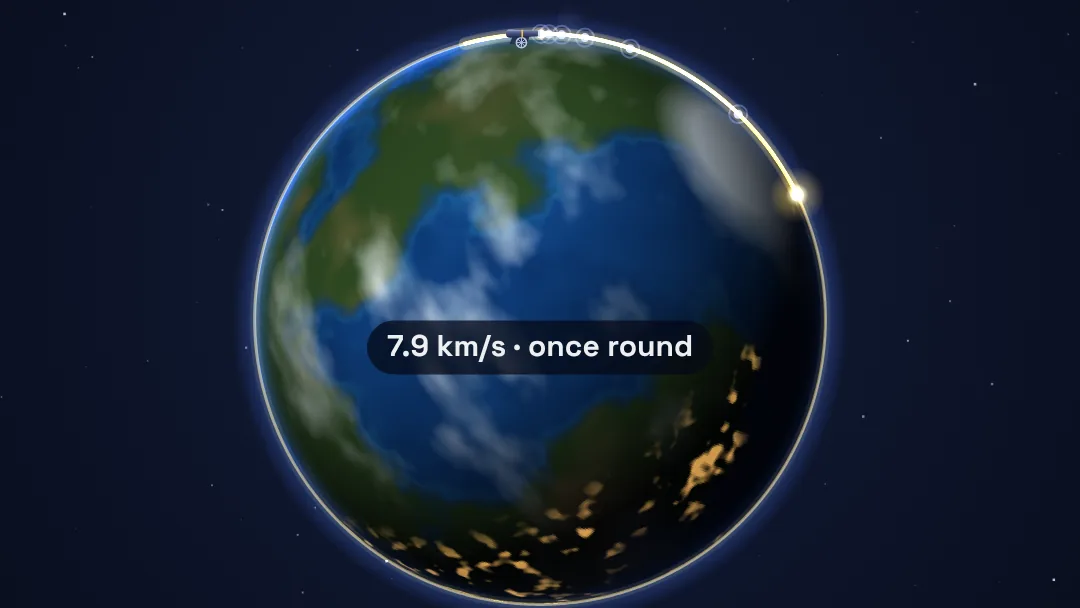
Satellites are falling right now. Fire Newton's cannonball faster and faster: at about 8 km/s the curved Earth drops away as fast as it falls, and past 11 km/s it escapes for good.


Transcript
Why don't satellites fall down? Here's the surprise: they do. The Space Station is falling toward Earth right now, and it has been for over twenty-five years. Isaac Newton pictured it with a thought experiment. Put a cannon on a very tall mountain, and fire a ball sideways. Gravity pulls it down, and it curves to the ground. Now fire it faster. It flies farther before it lands, and the curve of the Earth starts to matter. The surface drops away about five meters for every eight kilometers you travel. And a falling ball drops about five meters in its first second. So at about eight kilometers a second, the ball falls, and the ground curves away, at the same rate. It never catches up with the ground. That's an orbit: falling forever, and always missing. Go faster still, and the circle stretches into an ellipse. Past about eleven kilometers a second, it escapes for good. Real satellites fly above almost all the air, where very little slows them down. Try it yourself at Explainer Tools dot com.