Original film · Sky
Why do stars twinkle but planets don't? Atmospheric seeing, explained
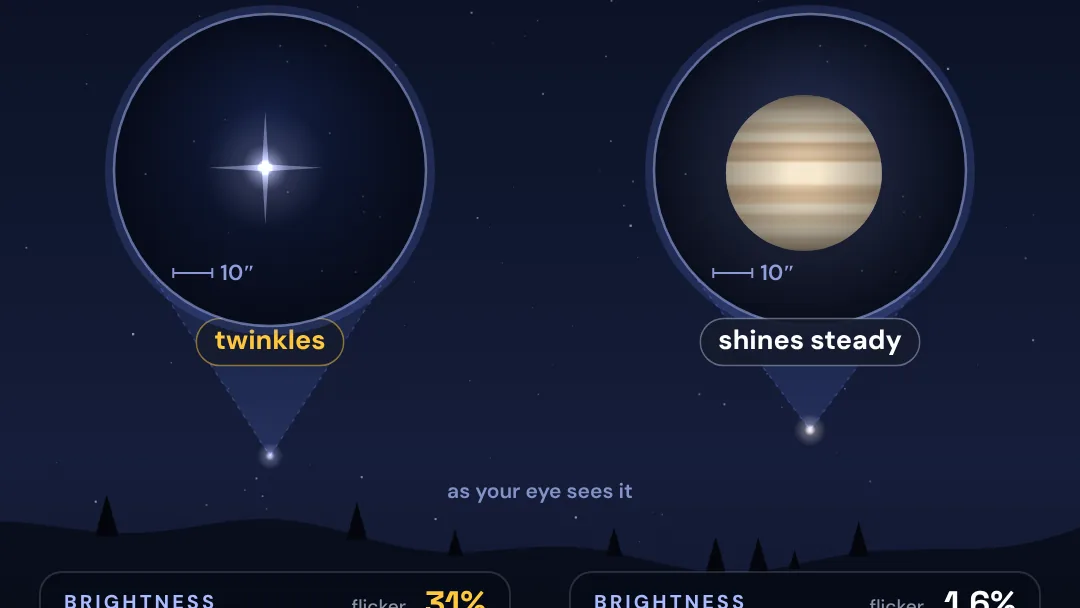
A star is a single point, so every wobble of our air shifts all of its light at once. Jupiter is a tiny disk whose flickers average out. Lower the star to the horizon and watch it flash.
Transcript
Why do stars twinkle, but planets don't? Twinkling isn't the star. It's our air. Starlight crosses space for years, sometimes thousands of years. Then, in the last fraction of a millisecond, it crosses our atmosphere. That air is full of drifting pockets of warm and cool air, each bending light a tiny bit differently, like a field of weak, moving lenses. A star is so far away that, even in a big telescope, it acts as a single point. All its light takes nearly the same path, so each wobble shifts or dims all of it at once. It flickers. Now lower the star toward the horizon. Its light crosses much more air, and the twinkling gets wilder, sometimes flashing color. Now grow the point into a disk. Jupiter isn't a point. It's a tiny disk, about forty arcseconds across. Each part of that disk takes its own path through the air, and wobbles its own way. The flickers average out, so it shines steadily. It's also why astronomers build telescopes on mountains, and launch them into space. Try it yourself at Explainer Tools dot com.