In the year before it filed for bankruptcy, Toys “R” Us sold $11.5 billion of toys and earned $792 million before interest. Nine months later it was in Chapter 11, and within a year the signs were coming down. The stores were not the problem. The loan was.
Try it yourself in Buyout Lab: drop a debt slab on the company, cut sales 10% and watch the cash tank drain.
Whose loan was it?
In 2005 three investment firms, KKR, Bain Capital and Vornado, bought the chain for $6.6 billion. Most of that price was borrowed, and in a leveraged buyout the loan does not stay with the buyers: it is placed on the company they bought. Toys “R” Us came out of the deal owing roughly $5 billion, and it was still carrying about $4.8 billion of it in 2016.
Where $792 million went
Interest took $457 million of it. Keeping the stores fresh, the capital spending that pays for shelves, lights and websites, took another $252 million. That left about $80 million, a cushion of roughly one tenth of the profit, for a company with $566 million of cash, $11 billion of sales and Amazon at the door. The company's own results for fiscal 2016 record those numbers, and a net loss of $36 million once interest was paid.
Why a bad year is fatal
A toy chain's costs are mostly fixed: rent, staff, warehouses. So when sales fall 10%, profit before interest does not fall 10%; in the model it falls by about half, from $792 million to roughly $380 million. The interest does not fall at all. It is a contract. With $457 million owed and $380 million earned, the company is short before it has bought a single shelf, and the $566 million of cash drains in about two years. In the real story the end came faster: about $400 million of the debt was due in 2018, and the lenders who would have had to refinance it chose liquidation instead.
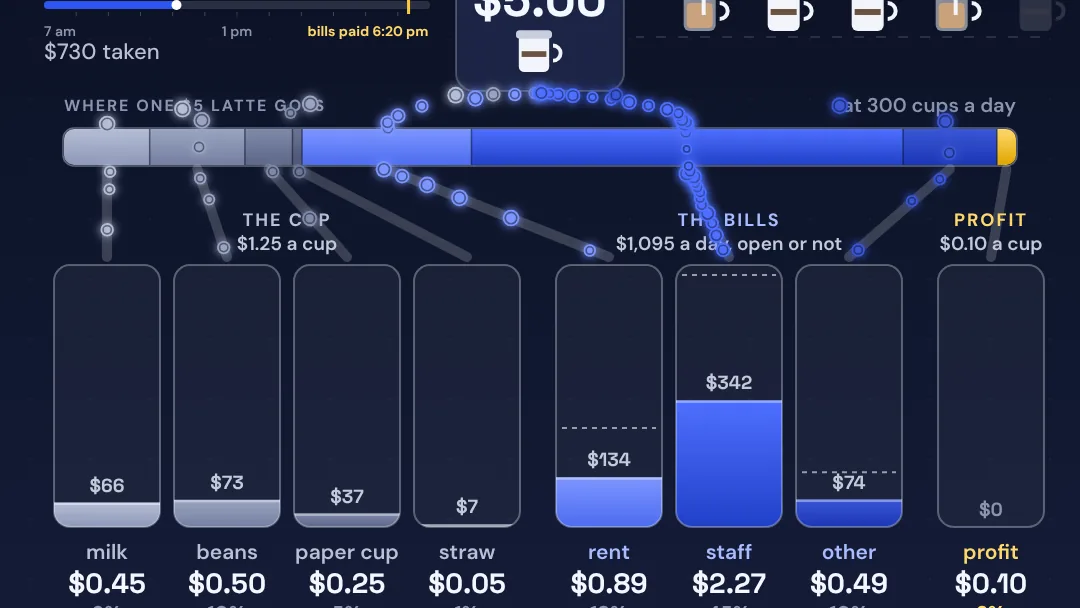
The same arithmetic as a café
This is the café's operating leverage with a second lever bolted on. A café's rent is owed whether anyone walks in; a buyout's interest is owed whether anyone buys. Each one turns a small fall in sales into a large fall in what is left. Stack them and a company that makes money every year can run out of it in one bad season.
The tool holds the fiscal 2016 cost structure fixed and leaves out taxes, working capital, store closures and refinancing, so the drain is a straight line the real company did not follow. The film's footage is a Toys “R” Us sign coming down in 2018, by @toysrusarchive; the machine, pipes and numbers come from the model.
Sources: Toys“R”Us, Inc., Results for the Full Year and Fourth Quarter of Fiscal 2016; Toys“R”Us fiscal 2016 Form 10-K; Fortune, Toys “R” Us files for bankruptcy (September 18, 2017); Retail Dive, Inside the 20-year decline of Toys R Us; Wikipedia, Toys “R” Us.
Sources & further reading
Make the next question an experiment.
Browse independent creators who make big ideas visible.
Find an explainer