SpinLaunch does not light a fire to leave the ground. It spins a projectile on an arm inside a vacuum chamber, faster and faster, then lets go, and the projectile flies out through a tube toward the sky. Neal Stephenson, asked about it on Core Memory, recalled an older cousin of the idea, the Slingatron: “it’s a big gun, basically.”
Try it yourself in Spin Launch Lab: set the release speed, the arm’s length and the payload’s mass, watch the g-meter, then press Release.
A throw, not a launch
SpinLaunch flew ten test flights from a 33 m “one-third scale” machine at Spaceport America in New Mexico between October 2021 and September 2022, reaching about 30,000 ft; the last carried payloads from NASA, Airbus US, Cornell and Outpost. Its planned full-size machine has a chamber about 100 m across and would release at up to 4,700 mph, about 2.1 km/s. That is only 27% of the speed needed for orbit, so the projectile carries a small rocket that lights at about 60 km up and finishes the job.
Why the speed hurts so much
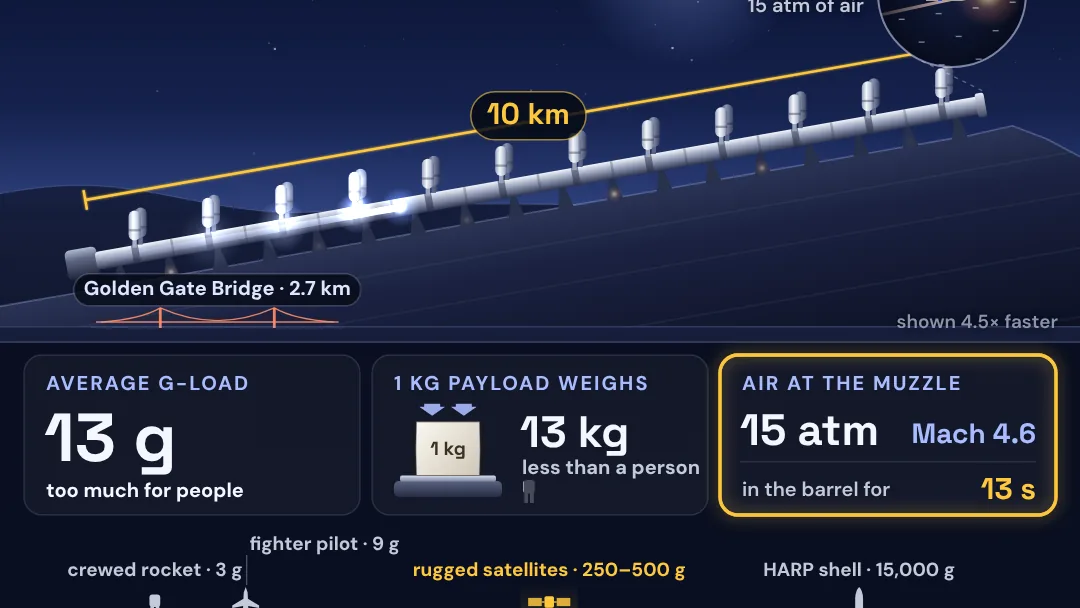
Anything moving in a circle is being pulled toward the centre, and the pull it needs is a = v²/r: the speed squared, divided by the radius. Double the speed and the force quadruples. Double the arm’s length and it only halves. SpinLaunch has not published its arm length, so the tool assumes 46 m, which fits inside a 100 m chamber. At 2.1 km/s that gives about 9,800 g, close to the 10,000 g SpinLaunch says its payloads are built for. Fighter pilots train to hold about 9 g, in g-suits. A washing machine’s spin cycle reaches about 550 g. The payload riding this arm feels more than a thousand times what a pilot does.
The arm feels it too. On a 200 kg payload, the pull at full speed is about 1,960 tonnes-force, more than four fully loaded Boeing 747-8s hanging from the arm’s tip. To keep the same 2.1 km/s throw under 1,000 g, the arm would have to be about 450 m long.
Then the air
Inside the chamber there is no air. The moment the projectile leaves the tube, it is doing Mach 6 in the thick air near the ground, and about 23 atmospheres of air press on its nose. That is the problem Stephenson pointed at for every big gun: “what happens when you meet the atmosphere.” Electronics can be hardened like artillery parts to survive the spin and the heat. People cannot ride it.
The tool is a model: steady circular motion on an assumed 46 m arm, with the load at full speed. It ignores the arm’s own mass, the counterweight, the time in the tube, and the drag and gravity losses on the climb. The film uses short excerpts of SpinLaunch’s own test-flight video (@spinlaunch_inc), credited on screen; the chamber, arm and numbers are drawn from the model. More launch ideas from the same conversation: Neal Stephenson’s launch ideas.
Sources: Wikipedia, SpinLaunch; Keeptrack, SpinLaunch deep dive; Space.com, Slingatron; Wikipedia, G-force and Boeing 747-8; Core Memory episode 94 with Neal Stephenson, video.
Sources & further reading
Make the next question an experiment.
Browse independent creators who make big ideas visible.
Find an explainer