On a dark country road, two points of light appear at the edge of your headlights. They are a deer’s eyes, blazing silvery green. Often the deer stands still, right in your path. Why do the eyes shine, and why doesn’t the deer run? The first question has a clear answer. Biologists are still working on the second.
Try it yourself in Eyeshine Lab: drag the mirror behind the deer’s retina down to none and watch the glow go out.
Why do deer eyes glow in headlights?
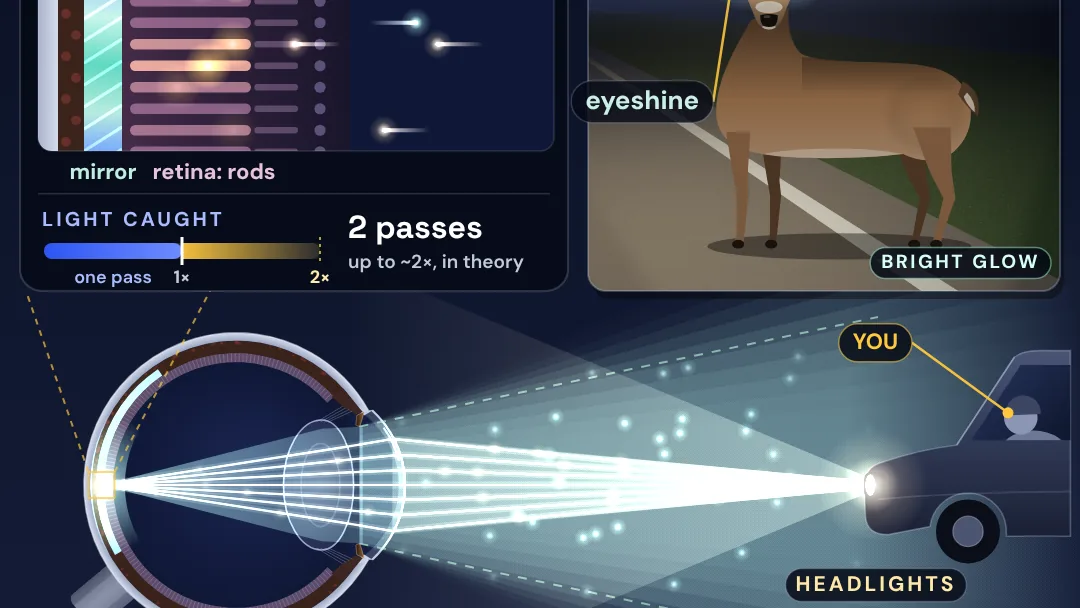
Behind a deer’s retina sits a mirror-like layer, the tapetum lucidum. Light that slips past the retina without being caught hits this layer. It bounces back through the retina for a second chance to be caught. Wikipedia: Tapetum lucidum.
Many night-active animals have one, including cats and dogs. White-tailed deer have the fibrous kind also found in cattle and horses. Ollivier et al. (2004); Newman et al. (2025).
The second pass always catches less than the first, because less light is left. So even a perfect mirror could at most double the catch, in theory. The real gain is lower and hasn’t been measured in deer. The mirror also blurs the image slightly. Wikipedia: Tapetum lucidum.
Why does the driver see the glow, but not someone by the road?
The eyes are not making light. The eye’s lens focuses your headlights onto a small spot on the mirror. Light from that spot leaves through the same lens, back toward the headlights, like a road reflector. To see it, you usually need to be directly behind the light. Texas Parks and Wildlife: Eyeshine.
In Eyeshine Lab, the deer starts 40 meters away, and the driver’s eyes sit 0.7 meters from the lights. Seen from the deer, your eyes and the lights are about 1 degree apart, inside the returning beam. Stand 5 meters to the side, and the angle grows to about 7 degrees. Now the eyes look dark.
Why don’t human eyes glow green?
Humans have no tapetum, and neither do apes or most monkeys. Dark cells behind our retinas absorb the light that slips past. Texas Parks and Wildlife: Eyeshine. A camera flash can still make our eyes glow, but red, from the blood-rich back of the eye. Red-Eye Lab follows that light. In Eyeshine Lab, the Human preset drops the mirror to zero. Drag it back up for a what-if.
So why do deer freeze?
Biologists don’t know. A 2024 review of deer vision calls the cause still unclear. The light might overwhelm eyes tuned for the dark. Two bright lights might not look like danger. Or the signals might contradict each other. Newman and D’Angelo (2024).
Experiments haven’t settled it. In a 2014 study, researchers drove a pickup toward wild deer after dark. Speeds ranged from 20 to about 90 km/h. How soon a deer ran did not depend on the truck’s speed, so a faster car leaves less time. The team judged it unlikely that vehicle lights overwhelm a deer’s dark-adapted eyes. Blackwell et al. (2014).
In 2025, a University of Georgia team drove an electric golf cart toward 23 captive deer. They tried halogen and LED headlights, on high and low beam. Across 174 trials, the deer fled only about half the time. Many stayed in the cart’s path, whatever the lighting. Reactions seemed to depend more on the individual deer than on the lights. Pakula et al. (2025).
What should you do when you see a deer?
These are practical tips, not research findings. Delaware’s Division of Fish and Wildlife suggests three things:
- Slow down. Deer usually travel in groups, so if you see one, expect others.
- Use high beams when there is no oncoming traffic. Deer eyes near the road will shine back.
- Brake rather than swerve, and stay in your lane. Leaving the road or hitting another car is likely much worse than hitting a deer.
Nationally, deer strikes peak from late October through mid-November.
What does the model leave out?
Eyeshine Lab is a model of simplified optics, not to scale. The distance to the car is drawn shorter and the angles larger, but the readouts give the true angle. The eye is schematic, and one eye stands in for every animal. The model also leaves out:
- Measured numbers. The returning beam’s 3-degree width is illustrative. “Up to 2×” is a ceiling in theory. Neither has been measured in deer.
- Real color. Each animal gets one color. Real eyeshine is iridescent, so its color shifts with the viewing angle. It also varies with age and between animals. Wikipedia: Tapetum lucidum. In white-tailed deer, the mirror’s color even varies by region. Newman et al. (2025).
- Real roads and real deer. Dimming with distance, the headlight beam pattern and pupil changes. The model shows what you see, not what the deer sees, and can’t predict whether it will move.
Can you catch eyeshine on a night walk?
These steps are a suggestion, so adapt them to the child beside you. Stay away from traffic, keep your distance from wild animals, and never shine the light in anyone’s face.
Predict. Hold a flashlight right beside your eyes. Ask your child whose eyes will shine back: a cat’s, a dog’s, a person’s? What changes if you hold the light at arm’s length, to the side?
Try. On a night walk, sweep the light slowly across lawns and porches. Look for pairs of glowing dots a few meters away. Then move the light out to arm’s length, and have your child put their eyes right next to it. Who sees the glow now? A pet across a dim room works too.
Explain. The mirror sends light back toward its source. Move the light away from your eyes, and the glow fades for you but not for your child. That is why the driver sees a deer’s eyes, and someone by the road doesn’t. Texas Parks and Wildlife: Eyeshine.
Back in Eyeshine Lab, pick “Standing 5 m to the side”, then drag the animal far down the road. Predict first: at 150 meters, will the glow come back?
Eyeshine Lab is an ExplainerTools Original.
Sources & further reading
- Wikipedia, Tapetum lucidum
- Ollivier et al. (2004), Comparative morphology of the tapetum lucidum (among selected species), Veterinary Ophthalmology 7:11–22
- Newman, Hammond & D’Angelo (2025), Potential spectral tuning of the tapetum lucidum in a broadly distributed ungulate, Journal of Experimental Zoology A 343:905–910
- Texas Parks and Wildlife, Eyeshine (Young Naturalist)
- Newman & D’Angelo (2024), A Review of Cervidae Visual Ecology, Animals 14:420
- Blackwell, Seamans & DeVault (2014), White-tailed deer response to vehicle approach: evidence of unclear and present danger, PLOS ONE 9:e109988
- UGA Savannah River Ecology Laboratory (2025), Headlights and Hesitation, on Pakula et al., Applied Animal Behaviour Science
- Delaware DNREC (2019), Division of Fish & Wildlife urges motorists to watch out for deer crossing roadways
Make the next question an experiment.
Browse independent creators who make big ideas visible.
Find an explainer