On the ground, your phone barely whispers to the nearest tower. Climb to cruising altitude, and the picture changes. Why does it matter whether the phone is on?
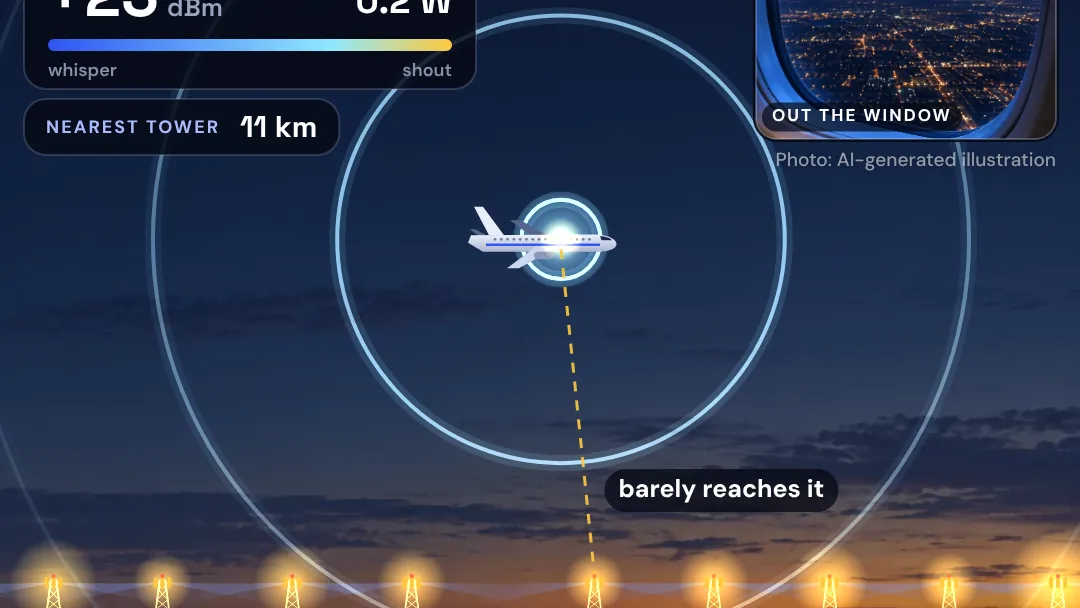
Try it yourself in Airplane Mode: drag a phone from the ground to cruising altitude and watch its radio climb to full power.
How does a phone set its power?
Your phone is a radio transmitter. It turns its power up or down to reach the nearest tower. Close by, it whispers. Far away, it shouts.
The model’s rule is simple: the phone adds enough power for its best tower to receive minus 110 dBm, within a range of minus 40 to plus 23 dBm. The model’s phone is an LTE power-class-3 phone, and 23 dBm is about 0.2 watts. Once it reaches that cap, it cannot shout any louder.
Why does altitude change the picture?
On the ground, the path loss follows a suburban slope, 128 + 35 log10(d) dB, where d is in kilometers. Above about 100 meters the path is clear, so the model switches to free-space loss instead.
A tower hears the phone when the signal arrives above minus 115 dBm, roughly the noise floor of one 180 kHz LTE resource block. For that reach, the model assumes every tower sees the phone through the same part of its antenna pattern as the nearest tower does.
Towers in the model are 30-meter masts with 15 dBi antennas, spaced 3 to 5 kilometers apart. Once the phone climbs, it sees towers it can barely reach. It may shout at full power, and the model draws the phone’s reach as rings. Those rings show how far a tower can hear it.
Predict first, then try
Before you move the phone, predict whether it will need more power or less to reach a tower at cruising altitude than it did on the ground. Then check it in Airplane Mode: drag the phone upward and watch the radio climb.
Explain to yourself why a phone can need more power far away than close by. Then switch airplane mode on, and notice what changes.
What does this do to the ground?
A phone that shouts from the sky can disturb networks on the ground. Older phones also put a faint buzz in pilots’ headsets. Older GSM phones could transmit up to 2 watts, in bursts once per 4.615-millisecond frame, about 217 times a second. That is the source of the familiar dit-dit buzz in speakers and headsets.
5G phones use the same 23 dBm power class. Airplane mode switches the cellular radio off. Wi-Fi and Bluetooth can be turned back on separately. Small risks, easily avoided: switching the transmitter off also makes your battery last longer.
What does the model leave out?
The model’s tag reads “simple link budget, not to scale.” Its numbers are illustrative, not measurements. The model leaves out:
- The aircraft. The aircraft’s metal skin weakens signals, and the model leaves it out.
- The network. Real networks use closed-loop power control, many frequency bands, varied antennas and terrain, and other phones. Handovers and timing limits are not modeled.
- Earth. Earth’s curvature is not modeled.
- Rules. Rules differ by country. The US FCC bars airborne use of cellular phones, while Europe allows in-flight mobile service through on-board cells.
The photos are AI-generated illustrations. Every number comes from the model.
Sources: Wikipedia, Mobile phones on aircraft; Wikipedia, GSM; 3GPP TS 36.101, UE maximum and minimum output power; 47 CFR § 22.925; Wikipedia, Hata model; CBS News, a pilot on the headset buzz.
Sources & further reading
Make the next question an experiment.
Browse independent creators who make big ideas visible.
Find an explainer