Earth · interactive
Your compass doesn't point north?
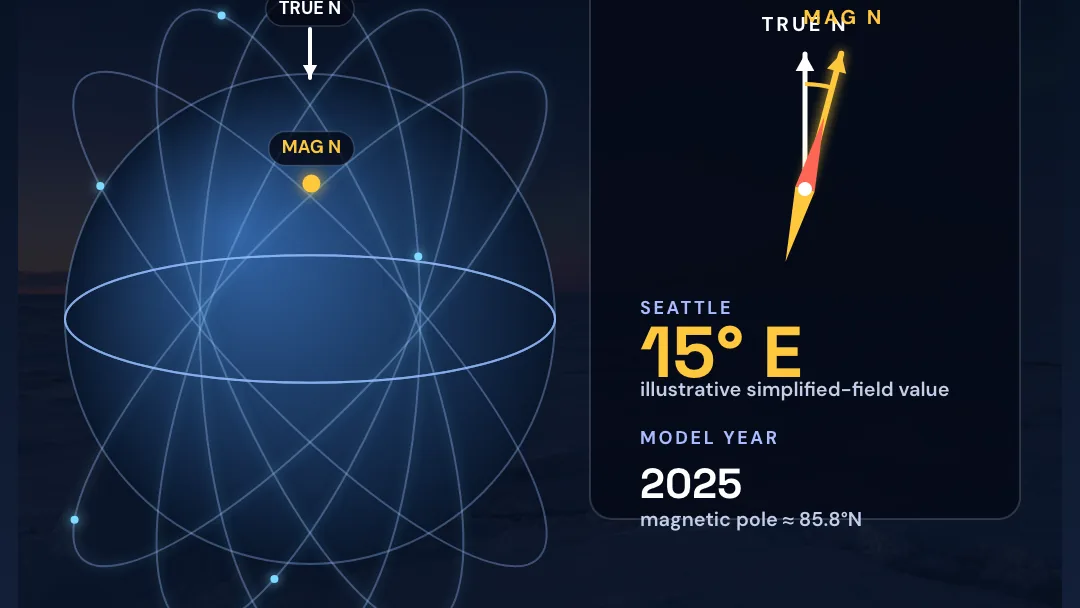
One computed proxy angle drives the needle and readouts. It is anchored to illustrated 2025 city samples, not WMM or navigation output.
1 See
True north is a direction on a map. Magnetic north is a moving feature of Earth’s field, so a compass can point east or west of the map line.
2 Change
3 Understand
Model notes and sources
Model. Declination is the horizontal angle from true north to magnetic north. Positive values are east, negative west. Four illustrated 2025 city samples are retained (Seattle 15° E, Chicago 4° W, Miami 7° W and Boston 14° W), with city latitude and longitude. For other years, the tool adds the wrapped change in initial great-circle bearing from that city to the interpolated model pole, relative to the bearing to the 2025 pole. This is an illustrative direction-to-moving-pole proxy, not a WMM field calculation or navigation output.
Pole history. The year control linearly interpolates an illustrative marker from 81.0°N, 110°W in 2000 to 85.8°N, 139°W in 2025. The interpolation and displayed longitude are illustrative. For navigation, calculate the actual date and coordinates with NOAA’s World Magnetic Model.
Not modeled. Non-dipole field terms, daily magnetic disturbance, altitude, crustal anomalies, secular-variation coefficients and the compass’s vertical dip. The photos are AI-generated illustrations.
Source: NOAA National Centers for Environmental Information, World Magnetic Model 2025.
An ExplainerTools Original.