Home energy · interactive
How can a heat pump give more heat than it uses?
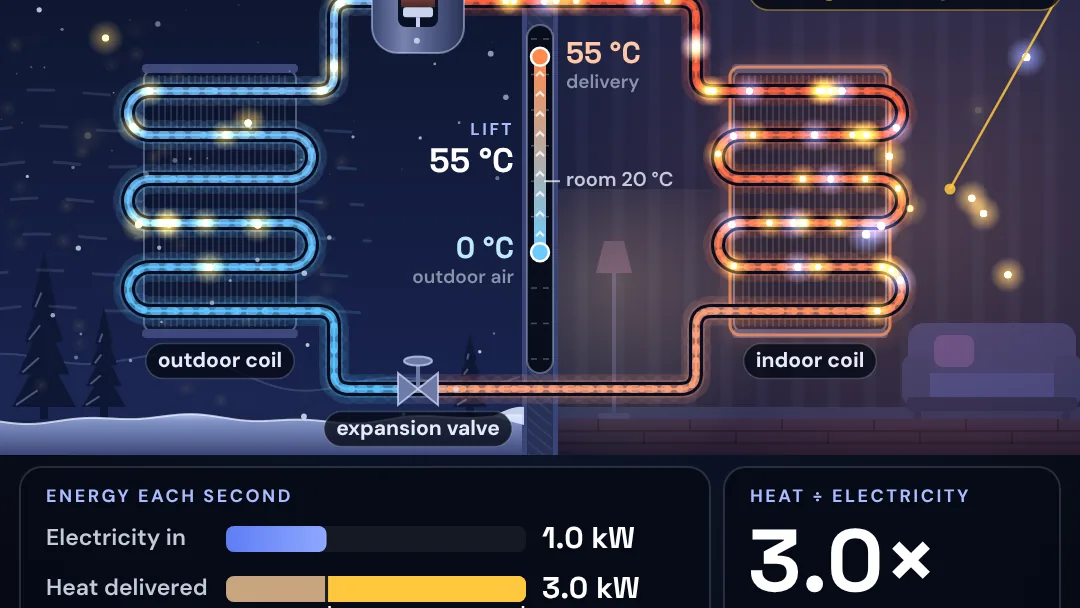
Sunshine dots: heat moved in from the outdoor air. Cobalt dots: electricity. Each dot is the same amount of energy, and every dot that goes in comes out as heat in the room. The fluid is blue where it is cold and orange where it is hot. Drag the markers on the wall thermometer, or use the knobs.
1 See
An electric heater turns 1 kW of electricity into 1 kW of heat. A heat pump on a freezing day delivers about 3 kW for the same 1 kW. Where does the extra heat come from?
2 Change
3 Understand
Watch the full 44-second film for the longer story.
Model notes and sources
The ratio. A heat pump’s coefficient of performance is COP = heat delivered ÷ electricity used. No machine can beat the Carnot limit, COPmax = Thot / (Thot − Tcold), with both temperatures in kelvin (°C + 273.15). This model assumes a machine that reaches a fixed 50% of that limit: COP = 0.5 × Thot / (Thot − Tcold). Tcold is the outdoor air temperature and Thot the delivery temperature (the water sent to radiators or the air sent to vents). Their difference is the lift. It is the same model, with the same 50% factor, as the earlier ExplainerTools heat pump explainer.
The bookkeeping. You choose the heat delivered, Q. The electricity needed is W = Q / COP, and the heat moved in from the outdoor air is Q − W, so heat delivered = heat from outdoors + electricity, exactly. The stage prints heat and electricity rounded, and prints the outdoor share as their difference, so the sum on screen always balances. Each glowing dot is the same parcel of energy, and dots appear at a rate proportional to kW, so dots in = dots out. For large outputs the tool draws fewer dots per kW (to keep the stage readable); the split between sunshine and cobalt dots stays exact.
The film’s numbers. With 0 °C outdoor air and 55 °C delivery the lift is 55 °C: COP = 0.5 × 328.15 / 55 = 2.98, about 3×. So 3.0 kW of heat takes 1.0 kW of electricity and moves 2.0 kW in from the outdoor air. At −15 °C the lift is 70 °C: COP = 0.5 × 328.15 / 70 = 2.34, and the same 3.0 kW of heat takes 1.3 kW of electricity. The film holds the heat delivered fixed so the electricity is easy to compare; a real house needs more heat on a colder day. Across the tool’s range the COP runs from 1.96 (−25 °C air, 60 °C delivery) to 10.1 (15 °C air, 30 °C delivery). The high end is far above real equipment. Treat the numbers as an optimistic ceiling that shows the trend, not as appliance data. For comparison, Wikipedia’s heat pump article lists a high-efficiency air-source heat pump with 0 °C air at a COP of 3.8 for 35 °C output, 2.8 for 45 °C and 2.2 for 55 °C: about 37–43% of the Carnot limit. This model gives 4.4, 3.5 and 3.0 at those points. Both fall the same way as the lift grows.
How the loop works. After the expansion valve the refrigerant is colder than the outdoor air, so heat flows into it in the outdoor coil, and it boils into a gas. The compressor squeezes that gas: its pressure and temperature rise until it is hotter than the delivery temperature, so it gives its heat away in the indoor coil and condenses back to a liquid. The valve then drops the pressure, which chills it again. On the stage the fluid’s dots crowd together where it is dense (squeezed gas and liquid) and spread out where it is a thin, low-pressure gas. The fluid’s colors are schematic: the model has no refrigerant property data, and the temperature gaps across each coil (the fluid must be a little colder than the air, and a little hotter than the delivery temperature) are folded into the 50% factor rather than modeled. The room is shown at 20 °C for comparison only.
Left out. Defrost cycles (in cold, damp air the outdoor coil collects ice and must be warmed now and then), the fall in heating capacity on very cold days, on–off cycling and part-load effects, fan and pump power, heat lost from pipes and the outdoor unit, and real refrigerants. In mild weather (about 10 °C outside) real air-source heat pumps reach a COP of roughly 3 to 5, and less in hard frost.
Sources: OpenStax, University Physics Volume 2, 4.5 The Carnot Cycle; Heat pump; Coefficient of performance; Vapor-compression refrigeration.
An ExplainerTools Original.