Nature · interactive
How does a hummingbird hover?
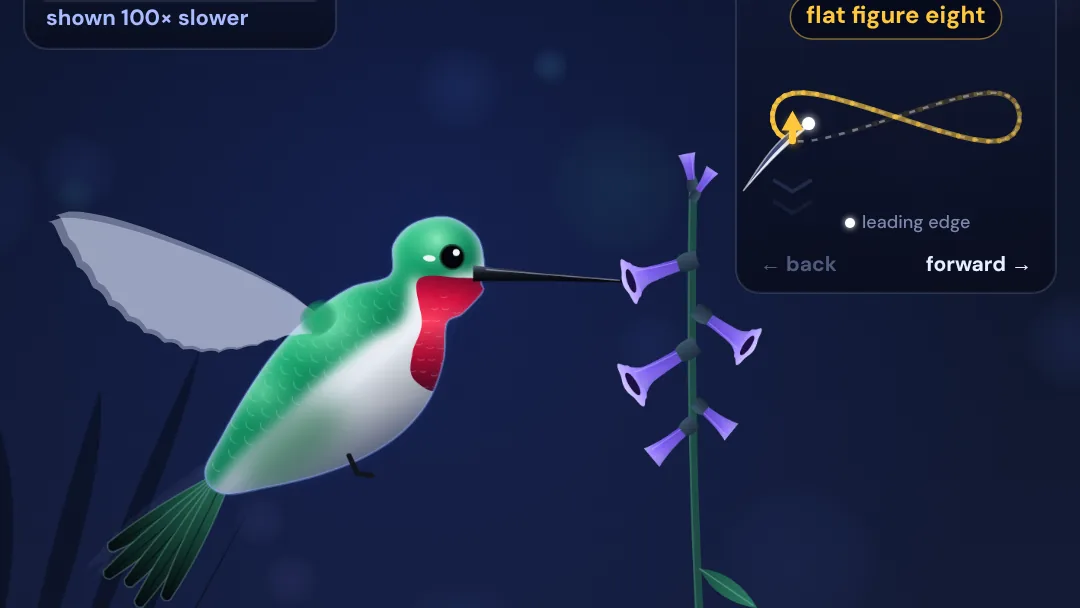
Left: the bird seen from slightly below, slowed down; streaks show the air it pushes. Right, top: one slice of the wing seen from the side. Right, bottom: the lift from each stroke in this model, and the split measured in real birds. Drag across the stage to step through a wingbeat.
1 See
A hummingbird's wings beat about 50 times a second, yet its body hangs still. How can a wing sweeping backward still hold the bird up?
2 Change
3 Understand
Watch the full 42-second film for the longer story.
Model notes and sources
Wing motion. One wingbeat is a phase φ from 0 to 2π. The wingtip sweeps forward and back through a stroke angle ψ = 62° sin φ (124° in all) and rises and falls by δ = 10° sin 2φ, so seen from the side it traces a flat figure eight. The forward stroke (the downstroke) runs while cos φ > 0 and the back stroke (the upstroke) while cos φ < 0. The wing’s pitch θ, the angle of its chord from the horizontal, is θ0 on the forward stroke and turns toward 180° − θ0 around each end of the stroke: θ = θ0 + u(φ) · flip · (180° − 2θ0), with u = ½(1 − tanh(4 cos φ) / tanh 4). Wing flip scales that turn and Wing angle sets θ0 (45° by default). These are the same equations and constants as our earlier Hummingbird Hover model.
Force proxy. The arrows come from a quasi-steady flat-plate rule for one slice of the wing at 65% of its length: vertical push ∝ (stroke speed)² × sin 2α, where α is the angle between the chord and its motion, positive when the edge in front is raised. The lift per stroke is that push added up over each half of the beat, scaled so that a full flip at 45° holds up exactly the bird’s weight. It is a teaching proxy, not a measurement or a flow simulation. It leaves out the wing’s curve and twist, leading-edge vortices, the wake from earlier strokes, speeds that grow toward the tip and any difference between the two strokes, so with a full flip it splits the lift 50/50. The air streaks are schematic: they move with the running total of the proxy.
Real birds. Hummingbird wings beat about 50 times a second: about 53 for the ruby-throated hummingbird, and an average of 41 for rufous hummingbirds filmed in a wind tunnel, whose wings swept through more than 100° each stroke. Seen from the side, a hovering rufous hummingbird’s wingtip traces a horizontal figure eight. Measuring the air in its wake, Warrick, Tobalske and Powers found that hovering rufous hummingbirds get about 75% of their weight support from the downstroke and 25% from the upstroke, partly because the curved (cambered) wing is upside down on the upstroke.
Drawing. The film slows time 100×; here you can set it. The bird is a stylized male ruby-throated hummingbird, seen from slightly below; the body is a flat illustration and the wings are a 3-D model drawn over it. The upper side of the wing is drawn dark and the underside pale so you can see the flip; real hummingbird wings are dark on both sides. The side view shows one slice of the wing at the wingtip’s position, with its thickness exaggerated.
Sources: D. R. Warrick, B. W. Tobalske and D. R. Powers, “Aerodynamics of the hovering hummingbird”, Nature 435, 1094–1097 (2005); B. W. Tobalske et al., “Three-dimensional kinematics of hummingbird flight”, J. Exp. Biol. 210, 2368–2382 (2007); National Geographic, Ruby-throated hummingbird; Ruby-throated hummingbird (Wikipedia).
An ExplainerTools Original.