Kitchen · interactive
Why does microwave food heat unevenly?
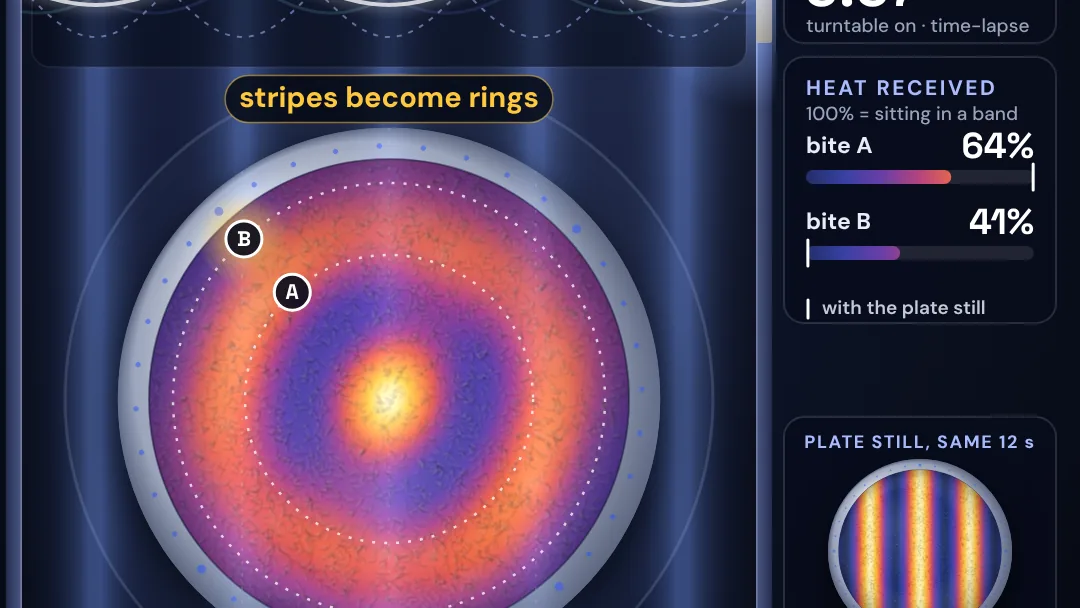
Top view inside the oven. Top: the standing wave across the oven, slowed down. Glowing bands: where it heats strongly. The plate shows the heat each spot has received; drag across the food to stir it.
1 See
One bite scalds, the next is still cold. Why does a microwave cook in patches, and what does the turntable fix?
2 Change
3 Understand
Watch the full 44-second film for the longer story.
Model notes and sources
The wave. Household ovens run at about 2.45 GHz, so the microwaves are λ = c/f = 299,792,458 m/s ÷ 2.45 GHz = 12.2 cm long. They bounce off the metal walls, and waves going opposite ways overlap into a standing wave. Averaged over each fast oscillation, the heating it gives is I(x) = cos²(2πx/λ): 1 on a band, 0 in a gap. Bands sit half a wavelength apart, 6.12 cm, and they stay put. This model takes one slice across the oven, 30.6 cm (2.5 λ) wide, with the field vanishing at both metal walls and a band through the center of the turntable.
Heat received. A spot of food collects D = ∫ I(x(t)) dt. The colours and bars show D as a share of what a spot sitting in a band gets over the same time (100%). In the film, the colours also build up from cold while the plate cooks without turning. With the turntable off, a spot keeps its share: bite A, 6 cm from the center on a band, gets 100%; bite B, 3 cm further out in a gap, gets 1%.
Turntable. A point at radius r and angle φ on the plate sits at x = r cos(φ + ωt), with one turn every 12 s (5 rpm, about what turntables do). Over any half turn (the pattern is symmetric) it gets (1 + J0(4πr/λ))/2, where J0 is a Bessel function: 100% at the center, 30% in a ring 3.7 cm out, 65% at 6.8 cm, 38% at 9.9 cm. Bite A ends up at 60% and bite B at 43%. The stripes turn into rings, closer but not equal, and the very center never travels.
Standing time. Heat then spreads by conduction, ∂T/∂t = α∇²T, with α = 0.14 mm²/s (water). After a time t it smooths out features about √(2αt) across: 4 mm after 1 minute, 7 mm after 3 minutes. That blurs small patches but barely touches 6 cm stripes, which is why stirring comes first. In the tool, dragging across the food moves and mixes it near your finger; the film's stir works the same way. Both are illustrations, not a fluid model. The share is treated like a temperature rise only for this spreading, assuming even heat capacity.
Not modeled. Real ovens are three-dimensional: many overlapping modes give a pattern of hot spots, not clean bands, and some ovens use a metal stirrer fan instead of a turntable. The food itself changes the field, microwaves reach only about 1 cm into most foods, and ice absorbs far less than liquid water, so frozen patches lag behind. There is no evaporation, browning or heat loss, and the share is relative energy, not a temperature. Whether the turntable center lands on a hot or a cold spot depends on the oven; here it is on a band. The waves are drawn about 2 billion times slower than 2.45 GHz, and cooking runs as a time-lapse.
Sources: OpenStax, University Physics Volume 2, 16.5 The Electromagnetic Spectrum (oven standing waves, hot spots half a wavelength apart, turntables); OpenStax, College Physics 2e, 24.3; Microwave oven (2.45 GHz and 12.2 cm, turntable centers, standing time, about 1 cm penetration); Clemson Cooperative Extension, Microwave Food Safety (stir or rotate, let food stand); Thermal diffusivity (water, 0.143 mm²/s).
An ExplainerTools Original.