Light · interactive
Does a prism create a rainbow?
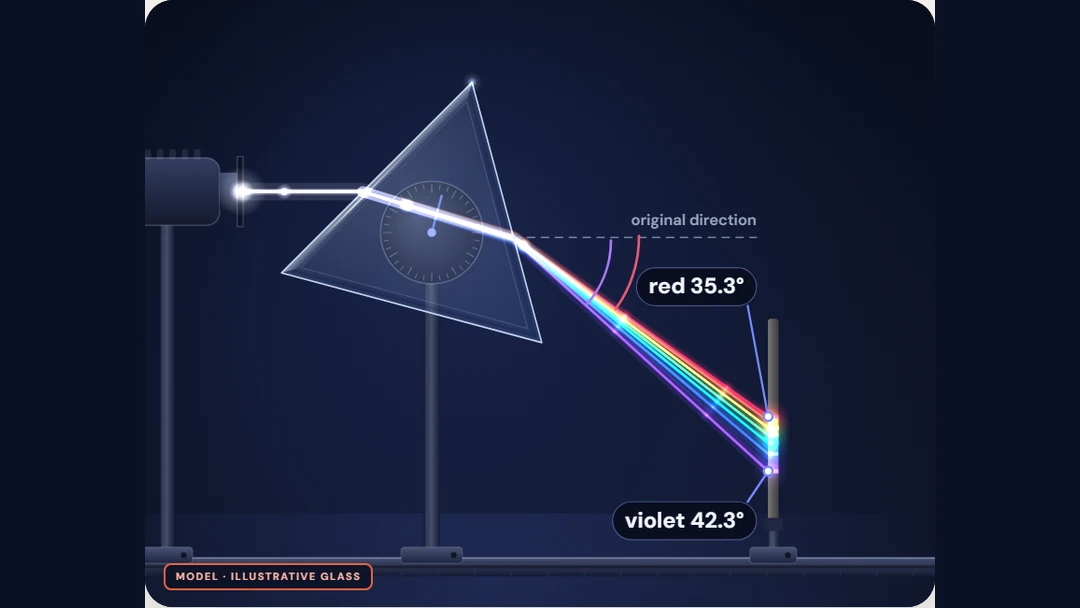
Side view of the bench, drawn from the model’s exact ray paths. Seven sampled wavelengths are drawn: 405, 450, 490, 530, 580, 650 and 700 nm. Moving glints are slowed and only show direction. Drag the prism to turn it.
1 See
A white beam goes in and a rainbow comes out. Is the glass making those colors, or were they in the light all along?
2 Change
3 Understand
Model notes and sources
Two-surface ray model of an equilateral (60°) prism in air. At each real face the ray refracts by the vector form of Snell’s law, n1 sin θ1 = n2 sin θ2: the index times the ray’s component along the surface is the same on both sides. When no transmitted ray exists (n1 sin θ1 > n2), the model applies total internal reflection and follows the reflected ray to the next face. A trace stops after 12 surface hits; a ray still inside is then reported as a trace limit, a limit of the calculation, not of light.
Index of refraction (illustrative, not a calibrated glass): n(λ) = 1.50 + d · 0.018 µm² · (1/λ² − 1/(0.550 µm)²), a Cauchy-style 1/λ² dependence centered on 550 nm. The Dispersion knob d runs from 1 (this model glass) to 0, where every wavelength gets n = 1.50. Zero dispersion is a hypothetical teaching control; real glass always disperses, and you cannot tune it away. At d = 1 the index runs from 1.550 at 405 nm to 1.477 at 700 nm. That dispersion is deliberately strong, larger than ordinary window or crown glass, so the fan is easy to see.
Fixed values: apex angle 60°, prism circumradius 190 model units, a horizontal incoming beam. The Entry angle knob turns the prism (default 45°). At 45° the model gives bends of 42.3° at 405 nm, 37.4° at 550 nm and 35.3° at 700 nm, a 6.9° spread; with d = 0 every color bends 37.4°. These are predictions of this illustrative model, not measurements. Not modeled: partial reflection at each surface (a few percent of the light), absorption, beam width and divergence, polarization, the measured dispersion of named glasses, and anything outside the drawing’s plane. Display colors are approximate. White light is a continuous spectrum; the seven rays are samples of it, and the faint fan between them is traced every 10 nm.
Sources: OpenStax, University Physics Vol. 3: Refraction, Total internal reflection and Dispersion; Cauchy’s equation.
An ExplainerTools Original. Concept inspired by Ryan Sael’s Prismatic.