Cameras · interactive
Why do propellers look bent?
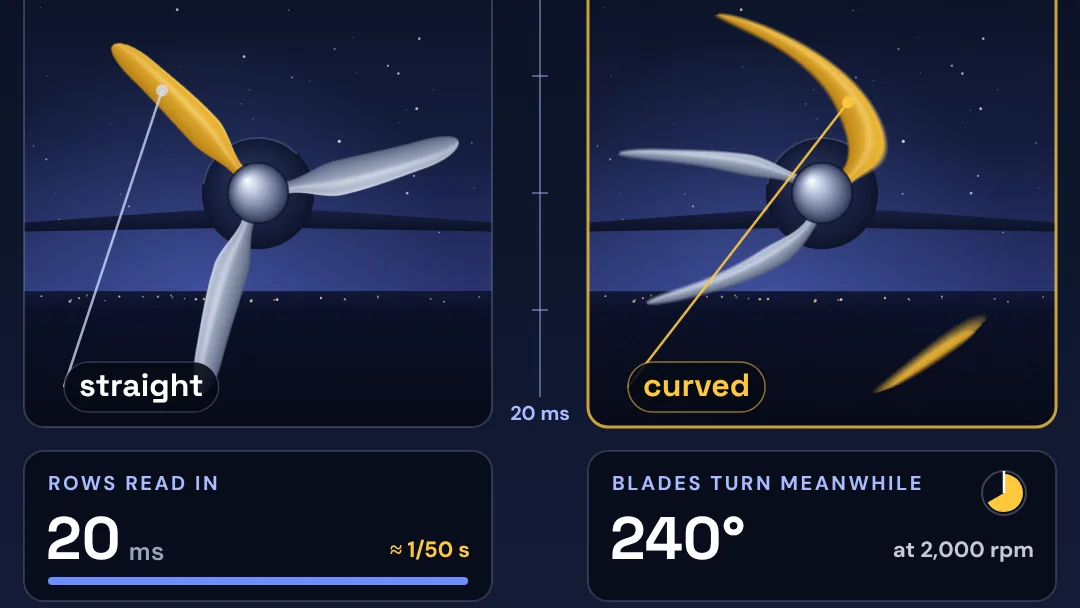
Left: the propeller as it really is, slowed 160×. The gold line marks where each row caught the gold blade. Right: the photo, built one row at a time. Drag up or down on the stage to move the scan yourself.
1 See
Photograph a spinning propeller with a phone and its straight blades come out curved, some even floating free of the hub. The blades never bend. So what is the camera doing?
2 Change
3 Understand
Watch the full 45-second film for the longer story.
Model notes and sources
Model. An ideal rolling shutter: the sensor’s rows are read one after another, top to bottom, at a steady rate. Row r (0 at the top, 1 at the bottom) collects light from r·R to r·R + X after the photo starts, where R is the readout time and X the exposure (the shutter speed). A global shutter is R = 0: every row collects light at the same moment. The propeller has three straight blades turning at a steady speed, so it turns 6 × rpm degrees per second. Between the top row and the bottom row it turns rpm × 6 × R / 1000 degrees (240° at 2,000 rpm with R = 20 ms), so each row catches the blades at a different angle. While one row collects light it turns rpm × 6 × X / 1000 degrees, which smears the blade: ordinary motion blur, a separate effect.
How the photo is made. Every pixel is the exact time-average of the scene over its own row’s exposure, computed with angular prefix sums of the blade’s shape, the same timing law and method as the earlier ExplainerTools rolling-shutter Original. The left view shows the propeller as it really is at each moment, slowed 160×: 1 ms of real time lasts 0.16 s on screen. The gold line on the left traces where each row caught the gold blade, which is exactly the gold shape in the photo.
Fixed values. A readout of 20 ms, about 1/50 s, stands in for a phone. Real readout times vary with the phone and the mode: DxO Labs measured 30 ms for a Nokia Lumia 1020 using its electronic shutter, and 12–23 ms for a Canon 650D’s video modes. The film uses a 1/4000 s exposure, typical of bright daylight, and spins the propeller at 60 and then 2,000 rpm. Presets: the Lycoming O-320, the engine in many Cessna 172s, is rated at 2,700 rpm; the Dash 8 Q400’s propellers turn at 1,020 rpm for takeoff (850 rpm in cruise). Those propellers have two and six blades; this model always draws three.
Not modeled. Readout that isn’t perfectly even, mechanical shutters, camera shake, flicker, lens distortion and blade flex. The photo is shown at full brightness whatever the shutter speed, as if the camera’s gain made up the difference, and its grain is decorative. The photo has a few hundred rows instead of a real sensor’s thousands; the timing law is the same.
Sources: L. Masson, F. Cao, C. Viard and F. Guichard (DxO Labs), “Device and algorithms for camera timing evaluation” (2014); Basler, Electronic shutter types; Rolling shutter; Lycoming O-320; Pratt & Whitney Canada PW100 (PW150A on the Q400).
An ExplainerTools Original.