Topic guide · AI world models
How does an AI world model draw the road live?
Not the way a game engine does. Elon Musk says Tesla’s new Reality View is generated live by an AI model running on half of one of the car’s AI chips; that is his claim, and Tesla hasn’t published the model. A game engine builds 3D models, lights them and draws every pixel. A diffusion-style model starts from pure noise and removes it step by step, guided by what the driving AI understands: the lanes, the cars, the curve ahead. Fewer steps mean faster frames but a blurrier road. In World Model Lab you can cut the steps yourself.
- Game engine
- 3D models → lighting → pixels
- Diffusion model
- noise → many denoising steps → picture
- Guided by
- lanes, cars, the curve ahead
- The trade-off
- fewer steps: faster, blurrier
Illustrative How Tesla’s model works has not been published. The claim that it runs on half of one AI chip is Elon Musk’s, posted on X in November 2026, and has not been independently verified.
Interactive · ExplainerTools
World Model Lab
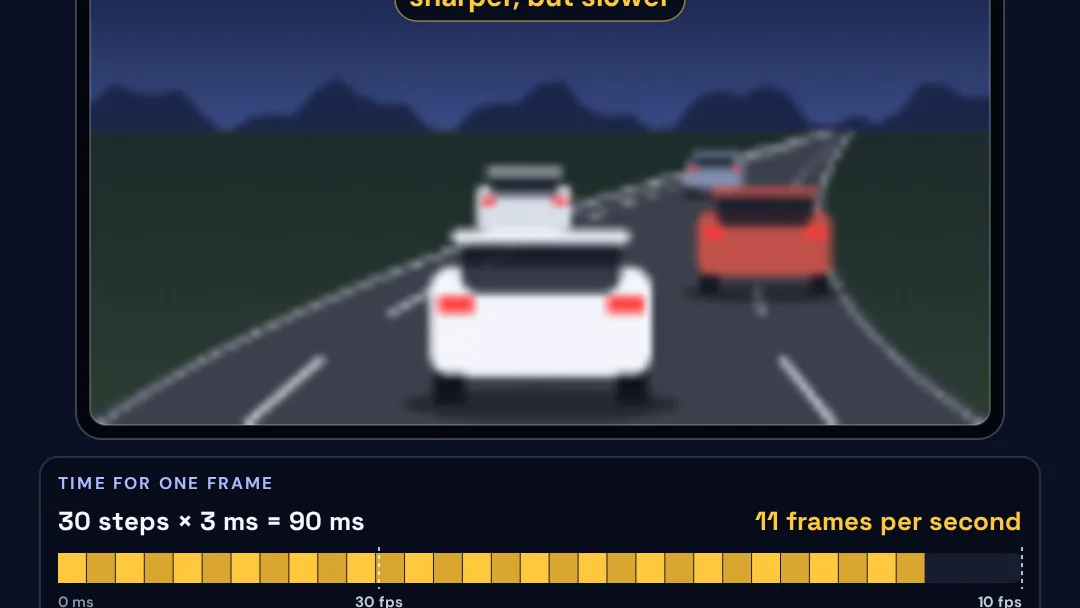
Watch a road come out of noise. Turn “Denoising steps” down for faster frames and a blurrier road, and turn “Guidance strength” down to see what the car’s view adds.
Model · illustrative denoising, not Tesla’s model
What did Musk say about Reality View?
In November 2026 Elon Musk and Tesla posted on X that the car’s new Reality View, the picture of the road on its screen, is generated by a neural “world model” rather than a game engine, and that it runs on half of one of the car’s AI4 chips. That is the company’s claim; it hasn’t been independently verified, and Tesla hasn’t published the model’s design. What follows is how models of this general kind work, not a description of Tesla’s.
How does a game engine draw a road?
A game engine builds the picture from geometry:
- 3D models
The road, cars and hills exist as meshes of triangles.
- Lighting
The engine works out how light falls on every surface.
- Rasterising
For each pixel it finds the surface in front and works out its colour.
Everything you see exists first as an object the engine can name.
How does a diffusion model make a picture from noise?
A diffusion model never builds objects. It starts from a frame of random noise and removes it in steps. At each step, a network trained on many real pictures predicts what the clean picture should look like, and the frame is nudged toward that guess. After enough steps, static has become a plausible picture. The method was set out in Denoising Diffusion Probabilistic Models (Ho, Jain and Abbeel, 2020).
How does it draw this road and not just any road?
It is conditioned. For a car display, the natural condition is what the driving AI already understands: where the lanes are, where the other cars are and how the road curves ahead. Every step is pulled toward a picture that fits those facts. How strongly it follows them is the guidance strength (Ho and Salimans, 2022). Without it, the noise settles into a generic road.
Why can’t it just use more steps?
Each step costs about the same computing, so the time per frame grows with the number of steps, and a live display has to draw many frames a second. Samplers that take fewer, bigger steps (DDIM) and distilled consistency models make this much faster. But with very few steps the model can only give an average of the roads it might be looking at, and that average is blurry. Live means finding the balance.
Try it: cut the steps yourself
- 1 See
Open World Model Lab: a road coming out of noise, next to the lanes, cars and curve that guide it.
- 2 Change
Turn Denoising steps from 40 down to 1. Watch the frame time fall and the road blur. Then turn Guidance strength down.
- 3 Understand
Find the number of steps that keeps the frame rate near 30 per second and the road still sharp. The timings are illustrative.
Where does this model stop?
World Model Lab runs no neural network. Its road is drawn in code, its noise is a fixed random pattern, and its denoising blends the noise toward a blurred road whose blur shrinks with each step, imitating how a sampler’s guesses sharpen. Its 3 ms per step and its detail score are illustrative. It uses no figures from Tesla: the model’s size and frame rate have not been published.
Explore by question
Generative pictures, step by step. Each card answers one part of the question.
World Model Lab
Model · illustrative denoising, not Tesla’s model
 Interactive · World Model LabHow does an AI world model draw the road live?Watch a road come out of noise, then cut the steps and turn the guidance down.
- Short · 47 secondsHow does an AI world model draw the road live?The claim, a game engine against a world model and the step trade-off. Narrated and captioned.
- JournalHow does an AI world model draw the road live?Musk says Tesla’s Reality View is generated live by an AI model, not a game engine. How a diffusion-style model draws a road from noise, and the step trade-off.
World models
Other teams are building models that generate whole scenes live.
- VideoFoveated Diffusion paper teaserA research teaser: spending diffusion steps where your eye is looking.by Brian Chao
The networks underneath
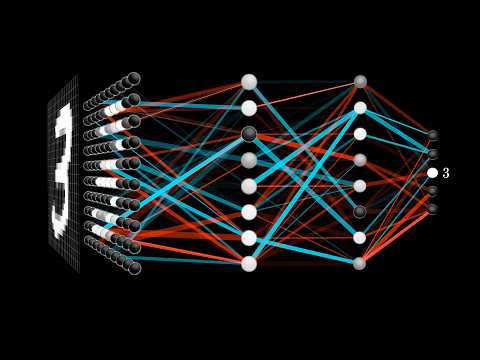
A denoiser is a neural network trained on pictures.
 VideoBut what is a neural network? | Deep learning chapter 1What a neural network is, from the ground up.by Grant Sanderson · 3Blue1Brown
- VideoVariational autoencoders, explainedVariational autoencoders, another way to generate pictures.by Akshay K
Common questions
Is Tesla’s Reality View really drawn by AI?
That is what Elon Musk and Tesla said on X in November 2026: a neural world model, with no game engine, running on half of one of the car’s AI4 chips. It hasn’t been independently verified, and the model hasn’t been published.
How is a world model different from a game engine?
A game engine builds 3D models, lights them and works out every pixel. A diffusion-style world model starts from noise and removes it step by step, guided by what the driving AI understands.
Why does a diffusion model start from noise?
It is trained to undo noise. Starting from pure noise and undoing it step by step turns static into a new picture that fits what the model has learned and what it is told.
Why are fewer steps blurrier?
With few steps the model has to jump to its best guess at once, and its best guess is an average of the pictures that could fit, which is blurry. More steps refine it but take longer.
How many steps does Tesla use?
Tesla hasn’t said. The step counts, timings and frame rates in World Model Lab are illustrative.
Concepts in this guide
Each one has a plain one-line definition in Concepts A–Z, with every model, film and post where it comes up.
Sources and credits
- Elon Musk and Tesla on X (November 2026) The claim that Reality View is generated by a neural world model on half of one AI4 chip, with no game engine. Not independently verified.
- Ho, Jain and Abbeel · Denoising Diffusion Probabilistic Models (2020) The denoising diffusion method.
- Song, Meng and Ermon · Denoising Diffusion Implicit Models (2021) Sampling in fewer, bigger steps.
- Song et al. · Consistency Models (2023) Generating in one or a few steps.
- World Model Lab · model notesThe code-drawn road, the imitation sampler and the illustrative timings.
Every creator named here made the work we link to. Listing it does not imply a partnership or endorsement.