AI · car displays
How does an AI world model draw the road live?
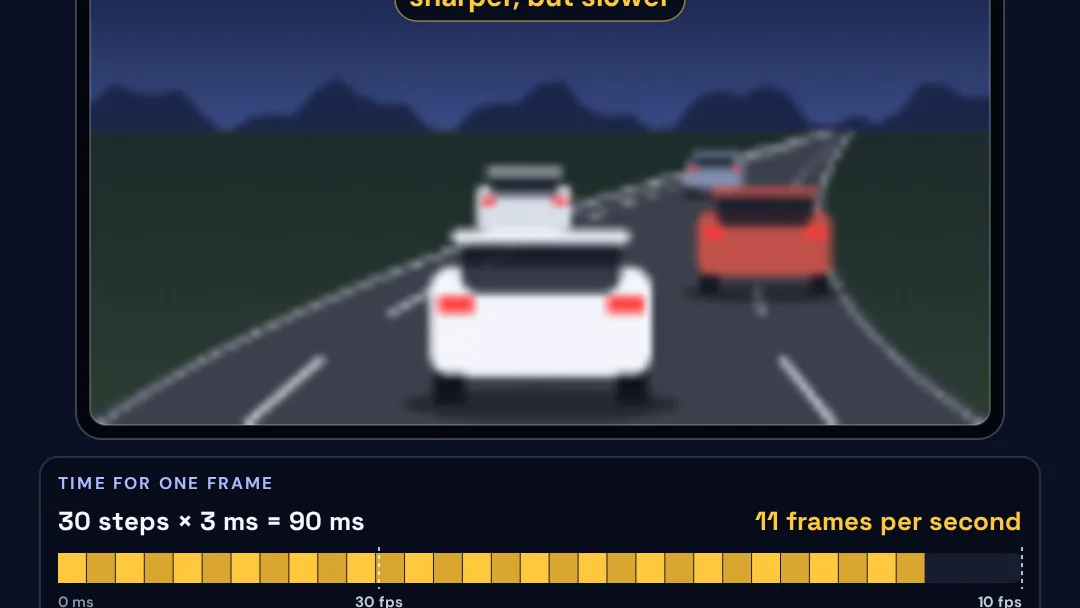
Turn “Denoising steps” to trade sharpness for speed. Turn “Guidance strength” down to see what the car’s view adds. Switch to the front cameras only, or look further ahead, to see what the driving AI can and can’t know. The timings are illustrative.
1 See
Elon Musk says Tesla’s new Reality View isn’t drawn by a game engine but generated live by an AI model. How can a picture come out of noise?
2 Change
3 Understand
Model notes and sources
Where this comes from. In November 2026 Elon Musk and Tesla posted on X that the car’s new Reality View visualization is generated by a neural “world model” running on half of one of the car’s AI4 chips, with “no gaming engine”. That is Musk’s claim; it has not been independently verified, and Tesla has not published how the model works. So this tool doesn’t show Tesla’s model. It shows the general idea behind models of this kind, and the trade-off any of them faces when it has to draw many pictures a second.
Two ways to draw a road. A game engine builds the scene from 3D models (meshes), works out how light falls on them and then rasterises it, deciding the colour of every pixel. A diffusion-style generative model works the other way round: it starts from random noise and removes the noise in a series of steps, each step nudging the picture toward something that fits what it has learned (denoising diffusion, Ho et al. 2020). To draw this road and not just any road, it is guided by a condition, here what the car’s driving AI understands: the lanes, the other cars and the curve ahead.
The trade-off. Each step costs the same amount of computing, so the time for a frame grows with the number of steps. Samplers that take fewer, bigger steps (DDIM, Song et al. 2021) or distilled “consistency” models make generation much faster, but with very few steps the result tends toward a blurry average. Running live means choosing enough steps to look sharp and few enough to keep up, many times a second.
The model. The “true” road is drawn in code at 320 × 180 pixels, and the noise is a fixed Gaussian field. At a fraction u of the way through N steps, the picture is x = α·x̂0 + √(1 − α²)·ε with α = sin(πu/2), where x̂0, the model’s current guess, is the road blurred by a radius that shrinks as the steps go on, down to 9 px ÷ N0.8 at the end. That imitates how a sampler behaves; it does not run one. Guidance blends how much of the condition reaches the picture: without it, the road straightens, the cars disappear and the markings fade. The time per frame is the number of steps times an illustrative time per step (3 ms by default), and “detail” is an illustrative score, exp(−blur ÷ 2.5 px). None of these numbers is Tesla’s: its model size and frame rate are not used.
The top-down map. A driving AI does not see a picture; it builds a map. Eight cameras are fused into one top-down view of what is occupied, what is free and what is still unknown, and every other road user gets a predicted path. Camera directions and ranges come from Tesla’s own Autopilot page (2016–2021, archived): narrow forward camera 250 m, main forward 150 m, wide forward 60 m with a 120° fisheye, forward-looking side cameras 80 m at 90°, rearward-looking side cameras 100 m and the rear camera 50 m. The other angles and the mounting points are our approximations, and nothing is hidden behind anything else here. The 2 m occupancy cells follow the idea Tesla showed at AI Day 2022, and the prediction spread, 0.3 + 0.4τ + 0.15τ² metres after τ seconds, is ours: it only shows that the further ahead you predict, the less sure you can be.
The film. The mechanism is drawn in code by ExplainerTools, with no AI-generated pictures. The Short also uses short real excerpts, picture only, a few seconds each and credited on screen: @BLKMDL3 (X); @congressdj (X). The numbers in the film come from the model, not from the footage.
Sources: Elon Musk and Tesla on X, November 2026 (claim, not independently verified); J. Ho, A. Jain and P. Abbeel, “Denoising Diffusion Probabilistic Models”, NeurIPS 2020; J. Song, C. Meng and S. Ermon, “Denoising Diffusion Implicit Models”, ICLR 2021; Y. Song et al., “Consistency Models”, ICML 2023; J. Ho and T. Salimans, “Classifier-Free Diffusion Guidance” (2022); Tesla, Autopilot hardware page (archived May 2020); Tesla, AI Day 2022.
An ExplainerTools Original. Prompted by Elon Musk’s posts on X about Tesla’s Reality View; the model shown is ours, not Tesla’s. Footage: @BLKMDL3; @congressdj.