Topic guide · Crypto security
How were $6 billion stolen from Binance with genuine signatures?
By asking the key to sign, not by stealing it. An exchange’s hot wallet keeps its key inside a signing service that signs whatever well-formed request it is handed. In its November 3 findings, Binance says attackers worked their way from engineers’ computers to that service and started transactions outside the normal withdrawal process, so they got genuine signatures. About $6.34 billion left between 20:05 and 23:56 UTC on October 29, and Binance says it found no evidence a private key leaked. A signature proves a key said yes. It can’t prove anyone meant it. In Signed, Not Meant, one check at the signer (no matching customer withdrawal, no signature) turns the same attack from the whole hot wallet to $0.
- Impacted (Binance)
- ≈ $6.34B
- Drain, Oct 29 (UTC)
- 20:05–23:56
- Frozen or intercepted
- ≈ $2.85B
- With a check at the signer
- $0 out
Model · simplified signer, not a replay The first three rows are Binance’s November 3 figures (Elliptic counts $6.43B; TRM Labs, 10 chains). The last is the toy exchange in the tool: the same attack, with a signer that refuses requests no customer made.
Interactive · ExplainerTools
Signed, Not Meant
Change how much money sits in the hot wallet, what the signer checks before it signs, and how far the attacker got. Watch the attacker’s requests get signed, capped or bounced, and how much could leave in four hours.
Model · simplified signer, not a replay
How does a hot wallet sign a withdrawal?
In three steps, and the key never leaves the box.
- Ask
A customer asks to withdraw. The exchange’s normal process checks the request: risk checks, limits, the account’s balance.
- Sign
The request reaches a signing service that holds the hot wallet’s key. It signs. Binance’s hot wallet used MPC, a key split into shares that sign together, but the idea is the same: the service produces the signature.
- Send
The signed transaction goes to the blockchain, and the coins leave in minutes. That speed is why exchanges keep some money hot. Most of it sits in cold storage, offline, where moving it is slow on purpose.
A digital signature is mathematical proof that whoever controls a key approved a transaction. It says nothing about who asked. Hand the signing service a well-formed request from somewhere else and it signs that too, with exactly the same signature. A key is only as safe as whatever can ask it to sign.
How much left, how fast, and how much came back?
Binance puts the impact at about $6.34 billion; Elliptic counts $6.43 billion and TRM Labs $6.36 billion across 10 chains. The drain ran from about 20:05 to 23:56 UTC on October 29, under four hours, and most of it left in the first half hour, by the reported times.
Three words get mixed up afterwards. Frozen: about $2.85 billion was frozen or intercepted, Elliptic says, mostly stablecoins whose issuers can block an address. Freezing stops coins moving; it doesn’t send them back, and Circle says it cannot reverse a completed USDC transfer. About $0.79 billion of the stolen stablecoins was swapped before the freezes landed. Covered: Binance says it is absorbing the loss from its own funds and had replenished about 98% of impacted assets. Recovered: that would mean stolen coins coming back, and covering is not that.
What does Binance say happened?
No single click, but a chain of footholds. In its November 3 findings, Binance says one engineer’s computer picked up a tampered Homebrew download in June, and another engineer was targeted with a fake job interview in September. On October 20, Binance says, an internal AI tool was used to take over other engineers’ computers. The attackers then took a container-deployment token and deployed a container that reached the internal wallet-signing service.
From there, Binance says, transactions were started through the signing service outside the normal withdrawal process, so the checks on that road never saw them. On Ethereum, the roughly 50 signed requests were EIP-7702 delegations that handed hot-wallet accounts to an attacker-controlled contract, which swept them. Binance says it found no evidence that private keys leaked.
The FBI, the Secret Service and IRS-CI attribute the theft to North Korea’s TraderTraitor group; North Korea denies it. Binance resumed withdrawals in phases from November 1.
Try it: add the check
- 1 See
Open Signed, Not Meant and tap Binance, Oct 29 (simplified). The attacker can reach the signer and there is no check there: Attacker’s requests reads signed, and Could leave in 4 hours reads $6.34B, the whole hot wallet.
- 2 Change
Tap Same attack, check at the signer. The signer now asks for a matching customer withdrawal, and the attacker’s requests have none. Attacker’s requests reads bounced, and Could leave in 4 hours $0.
- 3 Understand
Tap Attacker forges records too: the match passes, and only amount limits slow it, $1.00B in four hours. A person approves big ones cuts that to a trickle, $240M. Then tap Keep less money hot: with no check the loss stops at the $500M in the hot wallet, but Customer withdrawals reads hours on busy days.
Where does this model stop?
Signed, Not Meant is a toy exchange with one hot wallet and three dials. The attacker’s rates, the amount limits and the four-hour stop are illustrative; only the Binance figures are sourced. Real exchanges run many hot wallets and layered controls: risk engines, rate limits, multi-party approval and monitoring.
The fix in the film, a check where the key lives that each request matches a real withdrawal, is our model of a common defence. It is not a claim about what Binance’s signer did or didn’t check; Binance has not published that. An attacker who controls both the records and the approvals beats any check that trusts them, and limits only slow a drain.
Everything on the stage is drawn in code; the request amounts and addresses are made up. The film uses 3.5 seconds of Binance co-CEO Richard Teng’s own October 30 update, credited on screen.
Explore by question
A signature, the key behind it and the thing that asks for it. Each card answers one part of the question.
Signed, Not Meant
Model · simplified signer, not a replay
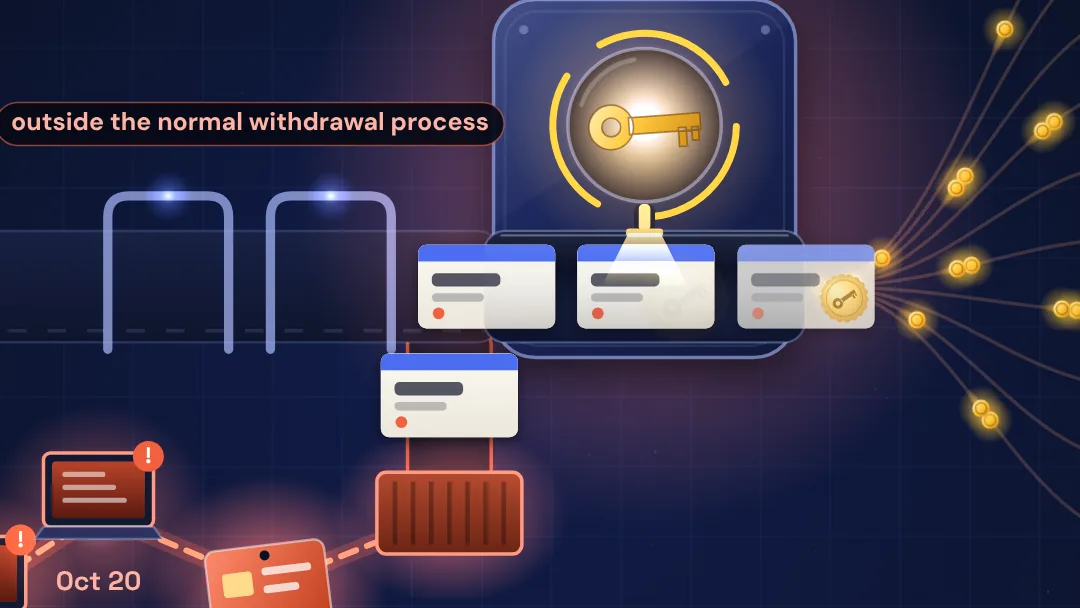 Interactive · Signed, Not MeantHow did hackers drain Binance without the key?Add a check at a toy exchange’s signer, change how far the attacker got, and watch its requests get signed, capped or bounced.
- Short · 49 secondsHow did hackers drain Binance without the key?Identical signatures, the route Binance describes and the check that bounces requests nobody meant. Narrated and captioned.
- JournalHow did hackers drain Binance without the key?Binance says attackers moved about $6.34 billion out of its hot wallets without a leaked key. A signature proves a key said yes, not that anyone meant it.
What a signature is made of
A crypto signature is math on a hash of the transaction. These two show the pieces: the hash, and the elliptic-curve math Bitcoin signs with.
- Interactive demoTHE CONSTRUCT — Bitcoin vs. The Quantum MachineZoom down into the elliptic-curve math behind Bitcoin’s keys and signatures.by Brad Mills · Best on a larger screen
Where a key comes from
A private key is just a very large random number. Whoever holds it, or can ask it to sign, controls the coins.
 Interactive demoSeedSigner Dice → Seed Phrase WalkthroughStep through how an offline signing device turns dice rolls into a seed phrase.by Doug Devine
Common questions
Was Binance’s private key stolen?
Binance says it found no evidence that private keys leaked. The attackers reached the internal service that signs with the key and had it sign their requests. The signatures were genuine; the requests were not ones any customer made.
What is a hot wallet?
The part of an exchange’s money kept online, so withdrawals can be signed and sent in minutes. Most of an exchange’s coins sit in cold storage, offline, where moving them is slow on purpose. Only what is in the hot wallets can be drained this way.
If the signature was genuine, why wasn’t the withdrawal valid?
It was valid as far as the blockchain can tell. A signature proves the key approved a transaction, not that a person meant it. Whether a withdrawal was authorized is a question for the exchange’s own records, which these requests went around.
What is an EIP-7702 delegation?
An Ethereum feature that lets an ordinary account hand control of its actions to a smart contract. On Ethereum, the roughly 50 requests the attackers got signed were delegations to their own contract, which then swept the accounts. The feature worked as designed; it was signed for the wrong party.
Did anyone get the money back?
About $2.85 billion was frozen or intercepted, which stops it moving but doesn’t return it. Binance says it is covering customers from its own funds and had replenished about 98% of impacted assets. That is Binance paying, not the stolen coins coming back.
Sources and credits
- Binance · 29 October 2026 Security Incident: Initial Findings and Response Update (November 3, 2026) The route through engineers’ computers, a container-deployment token and the wallet-signing service; transactions started outside the normal withdrawal process; about $6.34B impacted; no evidence that keys leaked.
- StepSecurity · The Binance hack and developer machine security Binance’s account of the internal AI tool used to take over engineers’ computers, and the 50 signing transactions with malicious delegations.
- Bitbo · Elliptic report: 44% of $6.43B Binance hack loot now frozen Elliptic’s count: $6.43B taken, $2.85B frozen or seized, $3.46B in stablecoins, about $786M converted before freezes landed.
- SOCRadar · Binance hack: $6.3B hot wallet theft The timeline: first transfers at 20:05 UTC, the Ethereum sweep at 20:20–20:24, a second wave until 23:56; withdrawals resumed in phases from November 1.
- Circle · Stablecoin blocklisting process Circle can block an address from moving USDC but cannot reverse or recall a completed transfer.
- Signed, Not Meant · model notesThe three dials, the illustrative rates and four-hour stop, the stablecoin share and what the model leaves out.
Every creator named here made the work we link to. Listing it does not imply a partnership or endorsement.