Topic guide · Touch and atoms
Do your fingers ever really touch?
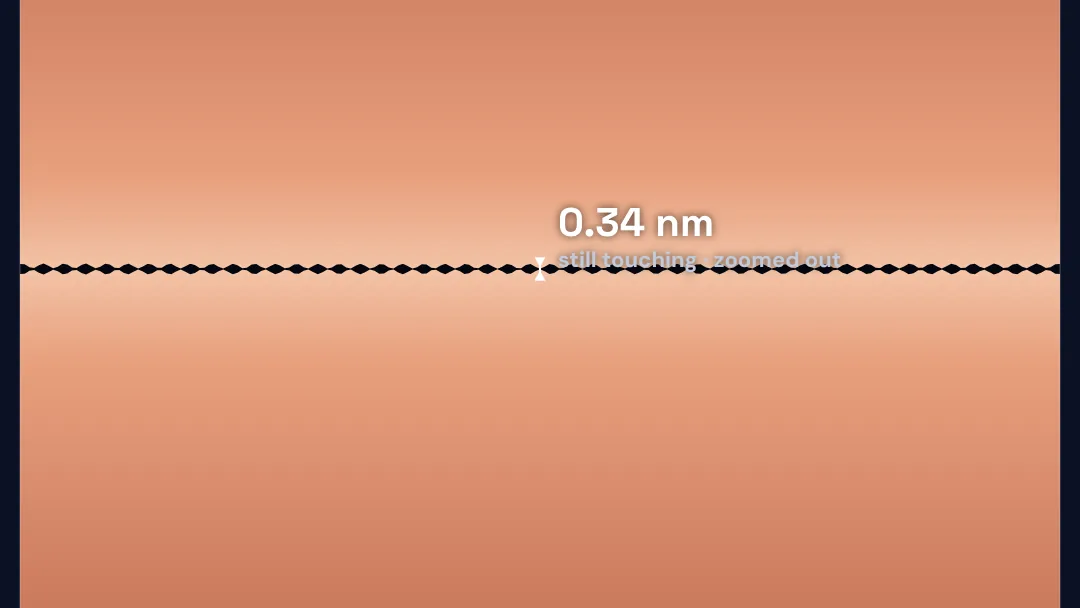
They do touch, in the only sense the word has for atoms. Zoom into the gap between two fingertips and you can halve it again and again: fingerprint ridges, skin cells, keratin fibres, atoms. Halving forever is Zeno’s paradox, and it cannot keep anything apart, because ½ + ¼ + ⅛ + … adds up to exactly 1. What stops the gap is the atoms’ electron clouds: when two start to overlap they repel steeply, so the surfaces come to rest about 0.3 nm apart, about 26 halvings below 2.28 cm. That push-back is what touching is. In Touch Lab you can zoom in yourself.
- Gap after 26 halvings of 2.28 cm
- ≈ 0.34 nm
- Two carbon atoms in contact
- ≈ 0.34 nm apart
- ½ + ¼ + ⅛ + …
- = 1
- 20× the push (illustrative)
- 0.34 → 0.27 nm
Model · typical sizes Contact distances are the sums of van der Waals radii (Bondi 1964): 1.70 Å for carbon, 1.20 Å for hydrogen. The push-back figure uses an illustrative 1/r¹³ repulsion, not a measurement of skin.
Interactive · ExplainerTools
Touch Lab
Turn “Zoom in” to halve the gap between two fingertips, or pick a scale. At the atoms, turn “Press harder” and watch the gap barely move.
Model · schematic sizes, illustrative repulsion
What do you see if you zoom into the gap?
Start with two fingertips 2.28 cm apart and halve the gap each step, zooming in 2× so it always looks the same size:
- ≈ 6 halvings · 0.36 mm
The round fingertips have flattened into fingerprint ridges, about 0.45 mm apart.
- ≈ 12 halvings · 5.6 µm
The ridges have flattened into dead skin cells: flat plates about 35 µm across and half a micrometre thick.
- ≈ 20 halvings · 22 nm
Inside those cells, the stuff of skin: fibres of the protein keratin, about 10 nm thick.
- ≈ 24–26 halvings · 1.4–0.34 nm
Single atoms, then their electron clouds. Here the gap stops shrinking.
That is the zoom in An Xuan’s viral 3D film, which ends: “The gap never closes. Electrons push back.” It joins two separate ideas, as the community note on the post says. Pull them apart and both become clear.
Does Zeno’s paradox mean they can never meet?
No. Zeno of Elea argued that to cross a gap you must first cross half of it, then half of the rest, forever, so you never arrive. But the halves form an infinite series that adds up: ½ + ¼ + ⅛ + … = 1 exactly. Moving at a steady speed, each half also takes half as long, so infinitely many steps take a finite total time: the gap divided by the speed. Halving is a way of describing a closing gap; it never stops one. The Stanford Encyclopedia of Philosophy covers the history and the modern answers.
What stops the gap at a third of a nanometre?
Electrons. An atom is a tiny nucleus inside a cloud of electrons, and when the clouds of two atoms start to overlap they repel very steeply. Part of that is ordinary electrical repulsion; most of it comes from the Pauli exclusion principle, which forbids two electrons from sharing the same state, so overlapping clouds have to squeeze into higher-energy states. Surfaces in contact therefore rest with their outermost atoms about the sum of their van der Waals radii apart: about 0.34 nm for two carbon atoms and 0.24 nm for two hydrogen atoms (Bondi, 1964). Push harder and the gap shrinks only a little, because the repulsion climbs so fast.
So do your fingers touch or not?
They touch. “Touching” at the scale of atoms just means electron clouds close enough to push on each other; there is no hard edge to an atom for anything to meet at zero distance. It is the same push that stops your hand going through a table and lets you feel texture at all. Real fingertips also touch less than it looks: rough at every scale, they meet only at the tops of ridges and cells, so the true area in contact is a small fraction of what you see.
Try it: zoom in yourself
- 1 See
Open Touch Lab: two fingertips, 2.28 cm apart.
- 2 Change
Turn Zoom in, or press Fingerprint ridges, Skin cells, Atoms. The bar underneath fills with halves: ½, ¼, ⅛ … and never passes 100%.
- 3 Understand
At Electron clouds the gap stops at 0.34 nm. Turn Press harder to 20×: it only reaches about 0.27 nm.
Where can I see more?
An Xuan’s 3D film on X is the zoom that started this. For a longer look at the physics, Veritasium’s “Can We Really Touch Anything?” works through the forces between atoms, and StarTalk’s “Does Anything Ever Touch?” takes the question on in conversation.
Where does this model stop?
Touch Lab’s surfaces are schematic, built from typical sizes, not a scan of one finger. The gap halves from 2.28 cm (the film’s starting gap) until it reaches 0.34 nm, the contact distance of two carbon atoms. Real skin carries water, oils and many kinds of molecule, so the actual spacing varies. The “Press harder” curve is an illustrative 1/r¹³ repulsion, the steepness of the Lennard-Jones model’s repulsive term, not a measured force for skin.
Explore by question
Halves, atoms and scale. Each card answers one part of the question.
Touch Lab
Model · schematic sizes, illustrative repulsion
 Interactive · Touch LabDo your fingers ever really touch?Halve the gap between two fingertips 26 times, then press harder at the atoms.
- Short · 57 secondsDo your fingers ever really touch?The viral zoom, Zeno’s halves adding up to one and the electron clouds pushing back. Narrated and captioned.
- JournalDo your fingers ever really touch?A viral film halves the gap between two fingertips 26 times. Halving can’t stop anything, but electron clouds can, at about a third of a nanometre.
Inside the atom
The push-back comes from the electrons around every nucleus.
- Interactive demoBuild an AtomBuild an atom from protons, neutrons and electrons, and see its electron shells.by PhET Interactive Simulations
Doubling and halving
The same powers of two that shrink the gap make a folded sheet thick fast.
 Interactive · Fold LabWhy is paper so hard to fold more than seven times?Why is paper so hard to fold more than seven times? Doubling, in your hands.
Zooming through scales
Another zoom from the everyday to the atomic.
- VideoZooming Into a CPUZoom into a computer chip from the package down to single transistors.by Branch Education
Common questions
Do your fingers ever really touch?
Yes, in the only sense touching has for atoms: the electron clouds of their outermost atoms get close enough to push on each other, about 0.3 nm apart. Nothing ever reaches zero distance, because atoms have no hard edge.
Does Zeno’s paradox prove things never touch?
No. Halving a gap forever describes it closing; it doesn’t stop it. The halves add up to the whole gap (½ + ¼ + ⅛ + … = 1), and at a steady speed they take a finite total time.
Why don’t atoms pass through each other?
Their electron clouds repel steeply when they overlap, mostly because of the Pauli exclusion principle, which forbids two electrons from sharing the same state, plus ordinary electrical repulsion.
How close do atoms get when two things touch?
About the sum of their van der Waals radii: roughly 0.34 nm for two carbon atoms and 0.24 nm for two hydrogen atoms. Pressing harder squeezes them only slightly closer.
How many times can you halve the gap between two fingers?
Starting from 2.28 cm, about 26 times before you reach atomic contact, about a third of a nanometre. That is the end of An Xuan’s viral zoom.
Concepts in this guide
Each one has a plain one-line definition in Concepts A–Z, with every model, film and post where it comes up.
Sources and credits
- N. Huggett · Zeno’s Paradoxes (Stanford Encyclopedia of Philosophy) The dichotomy paradox and the modern answer through convergent series.
- A. Bondi · van der Waals Volumes and Radii (J. Phys. Chem., 1964) Van der Waals radii: carbon 1.70 Å, hydrogen 1.20 Å, oxygen 1.52 Å.
- Wikipedia · Pauli exclusion principle Why overlapping electron clouds repel.
- An Xuan · the 3D film on X The viral zoom (November 10, 2026) and the community note on it.
- Veritasium · Can We Really Touch Anything? A longer video on the forces between atoms.
- Touch Lab · model notesThe sizes, the contact distance and the illustrative repulsion.
Every creator named here made the work we link to. Listing it does not imply a partnership or endorsement.