Topic guide · Sky and light
Why can the Hunter’s Moon look orange as it rises?
Because you see it through more air. Near the horizon, moonlight crosses a far longer path through the atmosphere than when the Moon is high. Air scatters short, bluer wavelengths out of that beam, so the light that reaches you looks warmer. Dust, smoke or haze can deepen the color. The Moon itself does not change. A Hunter’s Moon is a full Moon named by tradition, and it looks paler as it climbs.
- Color
- A longer path through air
- Phase
- Full means opposite the Sun
- Name
- A seasonal tradition
- 1High Moon: its light crosses a thin slice of air.
- 2Low Moon: the path runs sideways through far more air, and blue is scattered out.
Model · not to scale
Why does a low Moon look warmer?
Moonlight is sunlight reflected by gray lunar rock, so it carries every color. On its way to you, it meets air molecules. They scatter short wavelengths, like blue, far more than long ones, like red.
When the Moon is high, its light crosses a thin slice of atmosphere, and plenty of blue gets through. Near the horizon, the path runs almost sideways through the air. By the air-mass formula Sunset Lab uses, it is up to about 38 times longer. Much of the blue is scattered away. What is left looks yellow, orange or red.
NASA explains the longer path near the horizon, and dust or smoke can deepen the effect. Photographs by Emma Pezzi on USRA’s Earth Science Picture of the Day show it well: the same Moon, in different colors at different heights.
Try it: drag the light to the horizon
We have no Moon color model, but Sunset Lab shows the same scattering with the Sun. Sunlight and moonlight lose their blue the same way.
- 1 See
Tap Noon · 60°. Most of every color gets through, so the light stays nearly white.
- 2 Change
Now tap Sunset · 0°. The air crossed jumps to about 31 times the overhead path.
- 3 Understand
Almost none of the blue is left, while about a tenth of the red still arrives. Picture that beam as moonlight.
Sunset Lab models clean air, so its colors are illustrative, not a forecast. On a clear evening near full Moon, compare the Moon at moonrise with an hour or two later.
Why is a full Moon low at dusk?
A full Moon sits opposite the Sun in our sky. So as the Sun sets in the west, the full Moon rises in the east. It is near the horizon in the evening, when many people look up and its light crosses the most air.
Moon Phase Lab shows the geometry. Sunlight always lights half the Moon, and a full Moon is when that half faces us. It answers why the Moon is full, not why it looks orange. NASA’s phase guide covers the same idea.
What makes it the Hunter’s Moon?
The name comes from the calendar, not from optics. In the Northern Hemisphere tradition, the Harvest Moon is the full Moon closest to the September equinox. The Hunter’s Moon is the full Moon after it. Nothing about its light is special. Any full Moon can look orange near the horizon, and a high Hunter’s Moon looks as pale as any other.
Is an orange Moon an eclipse?
No. Phases come from viewing angle, not Earth’s shadow. A lunar eclipse happens only when a full Moon also passes through Earth’s shadow, which its tilted orbit usually avoids. Then the only sunlight reaching the Moon has crossed Earth’s atmosphere. That light has lost much of its blue on the way, so the Moon can glow coppery red. NASA’s eclipse guide explains the geometry.
Explore by question
Two models answer the two halves of this question. Neither is a Moon color film, and each card says what it covers.
The color: the same scattering, shown with the Sun
Our sunset model and Short show the mechanism that warms a rising Moon, with the Sun as the light source.
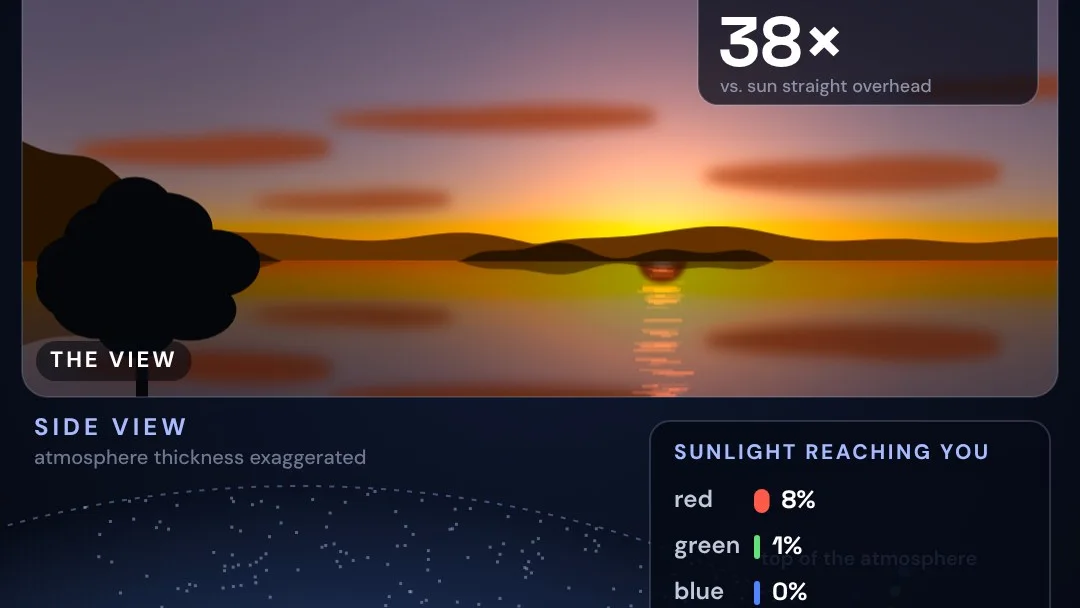 Interactive · Sunset LabWhy is the sky blue but sunsets red?Drag the Sun to the horizon and watch the blue scatter out of the beam.
- Short about sunsets · related mechanismWhy is the sky blue but sunsets red?The same scattering in 30 seconds. It is about the Sun, not a Moon film.
- JournalWhy is the sky blue but sunsets red?Air scatters blue light nearly six times more than red. Drag the sun to the horizon, then make a small sunset with a flashlight and a glass of milky water.
The phase: why it is full
A different question with its own model: why the Moon changes shape over about 29.5 days.
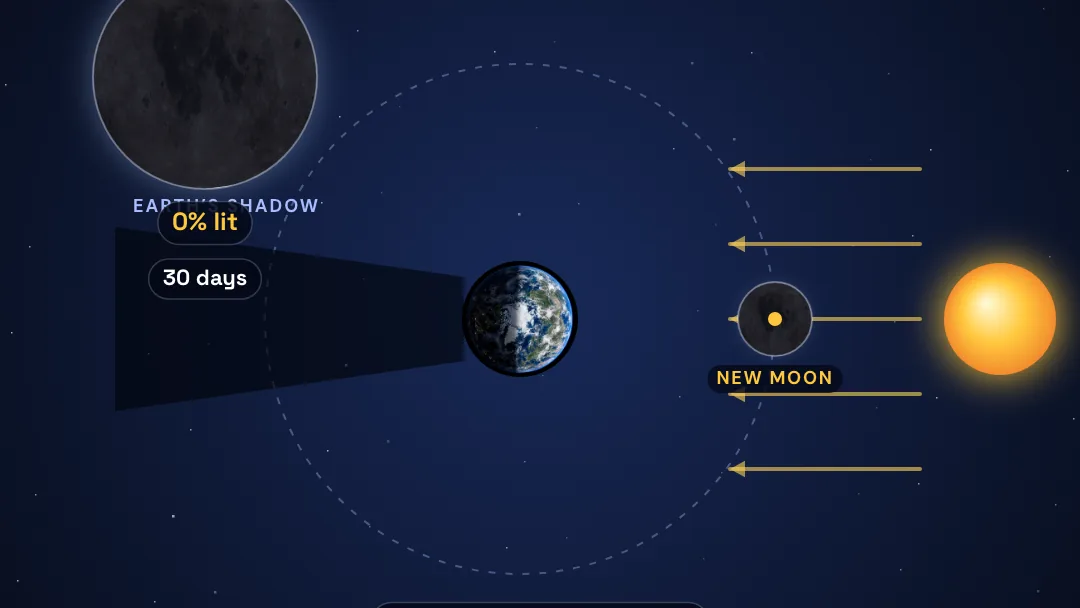 Interactive · Moon Phase LabWhy does the Moon change shape?Move the Moon around Earth and watch the lit fraction change.
- Short · a different questionWhy does the Moon change shape?Why the Moon changes shape, in 35 seconds. It does not cover color.
- JournalWhy does the Moon change shape?The Moon does not change shape. Sunlight always lights half of it; what changes is how much of that bright half faces Earth.
Go deeper
A long illustrated essay that ties the Moon’s motions together.
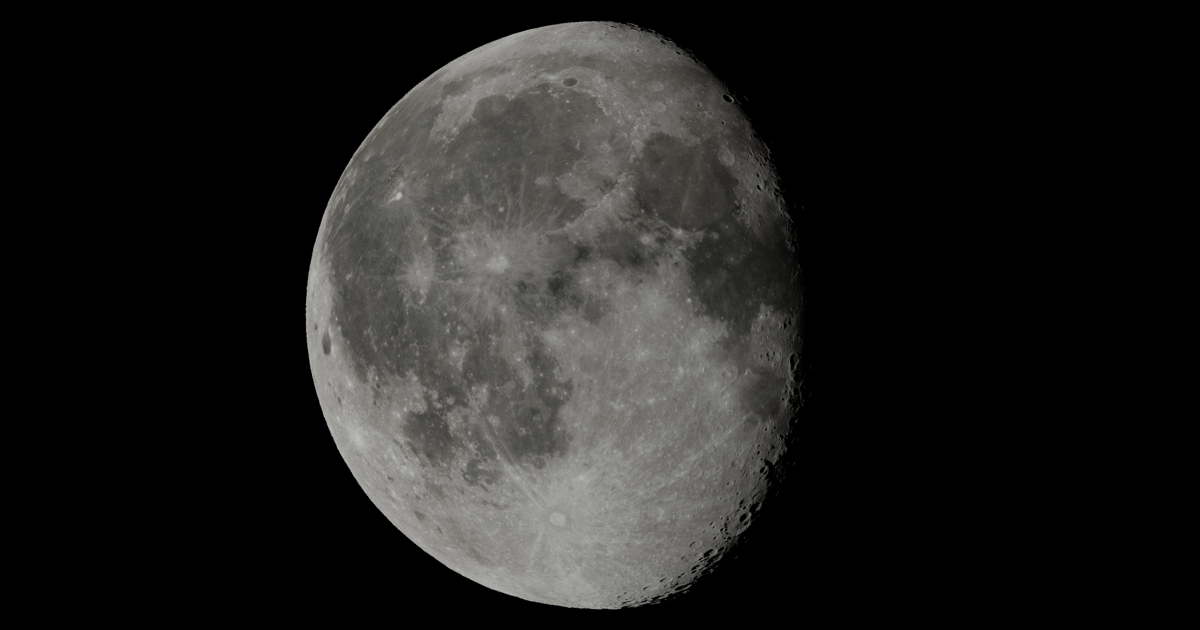 Interactive articleMoonMove bodies and scrub through time to connect phases, orbits, tides and eclipses.by Bartosz Ciechanowski
Common questions
Is the Moon bigger near the horizon?
No. Its size in the sky barely changes as it rises. The bigger look is the Moon illusion, a trick of perception that NASA treats separately from the color.
Does an orange Moon mean smoke in the air?
Not by itself. A long path through clean air already warms the color. Smoke, dust and haze can deepen it.
When exactly is the Moon full?
Full phase is one instant, the same worldwide, usually given in UTC. Moonrise is local and depends on where you are. NAOJ’s ephemeris lists October 2026’s full phase at 04:12 UTC on October 26.
Is an orange moonrise guaranteed?
No. Weather, haze and your horizon decide what you see. A low full Moon often looks warmer than a high one, but no date can promise a color.
Sources and credits
- NASA · The Moon illusion: why does the Moon look so big sometimes? The longer path through air near the horizon; the size illusion is a separate effect.
- USRA Earth Science Picture of the Day · Colors of the Moon, photographs by Emma Pezzi The same Moon photographed in different colors as its height and the air change.
- NASA · Moon phases Sunlight lights half the Moon; the phase depends on how much of that half faces us.
- NASA · Eclipses and the Moon Why a lunar eclipse needs Earth’s shadow, and why it is not monthly.
- NASA · Watch the Skies, October 2026 October 2026 skywatching: the full Moon date and the Hunter’s Moon name.
- National Astronomical Observatory of Japan · Phases of the Moon Full phase at 13:12 Japan time (UTC+9) on October 26, 2026, which is 04:12 UTC.
Every creator named here made the work we link to. Listing it does not imply a partnership or endorsement.