Topic guide · Smart TV fingerprinting
How does a smart TV know what you’re watching?
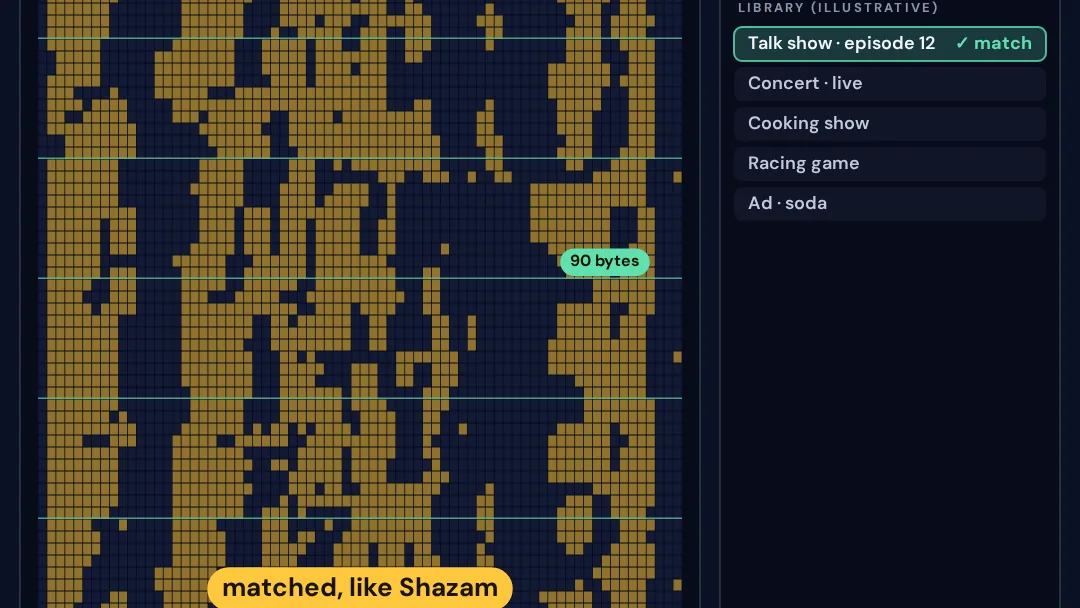
It fingerprints its own sound. In the TV gwerneckp took apart (a Hisense sold in the UK), a background service copies the decoded sound the TV is about to play, from every input including HDMI, not the microphone. About every 0.26 s it takes the last 1.024 s and measures 72 frequency bands from about 100 Hz to 3 kHz; each band becomes one bit, louder than the bands below it, or not. Every 10 rows, 90 bytes go to an ad company that matches them against a library, much as Shazam does. On that TV, switching off personalised ads left ACR on. In TV Fingerprint Lab you can play a show and watch it happen.
- Analysis window
- 1.024 s, every ≈ 0.26 s
- Frequency bands
- 72, ≈ 100 Hz – 3 kHz
- Bits per row
- 72 (9 bytes)
- Each upload
- 10 rows = 90 bytes, ≈ every 2.7 s
One TV · reported Figures from gwerneckp’s teardown of a Hisense 55U65QEVS on VIDAA firmware U09.60 (UK), checked 21 to 23 November 2026. Other models, firmware and regions may differ.
Interactive · ExplainerTools
TV Fingerprint Lab
Turn “Play the show” and watch the TV’s sound become rows of 72 bits, 90 bytes at a time. Then switch personalised ads or ACR off to see which one stops the uploads.
Model · synthetic sound, one TV’s reported behaviour
Does the TV listen through its microphone?
Not on the TV in the teardown. Its fingerprinter copies the decoded sound the TV is about to send to its speakers. That means it hears every input the same way: TV channels, streaming apps, and anything plugged into HDMI, a game console included. The service, HamService, runs an automatic content recognition (ACR) kit from the ad company Nexxen. gwerneckp’s README on GitHub documents what it does and how he decrypted its traffic.
How does a second of sound become 72 bits?
The recipe keeps only comparisons, not loudness:
- Every ≈ 0.26 s
Take the last 1.024 s of the TV’s sound.
- 72 bands
Measure how loud it is in 72 frequency bands between about 100 Hz and 3 kHz, where voices and melodies live.
- 1 bit per band
Write 1 if the band is louder than the running average of the bands below it, 0 if not.
- One row
72 bits, 9 bytes, describe that moment. Rows stack up into a fingerprint.
Because each band is compared with its neighbours, turning the volume down doesn’t change the bits; changing the sound does.
What does the TV send, and how often?
About every 2.7 seconds it uploads 10 rows, 90 bytes, with a device ID, the app, the input and the time. The ad company matches the fingerprints against its library, and in the teardown match replies came back about every 12 seconds. Nothing was sent while the sound was silent. The matching is like Shazam’s in outline, a short fingerprint looked up in a library, though Shazam builds its fingerprint from pairs of spectrogram peaks instead.
Does turning off personalised ads stop it?
Not on this TV. With personalised ads off, the setting for ACR stayed on, and the fingerprints kept going: they are separate switches. Turning off ads targeted at you is not the same as turning off the feature that recognises what you watch. These findings are for one model and firmware (Hisense 55U65QEVS, VIDAA U09.60, UK); other TVs, brands and regions may name and wire their settings differently.
Try it: play a show yourself
- 1 See
Open TV Fingerprint Lab: the TV’s sound, its 72 bands and an empty fingerprint.
- 2 Change
Turn Play the show. Rows of bits stack up and every 10 rows, 90 bytes fly to the ad company. Try Concert (music) or Silence.
- 3 Understand
Press Personalised ads off: the uploads carry on. Press ACR switch off: in the model, they stop.
Where does this model stop?
TV Fingerprint Lab plays no real audio: its talk show and concert are synthetic sound made in code. Its bands are spaced evenly on a log scale, and it reads “running average of the bands below” as an exponential average, because the kit’s exact averaging isn’t published. The server’s library is invented, its silence threshold is illustrative, and it assumes the ACR switch stops the uploads; the teardown’s finding is only that the ads switch did not. Everything else follows gwerneckp’s notes on one TV.
Explore by question
Sound, frequencies and lookups. Each card answers one part of the question.
TV Fingerprint Lab
Model · synthetic sound, one TV’s reported behaviour
 Interactive · TV Fingerprint LabHow does a smart TV know what you’re watching?Play a show and watch its sound become 72-bit rows, 90 bytes at a time.
- Short · 45 secondsHow does a smart TV know what you’re watching?The teardown, the tap on the TV’s sound, the bits and the switch that didn’t stop it. Narrated and captioned.
- JournalHow does a smart TV know what you’re watching?One owner’s teardown shows a smart TV turning its own sound into 72-bit fingerprints every quarter second and sending them to an ad company.
Looking sound up
Shazam uses the same summarise-then-look-up idea with a different fingerprint.
- VideoHow Shazam WorksHow Shazam turns a few seconds of a song into a fingerprint it can find.by Tibo Maker
Frequencies in a sound
The 72 bands are a coarse spectrum: how loud each pitch range is.
 Interactive articleCircles Sines and SignalsAn interactive introduction to signals, sine waves and the Fourier transform.by Jack Schaedler · Best on a larger screen
Common questions
Does my smart TV listen through its microphone?
On the TV in gwerneckp’s teardown, the ACR fingerprinter did not use the microphone. It copied the decoded sound the TV was about to play, which covers every input, HDMI included.
What does the TV actually send?
About every 2.7 seconds, 10 rows of 72 bits (90 bytes), with a device ID, the app, the input and the time, to an ad company that matches them against a library.
Does turning off personalised ads stop ACR?
Not on the TV in the teardown: with personalised ads off, ACR stayed on. They are separate settings.
Is it like Shazam?
In outline: both turn a few seconds of sound into a compact fingerprint and look it up in a library. Shazam’s fingerprint uses pairs of spectrogram peaks; this TV’s uses one bit per frequency band.
Does this apply to every smart TV?
No one can say from one teardown. The findings are for a Hisense 55U65QEVS on VIDAA firmware U09.60 bought in the UK; other models, firmware and regions may differ.
Concepts in this guide
Each one has a plain one-line definition in Concepts A–Z, with every model, film and post where it comes up.
Sources and credits
- gwerneckp · vidaa-tv-spyware (GitHub) The teardown: HamService, the Nexxen ACR kit, the fingerprint recipe, upload timing and the two settings. Checked 21 to 23 November 2026.
- A. Wang · An Industrial-Strength Audio Search Algorithm (ISMIR 2003) How Shazam fingerprints and looks up audio.
- Wikipedia · Automatic content recognition What ACR is and where it is used.
- TV Fingerprint Lab · model notesThe synthetic sound, the bands, the running average and what the model assumes.
Every creator named here made the work we link to. Listing it does not imply a partnership or endorsement.