Technology · privacy
How does a smart TV know what you’re watching?
Turn “Play the show” to let the TV fingerprint it, or click the timeline to jump. Pick speech, music or silence, watch the match scores, and switch personalised ads or ACR off to see which one stops the uploads.
1 See
One owner decrypted his smart TV’s traffic and found it sending a fingerprint of everything it played. How do you turn sound into a fingerprint?
2 Change
3 Understand
Model notes and sources
Where this comes from. In November 2026 gwerneckp (gwerneckp on GitHub) published a teardown of his own smart TV, a Hisense 55U65QEVS bought in the UK, running VIDAA firmware U09.60. He decrypted its traffic and documented a background service, HamService, that runs an automatic content recognition (ACR) kit from the ad company Nexxen. Everything this tool shows about the fingerprint comes from his README and notes (checked 21 to 23 November 2026). They describe one model on one firmware; other TVs, firmware versions and regions may behave differently.
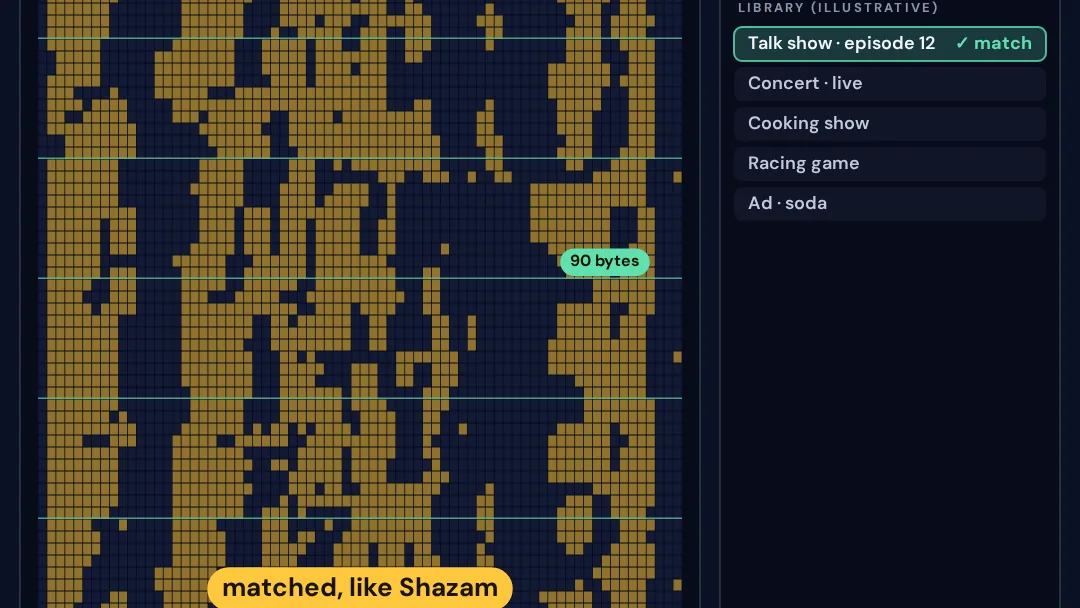
The idea. The fingerprinter doesn’t listen through the microphone. It copies the decoded sound the TV is about to play, so it covers every input: TV channels, apps and anything on HDMI, a game console included. About every 0.26 s it takes the last 1.024 s of sound and measures it in 72 frequency bands between roughly 100 Hz and 3 kHz. Each band gives one bit: 1 if it is louder than the running average of the bands below it, 0 if not. That makes a row of 72 bits, 9 bytes. About every 2.7 s the TV uploads 10 rows, 90 bytes, together with a device ID, the app, the input and the time. Match replies came back about every 12 s, and nothing was sent while the sound was silent. With personalised ads switched off, ACR stayed on: they are separate settings.
Like Shazam? Only in outline. Shazam also turns a few seconds of sound into a compact fingerprint and looks it up in a library, but it uses pairs of peaks in the spectrogram (Wang, 2003), not band-by-band comparisons. Both work because a fingerprint of a few seconds is almost unique to one recording.
The model. Nothing is recorded or played: the “show” is synthetic sound made in code, a speech-like voice (a pitch, vowel resonances and pauses) or music-like chords, melody, bass and hi-hat. The 72 bands are spaced evenly on a log scale from 100 Hz to 3 kHz. Each window is the average of 32 spectra taken 32 ms apart. We read “running average of the bands below” as the mean level, in decibels, of all the bands below; the kit’s exact averaging isn’t published, and band 1, with nothing below it, is set to 0. Because each band is compared with the others, the bits don’t change when the sound gets quieter, until it falls below an illustrative silence threshold (−26 dB), where no row is made. Rows come every 0.26 s and an upload goes every 10 rows. The server’s library is invented: its other entries are the same kinds of synthetic sound taken from other moments. It scores each entry by the share of bits that agree with the last ~12 s of rows it holds, compared at the right offset (a real server also has to search for the offset), and answers once it holds about 12 s. Counting agreeing bits is the usual way to compare binary fingerprints (Haitsma and Kalker, 2002); our 85% match line is illustrative, since the kit’s threshold isn’t published. In this model the right show agrees on every bit, another talk show on about two bits in three and unrelated sound on about half, which is what chance gives. That the ACR switch stops the uploads is the model’s assumption; the teardown’s finding is that the ads switch did not.
The film. The mechanism is drawn in code by ExplainerTools, with no AI-generated pictures. The Short also uses short real excerpts, picture only, a few seconds each and credited on screen: @neeazzy (TikTok); u/gwerneckpaiva (Reddit), gwerneckp (GitHub). The numbers in the film come from the model, not from the footage.
Sources: gwerneckp, vidaa-tv-spyware (README and notes, GitHub, November 2026); A. Wang, “An Industrial-Strength Audio Search Algorithm”, ISMIR 2003; J. Haitsma and T. Kalker, “A Highly Robust Audio Fingerprinting System”, ISMIR 2002; Wikipedia, “Automatic content recognition” and “Acoustic fingerprint”.
An ExplainerTools Original. Findings from gwerneckp’s TV teardown (gwerneckp on GitHub). Footage: @neeazzy; screenshots from gwerneckp’s teardown.