Ashlee Vance put it to Neal Stephenson on Core Memory: a startup called Longshot is “making like a 10 kilometer long space gun.” Stephenson had seen guns like it before, and warned that “all big gun systems have got problems … around what happens when you meet the atmosphere.” So why would anyone build one ten kilometres long?
Try it yourself in Space Gun Lab: drag the barrel from 10 m to 2,000 km and the muzzle speed up to 8 km/s, and watch what a 1 kg payload “weighs” on the way out.
Blasts of gas, one after another
Longshot Space Technologies, in Oakland, California, builds a multi-injection gas gun. Instead of one explosion at the back, pairs of high-pressure gas tanks along the barrel fire in turn just behind the projectile, keeping the push going all the way down the tube, an idea borrowed from the Second World War V-3 gun. Its test gun is about 20 m long and reached Mach 4.6 before, in CEO Mike Grace’s words, “we decided to just declare victory and withdraw.” Next is a gun about 500 m long in Nevada; the orbital one would be about 10 km.
Why so long
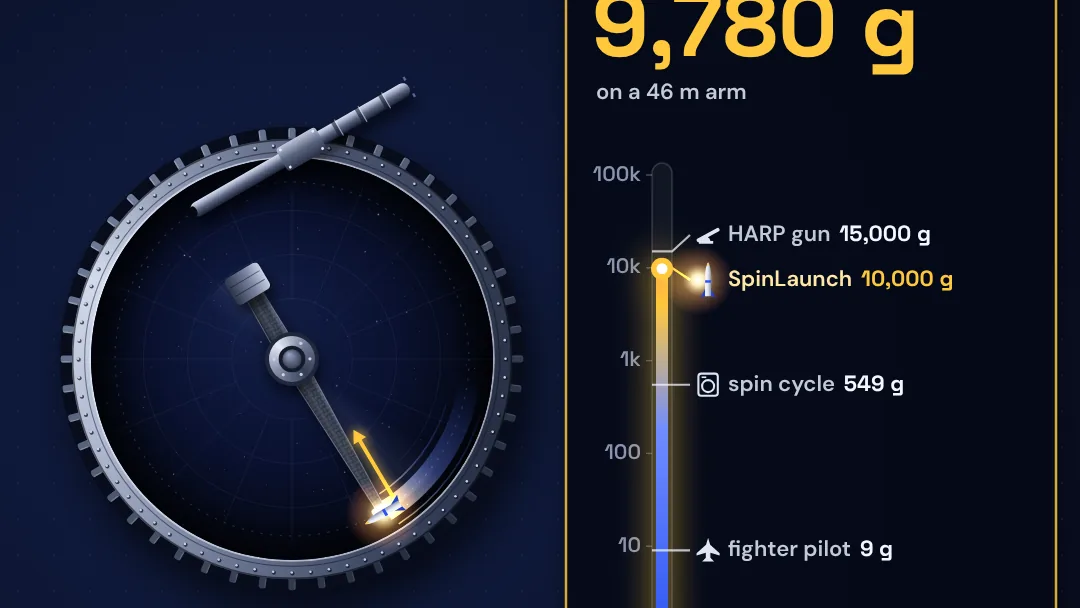
To reach a speed v in a barrel of length L with a steady push, the acceleration is a = v²/2L. A short barrel has only a few metres to get the job done, so it has to shove hard: Longshot’s 21 m gun at Mach 4.6 averages about 6,000 g, and New Atlas reports a peak near 30,000 g. A 1 kg box in it presses down like an elephant. Make the barrel ten times longer and the push is ten times gentler; make the speed twice as fast and it is four times harsher. At 10 km, near-orbital speed, 7.5 km/s, costs about 287 g on average. That is inside the 250–500 g Longshot is aiming for, a load that hardened electronics and rugged satellites can be built to take.
Why people can’t ride it
Crewed rockets keep to about 3 g. Getting a person to near-orbital speed at 3 g would take a barrel about 1,030 km long, most of the length of California. And whatever leaves the muzzle at Mach 22 hits a wall of air: about 340 atmospheres of ram pressure at sea level, which brakes and heats the payload. That is why gun launchers are proposed on mountains, why their payloads need heat shields, and why they still need a small rocket to round out the orbit. It is the problem Stephenson meant.
The tool is a model of a steady push along the barrel, so its g-loads are averages; real guns push hardest early. It leaves out drag, the gun’s own gas dynamics and the rocket a payload would still need. The film opens on Ashlee Vance on Core Memory and uses short pieces of Longshot’s own video of its test gun and a firing of Green Launch’s hydrogen gun, each credited on screen; the gun, landmarks and numbers are drawn from the model. More launch ideas from the same conversation: Neal Stephenson’s launch ideas.
Sources: Core Memory episode 94 with Neal Stephenson, video; New Atlas, interview with Longshot’s Mike Grace; TechCrunch, Longshot Space closes over $5M to build a space gun in the desert; Story Company, Shooting payload to orbit in a 10 km space gun; Green Launch, updates; Wikipedia, G-force and Martlet 2.
Sources & further reading
Make the next question an experiment.
Browse independent creators who make big ideas visible.
Find an explainer