Space · interactive
Why build a 10 km space gun?
A shot loops along the barrel: the gas-tank pairs fire in turn behind the payload. The barrel always fills the width, so the landmarks shrink as it grows. Below: the average g-load, what a 1 kg payload weighs under it, and the air waiting at the muzzle. Drag the barrel sideways to stretch it.
1 See
Longshot’s test gun in Oakland is about 21 m long and fires at Mach 4.6. Its payload averages about 6,000 g, enough to make a 1 kg box press down like an elephant. Why would anyone build one 10 km long?
2 Change
3 Understand
Model notes and sources
Model. A steady push along the barrel. To leave a barrel of length L at speed v, the average acceleration is a = v²/2L, and the average g-load is a/g₀ with g₀ = 9.80665 m/s². The time in the barrel is 2L/v. A 1 kg payload presses on its seat with a/g₀ kilograms of force, compared on screen with approximate masses: a person about 75 kg, a car about 1.5 t, an elephant about 6 t and a loaded truck about 30 t. The barrel length needed for a target load is L = v²/(2 · g-load · g₀); 3 g at 7.8 km/s gives about 1,030 km. The air at the muzzle is sea-level air (ρ = 1.225 kg/m³): its ram pressure is ½ρv², shown in atmospheres (101,325 Pa), and the Mach number is v/343 m/s. The shock cone in the drawing opens at the Mach angle, asin(1/Mach).
What the presets give. Longshot’s test gun, 21 m at Mach 4.6 (1.58 km/s): about 6,000 g on average, 27 ms in the barrel, 15 atm at the muzzle. Green Launch’s hydrogen gun, 16.5 m at 2.97 km/s: about 27,000 g, 11 ms, 53 atm. HARP’s 16-inch gun, about 36 m at about 2.1 km/s: about 6,200 g, 34 ms. Longshot’s 10 km plan at 7.5 km/s: about 287 g, 2.7 s, Mach 22 and about 340 atm. Gentle enough for people, 1,030 km at 7.8 km/s: 3.0 g, 4.4 min. Ten times longer is ten times gentler; twice the speed is four times harsher.
Limits. The numbers are averages. Real guns push hardest early, so their peak is several times the average: New Atlas reports about 30,000 g peak in Longshot’s small gun against our 6,000 g average, and HARP’s maximum launch acceleration was 15,000 g against our average of about 6,200 g. The model leaves out drag inside and outside the barrel, the gun’s own gas dynamics, Earth’s gravity during the push (about 1 g, which matters only for the gentlest settings) and the thinner air at altitude, where real guns are proposed. A payload leaving at 7.5 km/s also loses speed to the air and still needs a small rocket to circularize into orbit; Green Launch and others say the same. The shot on the stage is shown in real time when it lasts 1.3 to 2.8 s, otherwise slowed down or sped up, as labelled. In the drawing, lengths are to scale; the tube’s thickness, the tanks, the slope and the heights of small landmarks are not.
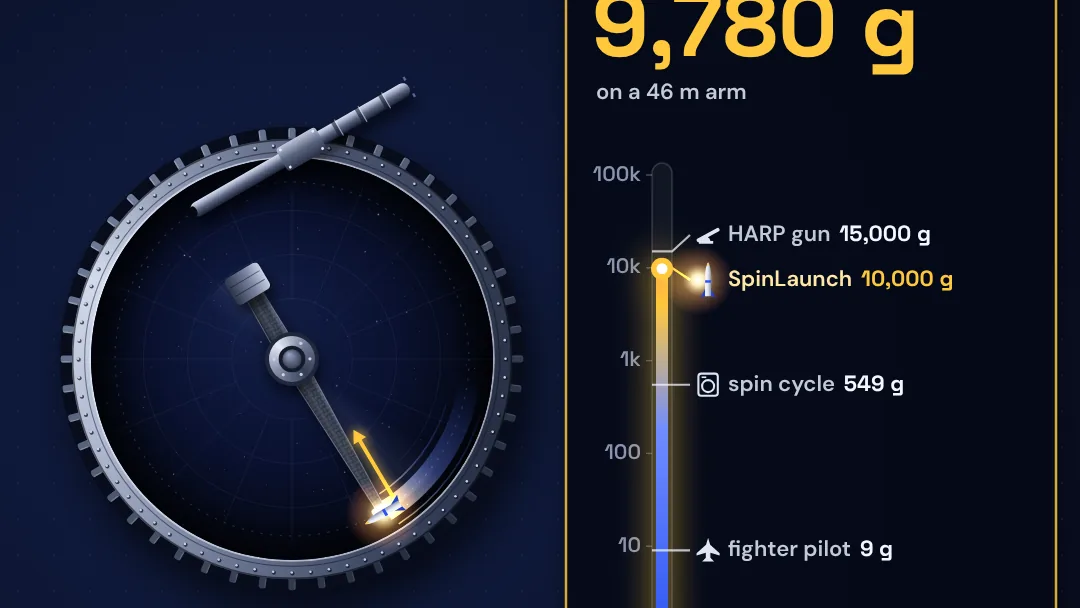
Why so long? A short barrel has only a few metres to reach the final speed, so it has to shove hard: thousands of g, fine for a slug of metal but not for most hardware. Spread the same speed over 10 km and the push drops to a few hundred g, which hardened electronics and rugged satellites can be built to take; Longshot says its big guns should stay around 250–500 g. People are another matter. Crewed rockets keep to about 3 g (the Space Shuttle’s maximum), and fighter pilots handle about 9 g in g-suits. At near-orbital speed, 3 g needs a barrel about 1,000 km long. And whatever leaves the muzzle at Mach 20 or more hits a wall of air: about 340 atmospheres of ram pressure at sea level, which brakes and heats the payload. That is why guns are proposed on mountains and payloads need heat shields.
Longshot. Longshot Space Technologies (Oakland, California; founded 2021; CEO Mike Grace, CTO Nato Saichek) builds a multi-injection compressed-gas gun: pairs of high-pressure gas tanks along the barrel fire in sequence just behind the projectile, an idea borrowed from the Second World War V-3 gun. Its Oakland prototype is about 15–21 m long (70 ft) and reached Mach 4.2 typically and Mach 4.6 at its peak; Grace: “We decided to just declare victory and withdraw at Mach 4.6.” Next is a gun about 500 m long in Tonopah, Nevada (Mach 5, 100 kg); the long-term orbital gun is about 10 km long (“6-mile-long (10-km) space cannon”, New Atlas; other reports say 10–15 km or longer).
The pictures. The gun, the ridge, the shot, the landmarks, the lens and every number are drawn in code from the model; the tanks follow the look of Longshot’s test gun, simplified. Landmarks: a full-size bus about 12 m; an American football field with its end zones, 110 m (120 yd); the Golden Gate Bridge, 2.74 km long with towers 227 m above the water; Manhattan, 21.6 km long; California, about 1,220 km long, drawn as its outline lying on the ground. The film also uses short pieces of real footage, picture only, each credited on screen: Ashlee Vance on Core Memory episode 94; Longshot’s test gun in its Oakland shed (“Hypersonic accelerator, May 2024”, from Longshot’s own video); and a firing of Green Launch’s hydrogen gun at Yuma Proving Ground.
Neal Stephenson. On Core Memory episode 94 (28 October 2026, chapter “Rockets, Guns and Giant Towers”), Ashlee Vance described Longshot: “They’re making like a 10 kilometer long space gun.” Stephenson compared it to “a ramjet accelerator that was developed at the University of Washington” (the ram accelerator behind today’s General Hypersonics, formerly HyperSciences, in Spokane, which reported Mach 3+ with its Space Dart in September 2025 and two Mach 4+ launches in June 2026) and warned that “all big gun systems have got problems … around what happens when you meet the atmosphere.”
Sources: Core Memory episode 94 with Neal Stephenson (chapter at 1:13:43) and the episode page; New Atlas, interview with Longshot’s Mike Grace (Mach 4.6, about 30,000 g peak, the 10 km gun); TechCrunch, Longshot Space closes over $5M to build a space gun in the desert; Payload, Longshot is gunning for kinetic space launch; Story Company, Shooting payload to orbit in a 10 km space gun (250–500 g); Green Launch, updates (16.5 m tube, 2.97 km/s in October 2025); General Hypersonics, Mach 3+ Space Dart launch and Interesting Engineering, Mach 4+ launches; Wikipedia, Martlet 2 (HARP: 180 km on 18 Nov 1966, about 2.1 km/s, 15,000 g) and SHARP (47 m tube, 5 kg at 3 km/s; the proposed Jules Verne Launcher with a 3.5 km barrel); Wikipedia, G-force (Space Shuttle 3 g; pilots about 9 g sustained in g-suits); Wikipedia, Golden Gate Bridge, Manhattan and California (760 mi, 1,220 km long).
An ExplainerTools Original. Concept from Neal Stephenson’s conversation with Ashlee Vance on Core Memory (episode 94, October 2026).