Neal Stephenson told Ashlee Vance on Core Memory that he once “looked at gigantic steel bull whips, which is still a topic I’m obsessed with,” and that he has written five Substack posts about that kind of technology. It starts with a sound most people have heard: the crack of a whip, which is a tiny sonic boom.
Try it yourself in Whip Crack Lab: thin the whip’s tip from a plain rope to 1/20 of the handle, change how hard the loop is thrown, and watch the speed chart cross the speed of sound.
A loop that rolls
A whip is not swung like a stick. A flick of the hand sends a loop rolling down the whip, the way a wave travels down a shaken rope, and everything interesting happens in that travelling bend.
Less mass, more speed
A bullwhip tapers, from a thick plaited handle to a thin fall and a frayed cracker. As the loop rolls on, the same energy is carried by less and less whip, so the loop has to move faster. Thickness counts twice, because mass per metre goes with the square of the diameter: a tip one tenth as thick as the handle has only 1% of its mass per metre. The mathematicians Alain Goriely and Tyler McMillen modelled a tapered whip in 2002 and found that with a tip one tenth the handle’s diameter, the end reached about 32 times the loop’s starting speed. A loop thrown at 12 m/s arrives at about 379 m/s, faster than sound’s 343 m/s. A rope with no taper only swishes.
Why it cracks
When the end of the whip outruns sound, the pressure waves it makes cannot get out of its way. They pile up into a shock wave, a cone that sweeps past your ear as a sharp crack. High-speed shadow photographs caught that shock as early as 1927, and an analysis by Bernstein, Hall and Trent in 1958 confirmed it.
Could a giant steel whip launch a rocket?
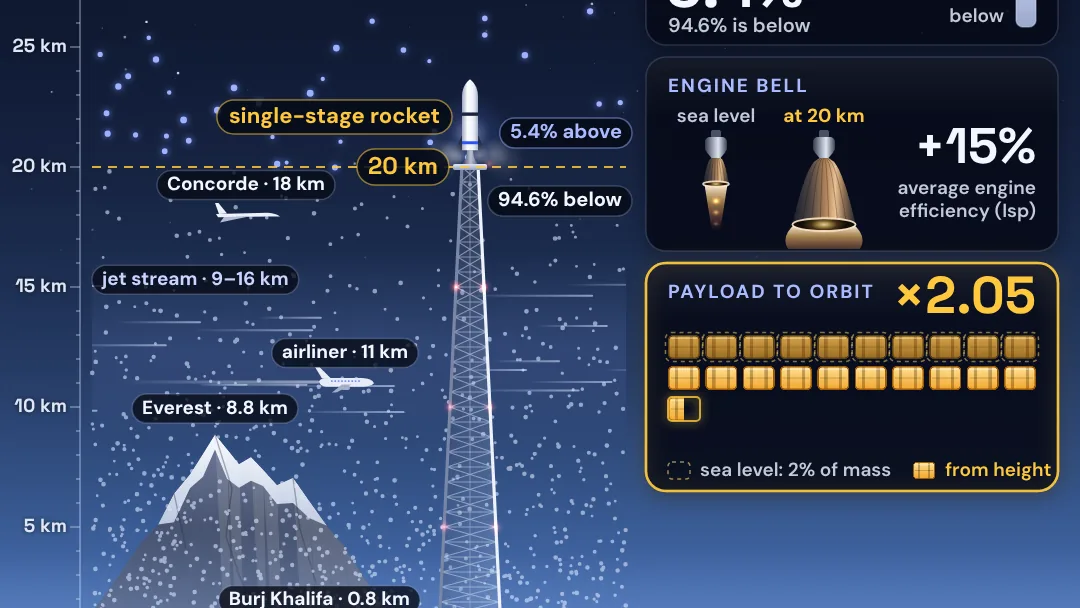
This is where Stephenson’s essays go. A whip is a machine for concentrating energy into something small and fast, so why not a giant steel one with a rocket at the tip? He is clear that giant whips or chain loops could not reach orbit: that takes about 7,800 m/s, twenty times a bullwhip’s crack. But because of the rocket equation, even a modest first boost is worth something. In the tool, a whole rocket starting at the bullwhip’s 379 m/s needs 93.3% of its liftoff mass as fuel instead of 94.0%, and that small saving raises the payload by about 36%.
The tool is a model of an ideal tapered whip with no air drag; its speed-up is fitted to Goriely and McMillen’s result, and real whips lose energy on the way, so read the speeds as an upper bound. The film uses a slow-motion shock-wave shot by Smarter Every Day, a slow-motion loop by Thomas Sagers (@thomas.sagers) and Neal Stephenson on Core Memory, credited on screen; the whip, loop and numbers are drawn from the model. More launch ideas from the same conversation: Neal Stephenson’s launch ideas.
Sources: Neal Stephenson, KdK: Kinetik der Kontinua, Part 1 and Part 5: The Aitkenator; A. Goriely and T. McMillen, “Shape of a Cracking Whip”, Phys. Rev. Lett. 88, 244301 (2002), as reported in American Scientist; B. Bernstein, D. A. Hall and H. M. Trent, “On the dynamics of a bull whip” (1958); Wikipedia, Whipcracking and Tsiolkovsky rocket equation; Core Memory episode 94, video.
Sources & further reading
Make the next question an experiment.
Browse independent creators who make big ideas visible.
Find an explainer