Physics · interactive
Why does a whip crack?
The loop rolls from your hand to the tip in slow motion; the faint arcs mark it at equal steps of time, and the chart below follows its speed. Drag along the whip or the chart to move the loop yourself.
1 See
A flick of the wrist, and the end of a bullwhip breaks the sound barrier. A loop runs down the whip and keeps getting faster. Why does a whip crack?
2 Change
3 Understand
Model notes and sources
Model. A 2.4 m (8 ft) whip whose diameter tapers linearly from d0 at the handle to τ·d0 at the tip; τ is the Tip thickness control, from 1 (no taper, a rope) to 1/20. Mass per metre goes as diameter squared, so a tip 1/10 as thick has 1% of the handle’s mass per metre. The loop’s speed at distance x along the whip is v(x) = v0 · (d0 / d(x))1.5, so the tip speed is v0 · τ−1.5, the speed-up is τ−1.5, and Mach = tip speed ÷ 343 m/s (dry air at 20 °C). v0 is the Throw speed control: the loop’s starting speed, 2–30 m/s. The exponent 1.5 is chosen so the model passes through Goriely & McMillen’s result for a tapered whip: with a tip one tenth the handle’s diameter, the tip reached about 32 times the loop’s starting speed (101.5 ≈ 31.6). It is a fit to that result, not a derivation. Length does not change the speed-up; it only sets the drawing and the real duration of the roll, ∫ dx / v (89 ms for the bullwhip at 12 m/s).
Limits. No air drag, no losses at the loop and no fraying. Real whips lose energy on the way, so read the speeds as an upper bound. The drawing keeps a simple fold whose radius scales with the whip’s thickness, and the thickness is exaggerated so the taper shows. The strand still to come slides forward faster than the fold, as Wikipedia’s Whipcracking puts it: the whip at the loop moves twice as fast as the loop, the way the top of a car’s wheel moves twice as fast as the car. The faint arcs behind the loop mark where it was at equal steps of time, so their widening gaps show it speeding up. The slow motion is not constant: it slows further near the tip so the end stays visible, and the label gives the real duration of the roll for the current settings. The final flip, when the loop reaches the end and opens, is drawn as the cracker shooting forward; its rings expand at the drawn tip speed divided by the Mach number, so the cone’s half-angle, asin(1/M), is right for the settings.
Why it cracks. The crack is a small sonic boom: the end of the whip moves faster than sound, so its pressure waves pile up into a shock. High-speed shadow photographs taken in 1927 caught it, and Bernstein, Hall and Trent’s 1958 analysis of them confirmed the shock. A loop running down a tapering whip hands its energy to less and less mass, so it speeds up; a rope without taper does not, and only swishes.
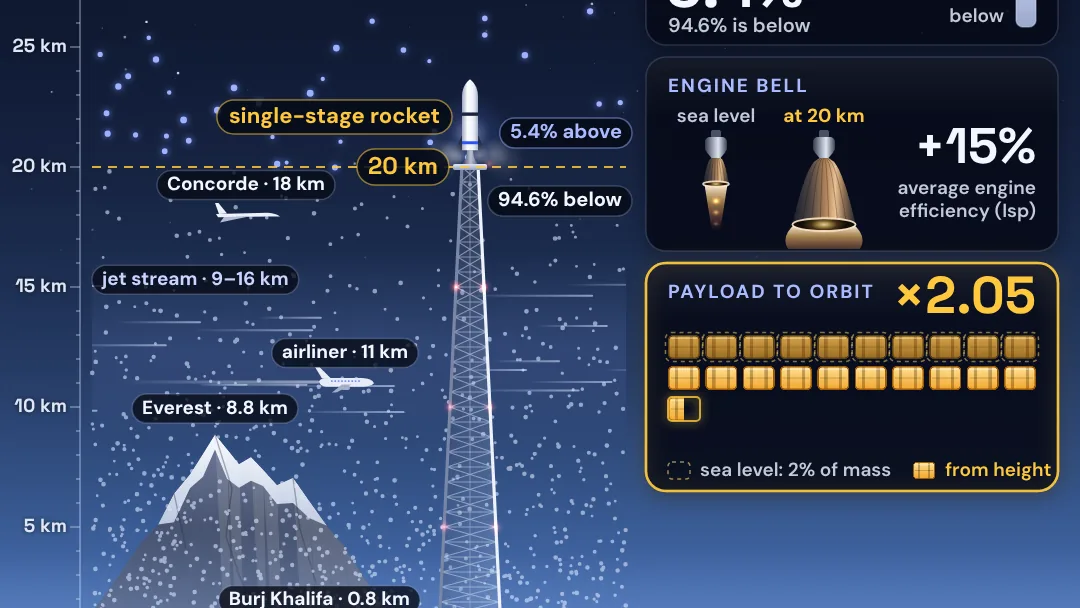
Head start. “If a whole rocket got this head start” means a rocket that starts at the tip speed vb and flies the rest of the way to low orbit: Δv 9.3 km/s, exhaust velocity 3.3 km/s, final-mass fraction f(vb) = exp(−(9.3 − vb) / 3.3). With no head start the payload is 2% of liftoff mass, so the rest of the rocket is f(0) − 2% ≈ 4.0%, held fixed; payload = f(vb) − 4.0%. At Mach 1 (343 m/s) that is about +33% payload; at the bullwhip’s 379 m/s, +36%, while the fuel drops from 94.0% to 93.3% of liftoff mass. Orbital speed is about 7,800 m/s, far above any whip here. No real whip can throw a rocket, and Stephenson himself says giant whips or chain loops could not reach orbit; his point is that, because of the rocket equation, even a smaller first boost still saves fuel.
The pictures. Everything on the stage is drawn in code from the model: the hand, the whip and its loop, the chart, the Mach rings and, in the film, the giant steel whip, the people and buildings for scale, the rocket and the fuel bars. When the film uses real footage (a slow-motion whip crack at the start and an image of a whip’s shock wave), it is shown as short, credited excerpts, picture only; the numbers on screen come from the model.
Neal Stephenson. On Core Memory (episode 94, chapter “Rockets, Guns and Giant Towers”) he told Ashlee Vance he “looked at gigantic steel bull whips, which is still a topic I’m obsessed with”, and that he has five Substack posts about that kind of technology. His series KdK: Kinetik der Kontinua is about the physics of long, slender, flexible things that move. Part 1 notes that the crack is a sonic boom, documented as far back as 1927, and says giant whips or chain loops could not reach orbit, though a smaller initial boost can still be useful because of the rocket equation. Part 5, “The Aitkenator”, is about chain-flingers.
Sources: Neal Stephenson, KdK: Kinetik der Kontinua, Part 1: Introduction and Part 5: The Aitkenator; Core Memory with Ashlee Vance, episode 94 (video, from 1:13:43; episode page); A. Goriely & T. McMillen, “Shape of a Cracking Whip”, Phys. Rev. Lett. 88, 244301 (2002), and Mike May, Crackin’ Good Mathematics, American Scientist 90(5), 2002 (tip one tenth of the handle’s diameter, about 32 times the loop’s speed); B. Bernstein, D. A. Hall & H. M. Trent, “On the dynamics of a bull whip”, J. Acoust. Soc. Am. 30, 1112–1115 (1958); Wikipedia, Whipcracking, Speed of sound, Low Earth orbit and Tsiolkovsky rocket equation.
An ExplainerTools Original. Concept from Neal Stephenson’s conversation with Ashlee Vance on Core Memory (episode 94, October 2026).