Science · Interactive demo
How can sound put out a fire?
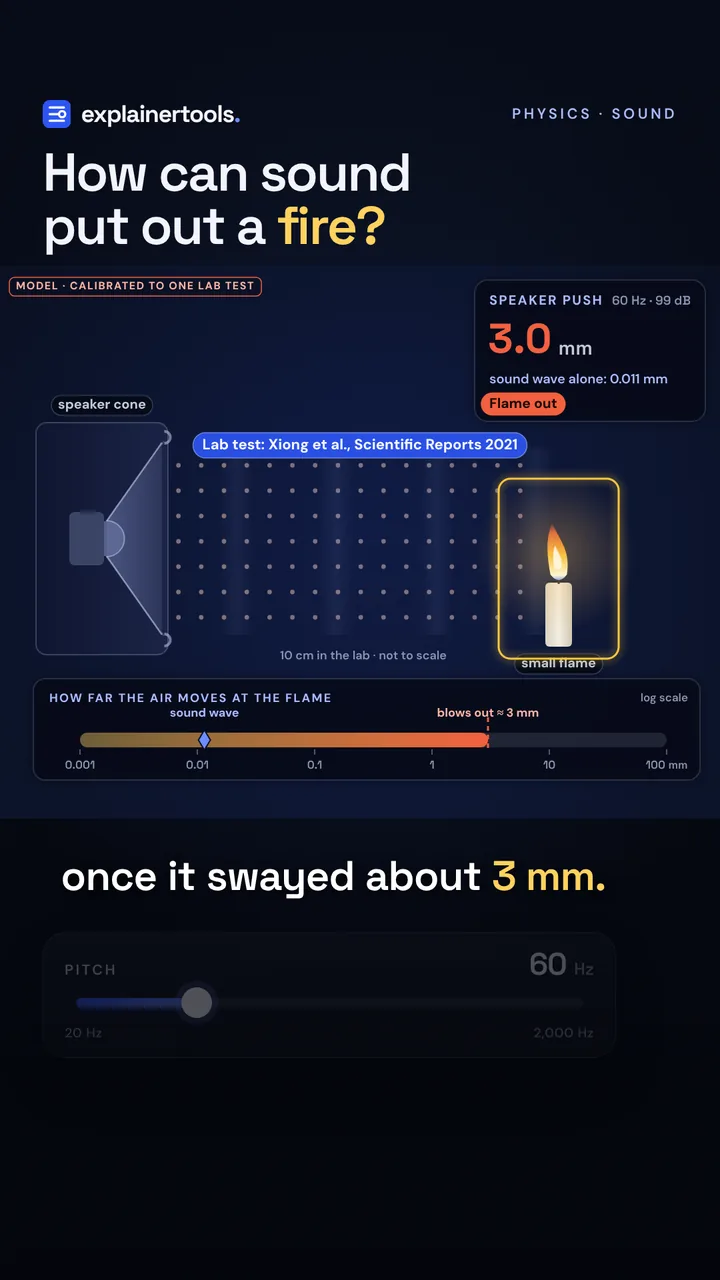
Drop a speaker’s pitch and watch its cone shove more air until a small flame tears and goes out. It isn’t really the sound.
Created by ExplainerTools.
About this explainer
- Made by
- ExplainerTools
- Format
- Interactive demo
- Subject
- Science
- Where it runs
- Plays here
- Full tool
- Open the tool page
- Published
- Added to collection
- sound
- fire
- loudspeakers
- flames
- vortex rings
How the model works
A high school student in Mexico put out fires with a 30 Hz hum and won gold in Indonesia. No water, no foam, just a speaker. How can sound put out a fire?
- Pitch20 Hz → 2,000 Hz
- Sound level80 dB → 120 dB
Speaker push ∝ sound pressure ÷ pitch², calibrated to one lab test (Xiong et al., Scientific Reports 2021: a 15 mm flame 10 cm from a speaker blew out at 60 Hz, 99 dB, when it swayed about 3 mm). Measured only from 50 to 70 Hz; a real fire is bigger and reignites.
Model notes and sources
Model. The Sound level control is the sound pressure level at the flame, L in dB re 20 µPa, so the pressure is p = 20 µPa × 10L/20 (99 dB ≈ 1.8 Pa). The sound wave’s own air motion is that of a plane wave: the air moves back and forth by ξ = p / (ρc · 2πf), with ρ = 1.2 kg/m³ and c = 343 m/s, about 0.01 mm at 60 Hz and 99 dB. The speaker’s push at the flame is δ = K · p / f². A compact speaker that makes pressure p at a given distance moves a volume of air in proportion to p/f² each stroke (for a simple source, p = ρω²V/4πr), and close to the speaker the air, and a flame in it, move with the cone. K = 6,060 mm·Hz²/Pa is set by one measured point: in Xiong and colleagues’ experiment a 15 mm propane flame, 100 mm in front of a 460 mm speaker, blew out at 60 Hz and 1.8 Pa (99 dB), when its swing reached about 3.0 mm. They found that swing at blow-off was the same whatever the sound field (δex = 0.04Hf + 2.4 mm for flame height Hf), so the tool calls the flame out at 3.0 mm. Level to blow it out solves δ = 3.0 mm for L.
Half the pitch, four times the push. Because δ ∝ p/f², halving the pitch at the same level quadruples the push, and 30 Hz pushes (1,000/30)² ≈ 1,100 times as much air as 1,000 Hz. The same law says the sound level needed rises 12 dB for every doubling of pitch: about 87 dB at 30 Hz, 99 dB at 60 Hz and 148 dB at 1,000 Hz, beyond any ordinary speaker.
Limits. The constant comes from one flame, one speaker and one distance; the measured range was 50–70 Hz, and the f² rule carries it to other pitches. In that range Xiong and colleagues’ own fit (pex = 0.11f − 4.5 Pa) gives 1.0 Pa at 50 Hz and 3.2 Pa at 70 Hz, where the f² rule gives 1.25 and 2.45 Pa, so the model is good to about 25% there. Above a few hundred hertz, 10 cm is no longer close to the speaker compared with the wavelength, and the push shrinks toward the sound wave’s own motion; the model then overstates the push, which only flatters high notes. Real woofers can travel only a centimetre or two, so the biggest pushes at very low pitches are out of reach. The flame is a small lab flame; a real fire is bigger, hotter and reignites, and none of this model’s numbers apply to it. The motion on the stage is slowed down and exaggerated so a hundredth of a millimetre and a centimetre both show.
VortexTech. Ángela Karime Hernández Venegas, a student at CETis 78 in Altamira, Tamaulipas, built a portable acoustic extinguisher: a 12-volt battery, a frequency generator set to 30 Hz, an amplifier and a speaker, with a bucket that sends each push out as a ring of air. She and her team report more than 100 tests on small fires, including wood, flammable liquids and cooking oil, and say the rings cut off the flame’s oxygen. In October 2026 the project won gold at the International Science and Invention Fair (ISIF 2026) in Indonesia, according to Tamaulipas’s education department. The tool is not a model of her device; it shows the mechanism lab experiments point to. The same idea was shown by George Mason University students in 2015 (30–60 Hz) and by DARPA in 2012.
The pictures. Everything on the stage is drawn in code from the model. In the film, the opening, the outdoor fire and the smoke rings are short excerpts of the student’s own videos (Karime vortex on YouTube); a woofer at full travel is from barevids, and a pan fire from George Mason University. All are credited on screen and shown picture only.
Sources: C. Xiong, Y. Liu, H. Fan, X. Huang and Y. Nakamura, “Fluctuation and extinction of laminar diffusion flame induced by external acoustic wave and source”, Scientific Reports 11, 14402 (2021), nature.com; C. Xiong, Z. Wang and X. Huang, “Acoustic flame extinction by the sound wave or speaker-induced wind?”, Fire Safety Journal 126, 103479 (2021), doi; Tamaulipas Secretaría de Educación, ISIF 2026 gold medal release; N+, Vortex Tech: cómo funciona el extintor acústico; Mexico News Daily, A Tamaulipas teen built a fire extinguisher that puts out flames using sound; TechXplore, Students build sound-wave fire extinguisher (George Mason University, 2015); Wikipedia, Sound pressure and Particle displacement.
An ExplainerTools Original. Inspired by Ángela Karime Hernández Venegas’s VortexTech acoustic extinguisher (CETis 78, Altamira). Lab data: Xiong et al., Scientific Reports 11, 14402 (2021).
Watch it move
- How can sound put out a fire?42-second Short
Go deeper
Explore interactive ideas in space, science, math, and more. Try a demo, read an interactive article, watch a short video, and follow what makes you curious.
New Originals
Change one thing and see why.
The three newest models, each with a short film. Watch the question, then play with the answer.
Follow your curiosity
A collection of small doors into big ideas.
Format
Swipe or scroll for more formats →
Subject
Swipe or scroll for more subjects →
Topic
Swipe or scroll for more topics →
Sort by
Rankings count activity here on ExplainerTools. Newest means added to this collection.
Loading collection…
Make something click.
Made an explainer, or found one you love? Give it a place in the collection.