Engineering · Interactive demo
How can a few drops of liquid cool a phone?
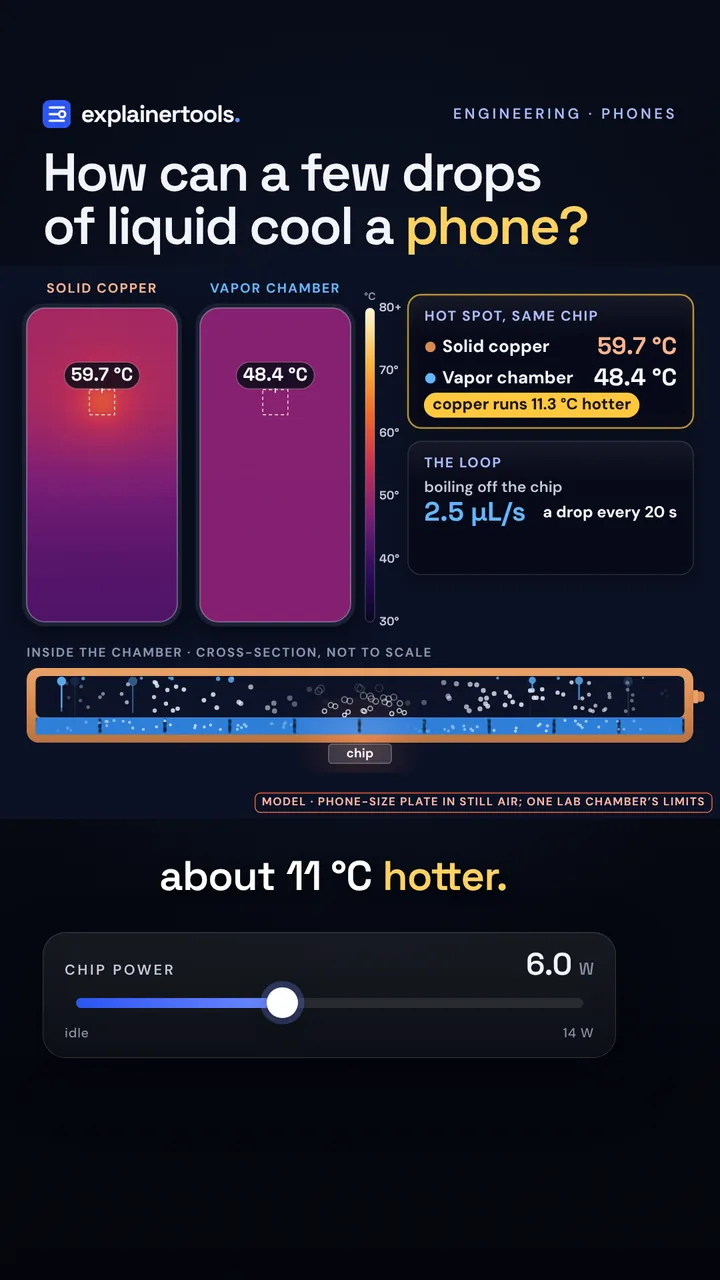
Turn a phone chip up from idle to a 13 W burst and watch a vapor chamber spread heat that solid copper can’t, until its wick runs dry.
Created by ExplainerTools.
About this explainer
- Made by
- ExplainerTools
- Format
- Interactive demo
- Subject
- Engineering
- Where it runs
- Plays here
- Full tool
- Open the tool page
- Published
- Added to collection
- vapor chambers
- phones
- heat transfer
- boiling
- iPhone Duo
How the model works
A phone’s chip turns its work into heat in a spot about the size of a fingernail. Many phones now spread it with a vapor chamber: a thin sealed copper pocket with a little liquid inside and almost no air. How can a few drops of liquid move heat better than solid metal?
- Chip poweridle → 14 W
Presets Idle · 1 WGaming · 6 WNear the limit · 7.5 WPeak burst · 13 W
Steady heat flow in a bare 72 × 150 × 0.5 mm plate in still air (h = 12 W/m²·K). The chamber uses one 0.5 mm lab chamber’s measured conductivity (about 20,900 W/m·K) and 7.58 W wick limit; it is not a model of any one phone.
Model notes and sources
Model. A phone-size plate, 72 × 150 mm and 0.5 mm thick, lies in still air at 25 °C with a 12 × 12 mm chip under it, 45 mm from the top. The plate is split into 3 mm squares. Heat flows between neighbours through the plate (conductance k·t) and leaves both faces to the air at h = 12 W/m²·K, our assumption for natural convection plus radiation from a warm phone. The steady temperature of every square is solved exactly. Solid copper conducts k = 400 W/m·K. For the vapor chamber we use what one 0.5 mm ultra-thin chamber measured lying flat in a 2020 Applied Thermal Engineering study: an effective conductivity of about 20,900 W/m·K (about 52 times copper) and a maximum heat transfer capacity of 7.58 W at its best filling ratio.
Inside the chamber. With the air pumped out, the pressure inside is just the vapor pressure of the water at the plate’s temperature (Antoine equation). At 48 °C that is about 11 kPa, 11% of the air outside, so the water boils at the temperature of a warm phone instead of at 100 °C. Boiling water absorbs its latent heat, about 2,390 kJ per kilogram at 45–50 °C, so a 6 W chip boils about 2.5 mg, roughly 2.5 µL, a second: one drop (0.05 mL) every 20 seconds, which condenses back on the cooler parts of the plate. Phone chambers are sealed with water in them; Apple says the iPhone 17 Pro’s holds deionized water. The fill, pressure and wick of any one phone’s chamber are not published, so the tool doesn’t claim them.
The wick’s limit. The wick returns the liquid by capillary action, and its pull is limited. Above 7.58 W, the model lets the wick return only 7.58 W worth of water. The liquid front then retreats from the chip; we estimate where with a radial wick, in which a fixed capillary pull must overcome a resistance that grows with ln(R/r): the front stops at r = R·(rchip/R)Qmax/P, where R = 59 mm is the plate’s equivalent radius and rchip = 6.8 mm the chip’s. Inside that dry patch the chamber is only its copper walls, assumed 2 × 0.1 mm. In this estimate the whole patch over the chip dries as soon as the load passes the limit, so the hot spot jumps there; real chambers dry out over a narrow range of power. This is an illustration of dry-out, not a measurement of any phone.
What the numbers say. At 6 W, about what an iPhone 17 Pro sheds while gaming, the copper hot spot is 59.7 °C and the chamber’s 48.4 °C, 11.3 °C cooler, with the whole chamber within half a degree. At 1 W the gap is 1.9 °C. At the 7.58 W limit it is 14.3 °C. At 13 W, a short burst near the A19 Pro’s reported peak, the chamber has a dry patch about 33 mm across and its hot spot (108 °C) is hotter than solid copper’s (100 °C), because its dry walls are thinner than the copper plate.
Limits. A bare plate in still air, not a phone: a real phone also has a battery, a screen, a case and other heat paths, and it slows its chip down (throttles) long before these temperatures. The chamber is one lab chamber’s measured conductivity and capacity, lying flat; real chambers vary with size, wick, fill and orientation, and very thin chambers can do worse than solid metal at low power. The colour scale runs from 30 to 80 °C, like a thermal camera’s range; anything hotter reads white. The cross-section is not to scale, and its bubbles, vapor and droplets are drawn to show the loop, not to measure it.
Sources. Apple, Apple unveils iPhone Duo (9 September 2026, custom-designed vapor chamber); 9to5Mac, Here’s how the iPhone 17 Pro vapor chamber actually works (Apple’s Greg Joswiak: “Deionized water is sealed inside the vapor chamber”); Notebookcheck, iPhone 17 Pro thermal results (Geekerwan: about 6.1 W dissipated while gaming, peaks near 13 W); A novel ultra-thin vapor chamber for heat dissipation in ultra-thin portable electronic devices (Applied Thermal Engineering, 2020: 0.5 mm, 7.58 W, about 20,900 W/m·K); Yadavalli, Weibel and Garimella, Performance-governing transport mechanisms for heat pipes at ultra-thin form factors (2015); NASA Spinoff, heat pipes; Fraunhofer, how heat pipes work; Wikipedia, Heat pipe, Vapor pressure and Enthalpy of vaporization.
An ExplainerTools Original. In the film, thermal-camera footage and real iPhone vapor chambers by @iphonedo on TikTok, credited on screen.
Watch it move
- How can a few drops of liquid cool a phone?43-second Short
Go deeper
Explore interactive ideas in space, science, math, and more. Try a demo, read an interactive article, watch a short video, and follow what makes you curious.
New Originals
Change one thing and see why.
The three newest models, each with a short film. Watch the question, then play with the answer.

Follow your curiosity
A collection of small doors into big ideas.
Format
Swipe or scroll for more formats →
Subject
Swipe or scroll for more subjects →
Topic
Swipe or scroll for more topics →
Sort by
Rankings count activity here on ExplainerTools. Newest means added to this collection.
Loading collection…
Make something click.
Made an explainer, or found one you love? Give it a place in the collection.