Topic guide · Forces and motion
How could suction and thrusters help a car grip and launch?
In two different ways. A suction fan lowers the air pressure under the car. The higher pressure on top then presses the car onto the road, so the tires can grip harder. A cold-gas thruster throws gas backward, and the reaction pushes the car forward without relying on tire grip. Tesla’s Roadster page describes both as options. We have not verified how they would perform.
- Suction
- Pressure difference × area
- Thrust
- Gas out the back, car pushed forward
- Torque
- Force × lever arm
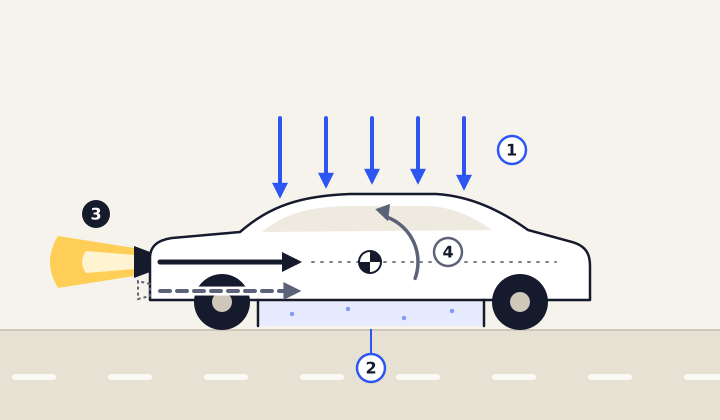
- 1Air above presses down at full atmospheric pressure.
- 2A fan lowers the pressure under a sealed skirt. The difference presses the car down.
- 3Thrust in line with the center of mass pushes the car forward without turning it.
- 4The same thrust mounted low also adds torque, so the nose tries to lift.
Model · concept sketch, not Tesla hardware
How can a fan hold a car down?
Air presses on every surface, about 10 newtons on each square centimeter at sea level. A fan under a sealed skirt pulls air from beneath the car. Now the pressure underneath is lower than the pressure on top.
That difference, multiplied by the area, is a force pressing the car down. Small differences add up. Lower the pressure by 1% under an illustrative 4 m² floor, and air pushes down with about 4,000 newtons. That is roughly the weight of 400 kg.
Why does pressing down help? A tire’s grip grows with how hard it is pressed onto the road. More push means more friction for braking, cornering and launching. Unlike a wing, a fan works even when the car stands still.
What does a thruster push against?
Not the air behind it. A thruster forces gas out of a nozzle, and the gas pushes back on the thruster. NASA Glenn’s rocket principles use a balloon to show it: air rushes out one way, and the balloon flies the other.
That push is thrust, and it needs no traction. A cold-gas thruster releases stored compressed gas instead of burning fuel, so it pushes only while the gas lasts.
Could a thruster flip a car?
Where a force acts matters as much as how strong it is. A push in line with the car’s center of mass speeds it up without turning it. Move the same push off that line, and it also creates torque, a twisting effect that starts rotation.
OpenStax University Physics writes torque as τ = r × F: force times its lever arm. A thruster mounted low would try to lift the nose. Mounted high, it would try to tip the car forward.
The car’s own weight twists back only while its tires touch the road or a ramp. There, the car lifts its nose by pivoting on its rear tires. Weight pulls down through the center of mass, ahead of that pivot, and holds the nose down. The low thruster’s twist must beat that to start a tip. Once airborne, the car turns about its center of mass. Weight acts right through that point, so it adds no twist to beat.
Beating weight starts a tip, but it does not guarantee a flip. Twist multiplied by how long it lasts, the angular impulse, sets how much spin builds. A car with more rotational inertia turns more slowly for the same impulse. Counter-thrust can slow or stop the turn, and the flip still has to end in a landing. This is a generic teaching example, not a description of Tesla hardware.
Try it: three small experiments
- Pressure
Press a suction cup onto a smooth tile and pull. Outside air holds it on. Lift one edge with a fingernail, and it lets go.
- Thrust
Blow up a balloon and let it go. Air rushes out backward, and the balloon shoots forward with nothing behind it to push on.
- Torque
Push a book across a table through its middle, and it slides straight. Push the same way near one corner, and it turns.
Rocket Nozzle Lab, by Ryan Sael, takes thrust further. Change the nozzle’s throat, the throttle and the surroundings to see how hot gas becomes a push.
Where do these ideas stop working?
Suction needs a seal. The skirt must stay close to a surface so outside air cannot rush in. Over a bump, a ramp lip or a jump, the seal breaks and the hold fades. Once the car leaves the ground, there is no surface left to pull against.
Thrust keeps working in the air, but only while the gas lasts. Every number on this page is a generic illustration. Claims about the Roadster are Tesla’s, and we have not tested them.
Explore by question
A fan presses a car onto a ramp. A jet pushes it along. Two more jets turn it over in mid-air. What does each one actually push on?
Roadster Lab
Model · illustrative numbers
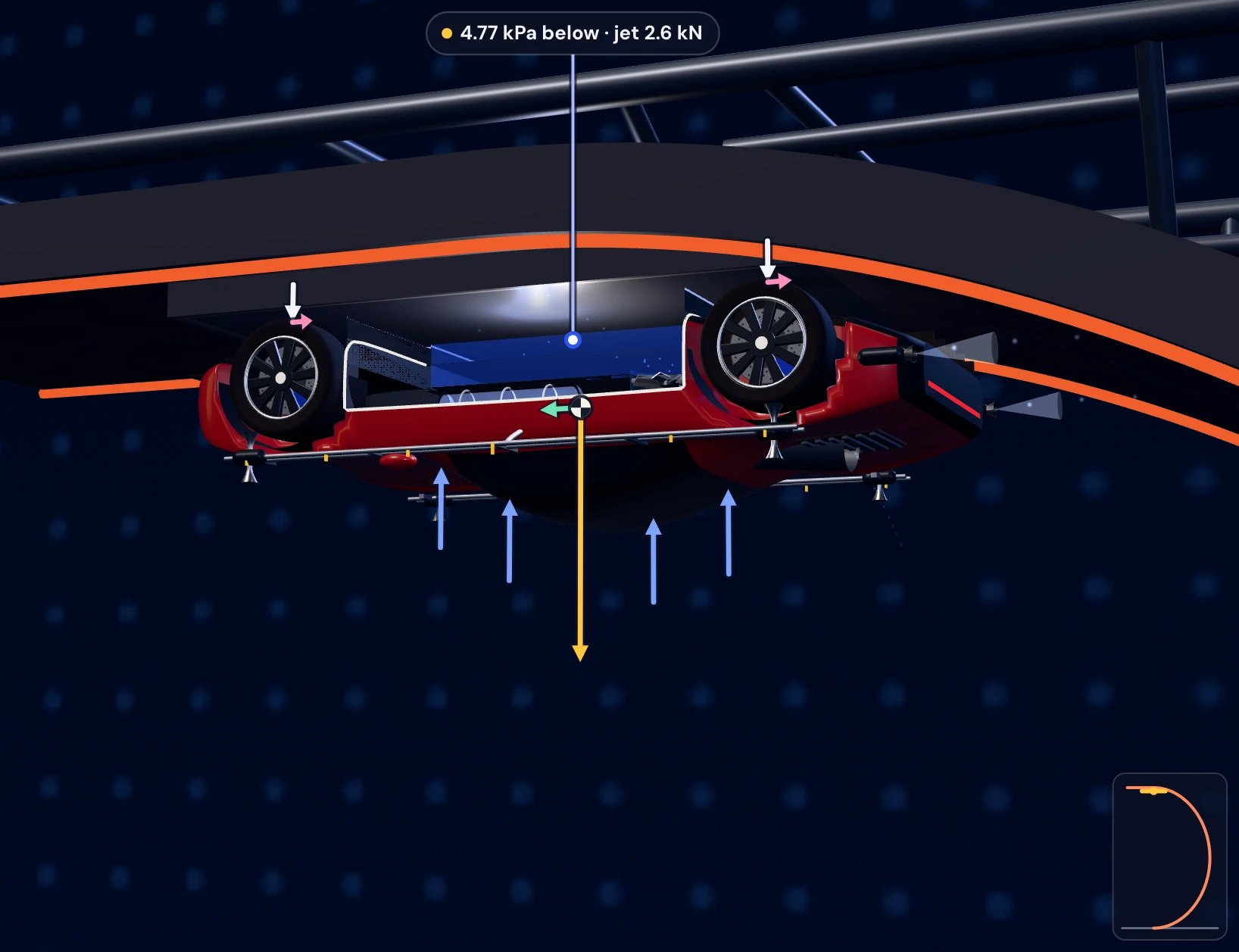 Interactive · How could a car stick, then flip?How could a car stick, then flip?Move a fan car up a curved ramp to upside down. Push it with a jet. See when it holds, slides or falls off, then flip it with two jets. An illustrative model.
Grip: pressing tires onto the road
Downforce matters because braking and cornering are limited by grip.
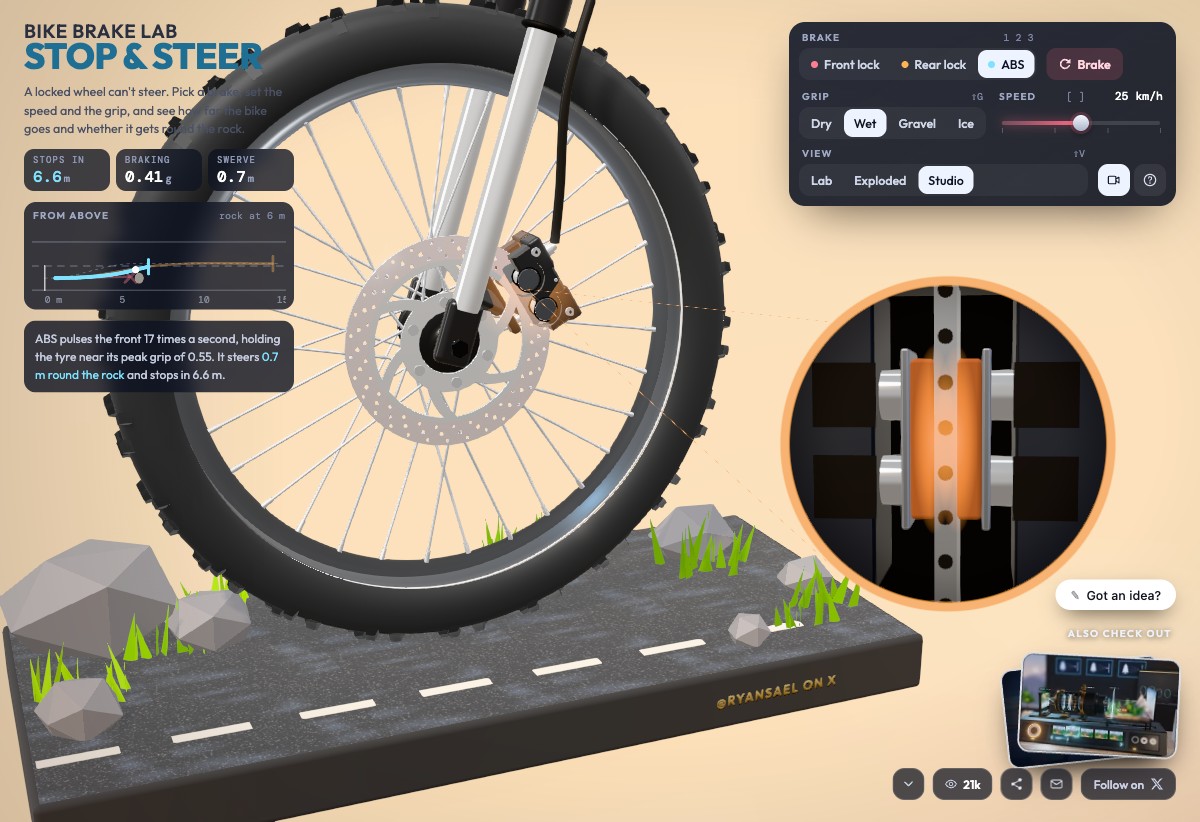 Interactive demoBike Brake LabCompare a front lock, a rear lock and ABS while you change speed and road grip.by Ryan Sael · Opens on the creator’s site
Thrust: a push without traction
A nozzle turns gas pressure into a push you can change.
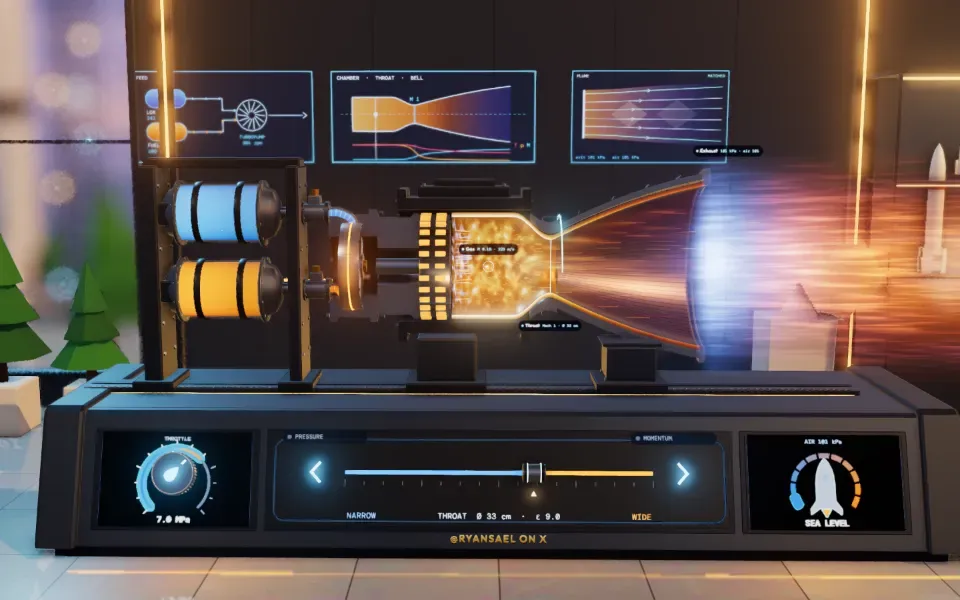 Interactive demoRocket Nozzle LabChange a nozzle’s throat, throttle and surroundings to see how hot gas makes thrust.by Ryan Sael · Best on a larger screen
Pressure doing other work
A separate mechanism, useful for watching a pressure difference move something.
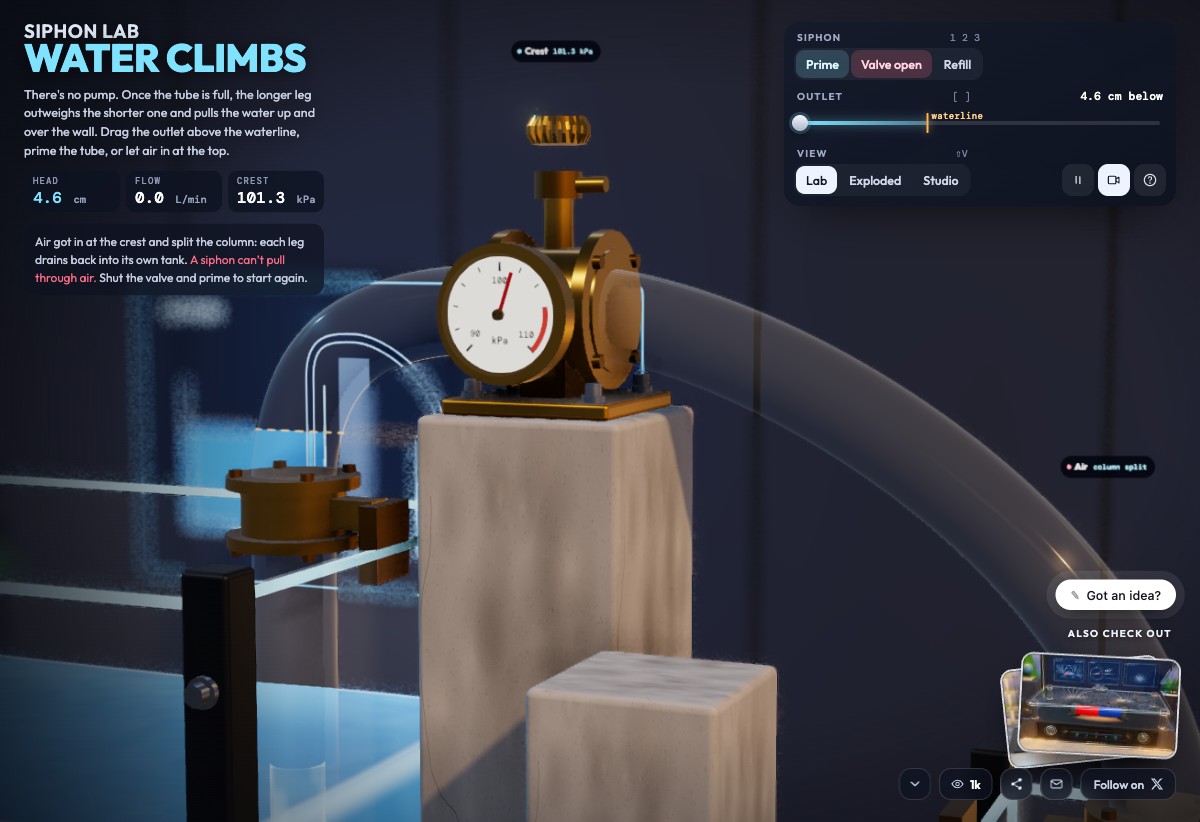 Interactive demoSiphon LabRaise the outlet, prime the tube or let air in, and follow the flow.by Ryan Sael · Opens on the creator’s site
Spin, once it has started
Angular momentum explains how a spinning body speeds up or slows down. It does not model a car, or the torque that starts a flip.
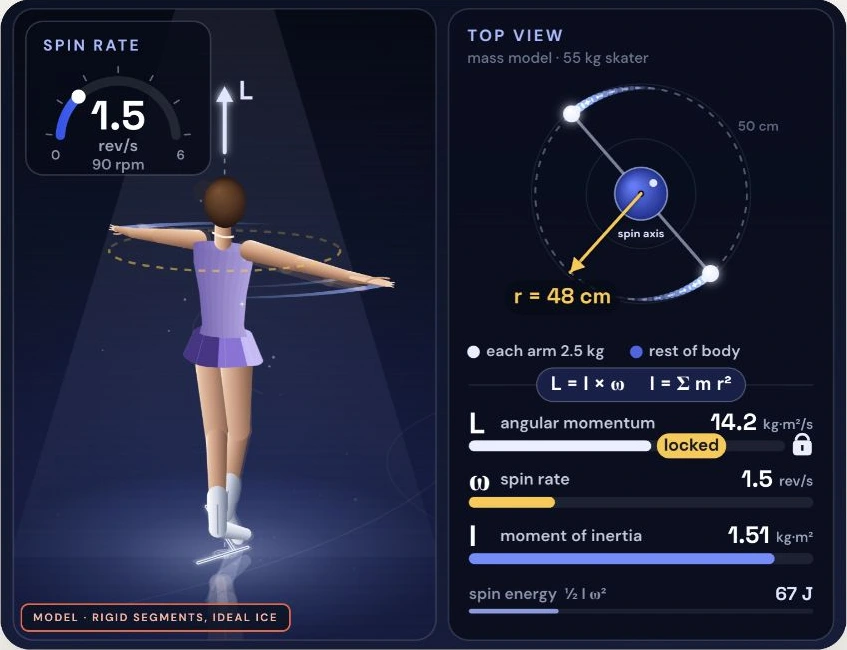 Interactive · Spin LabWhy do skaters spin faster with their arms in?Pull a skater’s arms in and watch the spin speed up while angular momentum stays fixed.
- JournalWhy do skaters spin faster with their arms in?A spinning skater pulls her arms in and turns 2.8 times faster, with no outside push. Drag them in yourself, then feel it on an office chair.
Common questions
Is suction the same as downforce from a wing?
Both press the car down. A wing needs speed, because it turns moving air into force. A fan under a sealed skirt can lower the pressure even when the car is parked.
Has a fan car really held on upside down?
McMurtry Automotive says its own Spéirling did, in 2025. A rotating rig turned the car over, and its fan held it in place, even while stationary. That is McMurtry’s car and demonstration, not Tesla’s.
Does a thruster need air to push against?
No. It pushes on the gas it throws out. That is why rockets also work in space, where there is no air at all.
Why does more downforce help braking?
Braking force comes from tire friction, and friction grows with how hard each tire is pressed down. More downforce lets a tire push harder on the road before it slides.
Sources and credits
- Tesla · Roadster The manufacturer’s page describing optional suction and rear cold-gas thrusters. Performance claims are Tesla’s.
- McMurtry Automotive · Upside-down driving Primary account of its own Spéirling fan car, inverted on a rotating rig in 2025.
- NASA Glenn Research Center · Rocket principles Thrust from expelled gas, the balloon analogy and Newton’s laws.
- OpenStax · University Physics Volume 1, 10.6 Torque Torque as force times lever arm, τ = r × F.
Every creator named here made the work we link to. Listing it does not imply a partnership or endorsement.