Language · machine shorthand
How does a court reporter write 225 words a minute?
Click keys, or hold them on your keyboard, to build a chord and write it: K, A and T together make KAT, “cat”. Then turn “Words per minute” and compare keystrokes a second with steno strokes.
1 See
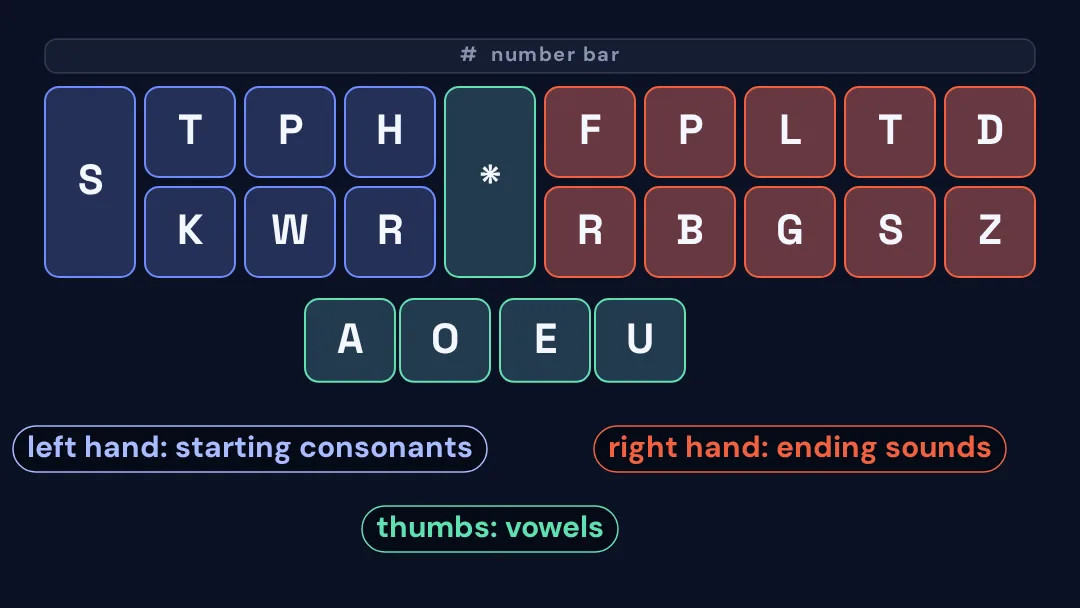
A steno machine has just 22 letter keys, and you press several at once, like a chord on a piano. Left hand: starting consonants. Thumbs: vowels. Right hand: ending sounds.
2 Change
3 Understand
Model notes and sources
Where this comes from. To earn the National Court Reporters Association’s Registered Professional Reporter (RPR) certification, a reporter passes three five-minute skills tests: literary at 180 words a minute, jury charge at 200 and testimony / Q&A at 225, each with 95 percent accuracy (NCRA).
The keyboard. The American stenotype, in the layout from Ward Stone Ireland’s machine, has 22 letter keys and a number bar. The left hand writes starting consonants, S T K P W H R; the thumbs write the vowels A O E U, with the asterisk between them; the right hand writes ending sounds, F R P B L G T S D Z. Letters that are missing are made from combinations: TK is D, PW is B and PH is M, so “dog” is TKOG and “mat” is PHAT. All the keys of a stroke go down together, like a chord, and the machine records them together.
One stroke, one word. On a keyboard “cat” is three presses; in steno it is one stroke, KAT. Common words get one-stroke shortcuts called briefs: -T is “the”, SKP is “and”, -F is “of”. Software with a steno dictionary turns each stroke into English as it is written.
The speed comparison. Typing speed is usually measured with the convention that a “word” is 5 keystrokes, including spaces and punctuation, so 225 words a minute would be about 19 keystrokes a second on a keyboard. At one stroke a word, steno needs 3.75 strokes a second for the same speech.
The model and its limits. The tool’s dictionary is a 33-entry demo: simple phonetic one-stroke words and common briefs from Plover’s default dictionary. Real steno dictionaries are vastly larger, and longer words take more than one stroke, which is why the tool lets you set strokes per word. The number bar is drawn but not used. Keyboard input follows Plover’s default QWERTY mapping. The diagrams in the film and the tool are drawn in code by ExplainerTools; no AI-generated pictures are used.
Real speeds. The tool’s speed ladder marks NCRA’s skills tests: the Registered Professional Reporter test at 180, 200 and 225 wpm with 95 percent accuracy, the Registered Merit Reporter test at 200, 240 and 260 wpm, and the Certified Realtime Reporter test, a five-minute realtime testimony leg at 200 wpm with 96 percent accuracy. Guinness World Records lists 360 wpm at 97.23 percent accuracy as the highest speed achieved on a stenotype (2004), and a 1999 study by Karat and colleagues found that average computer users copied text at 32.5 wpm (both as reported in Wikipedia’s “Words per minute”). Comfortable speech is about 150 to 160 wpm, the rate recommended for audiobooks (same article). The small letters on the keys are the QWERTY keys that Plover’s default layout reads for each steno key; the lights next to the speed bars blink once per keystroke or stroke at the chosen speed.
The film. The mechanism is drawn in code by ExplainerTools, with no AI-generated pictures. The Short also uses short real excerpts, picture only, a few seconds each and credited on screen: @averie_parsons (TikTok); @kaylabussmann (TikTok). The numbers in the film come from the model, not from the footage.
Sources: NCRA, “Registered Professional Reporter”; Wikipedia, “Stenotype” and “Words per minute”; the Open Steno Project and Plover’s beginner’s guide; Art of Chording; NCRA, “Registered Merit Reporter” and “Certified Realtime Reporter”.
An ExplainerTools Original. Test speeds from NCRA’s RPR, RMR and CRR certifications; strokes from Plover’s open steno dictionary. Footage: @averie_parsons; @kaylabussmann.