Topic guide · Business and money
Why does a $5 latte earn only ten cents?
Because most of the $5 is spoken for before the café earns anything. About $1.25 is the cup itself: milk, beans, the paper cup, the straw. The rest goes to the bills: rent, staff and the lights, owed whether anyone walks in. In Latte Ledger’s New York café, those bills come to $1,095 a day. It takes 292 cups to pay them, which on a typical day means 6:20 pm. On a 300-cup day the last 8 cups are the profit: $30, or ten cents a latte.
- Price
- $5.00
- The cup itself
- $1.25
- Bills a day
- $1,095
- Break-even
- 292 cups
Model · illustrative New York inputs Daily profit = cups × ($5.00 − $1.25) − $1,095. At 300 cups, $30; at 350 cups, $217.50.
Interactive · ExplainerTools
Latte Ledger
Change the price, the cups a day and the rent, and watch when in the day the bills are paid and what each latte leaves.
Model · one café, one product
Where does the $5 go?
Two kinds of cost hide in a latte. The first is spent cup by cup: milk, beans, the paper cup and lid, the straw. Latte Ledger puts that at $1.25. Sell no lattes, and you spend none of it.
The second kind is owed whether anyone walks in. Rent, the baristas’ hours, electricity, insurance, the card terminal. In the model that is $1,095 a day: an $8,000 monthly rent spread over 30 days, 34 barista-hours at $20, and $148 of everything else.
So each latte contributes $3.75 toward the bills. Accountants call that the contribution margin, and the number of cups needed to cover the bills is the break-even point: $1,095 ÷ $3.75 = 292 cups.
Why is nothing earned until 6:20 pm?
The bills are paid in order. Every $3.75 of contribution goes into the rent, the wages and the lights first, and only after those are full does a coin reach the profit jar.
Cups do not arrive evenly. Latte Ledger assumes a morning rush: about 9% of the day’s cups in the first hour, 38% by 10 am, 65% by 1 pm. On a 300-cup day the 292nd cup is poured around 6:20 pm. Everything before that was for the landlord, the staff and the utilities. The last eight cups are the day’s profit: $30.
Price it like a Manhattan café, at $7, and the arithmetic changes fast. Each cup contributes $5.75, break-even falls to 191 cups, and the bills are paid before lunch.
Why do 50 more customers change so much?
Because the bills do not grow with them. Add 50 customers and the café sells 350 cups. The $1,095 of bills is the same, so it is paid by about 3:30 pm, and the rest of the afternoon is profit. The day earns $217.50, or 62 cents a latte: a 17% rise in cups, a 625% rise in profit.
That is operating leverage: when most costs are fixed, a small change in sales becomes a large change in profit. It works both ways. Lose 50 customers and the same café loses $157.50 a day.
The same lever runs a company with debt. Buyout Lab drops Toys “R” Us sales by 10%, and its profit before interest halves, because the stores cost the same to run either way.
Try it: move the rent, then the customers
- 1 See
Open Latte Ledger at its defaults: $5.00, 300 cups, $8,000 rent. The counter reads bills paid at 6:20 pm · cup 292.
- 2 Change
Drag Cups a day to 350. The bills are paid at 3:30 pm and the profit jar fills from there: $217.50, 62 cents a latte.
- 3 Understand
Now drag Rent to $19,000 a month, a real former West Village coffee shop listing. At 300 cups the day loses money, and no price under $6.50 saves it.
Where does this model stop?
Latte Ledger is one café selling one product. Price does not change how many people come, staff hours do not rise with the queue, and food, pastries, taxes, waste, discounts and loan payments are left out. The New York inputs are rounded from café owners’ own numbers in our footage research: a 405-square-foot shop doing about $20,000 a month, rents from $3,000 to $19,000, baristas at $20 to $32 an hour, lattes at $6 to $8 in Manhattan.
So the numbers are illustrative inputs you can change, not a forecast for any real café. The film’s real footage is credited on screen: a latte poured at LB Coffee by @lbcoffeenyc, and the $19,000 listing by @capstonepropertiesny. The numbers come from the model, not from the clips.
Explore by question
One café, one product, and the two kinds of cost that decide whether it earns anything. Each card answers one part of the question.
Latte Ledger
Model · one café, one product
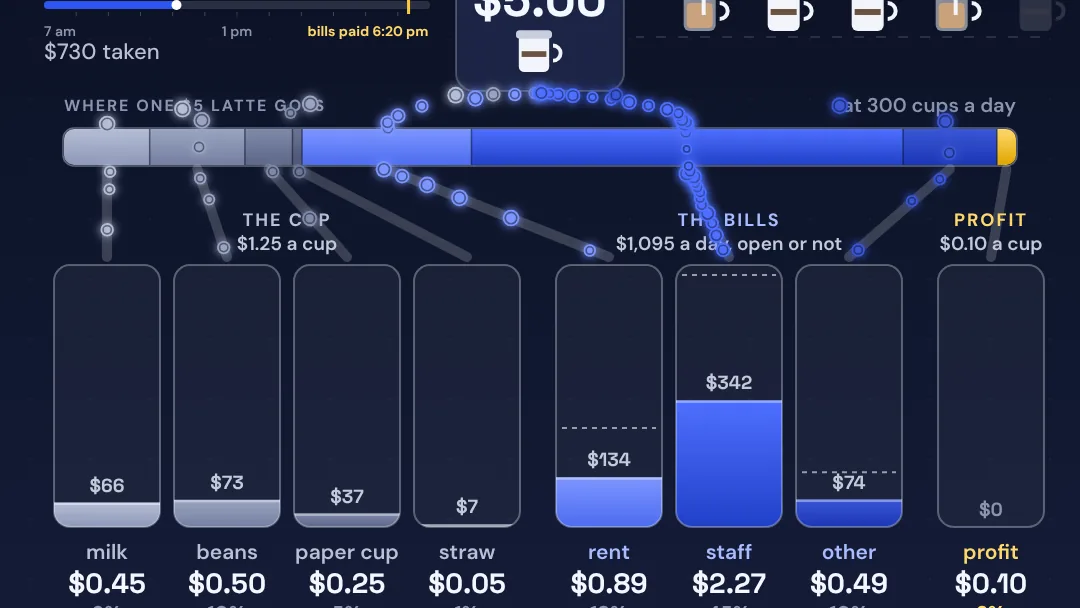 Interactive · Latte LedgerWhy does a $5 latte earn ten cents?Change the price, the cups a day and the rent. Watch the bills fill first, and the clock tell you when.
- Short · 41 secondsWhy does a $5 latte earn ten cents?The $5 sorted into the cup, the bills and the jar, then 50 more customers. Narrated and captioned.
- JournalWhy does a $5 latte earn ten cents?The cup itself costs $1.25. The rest goes to rent, staff and the lights, owed whether anyone walks in or not. At 300 cups a day the first 292 only pay the bills, so on a normal café day nothing is earned until 6:20 pm; that is why a busy café can earn a dime a latte, and why 50 more customers change everything.
The same lever, with debt on top
Fixed costs cut profit in half when sales dip 10%. Add a loan, and the interest does not dip at all.
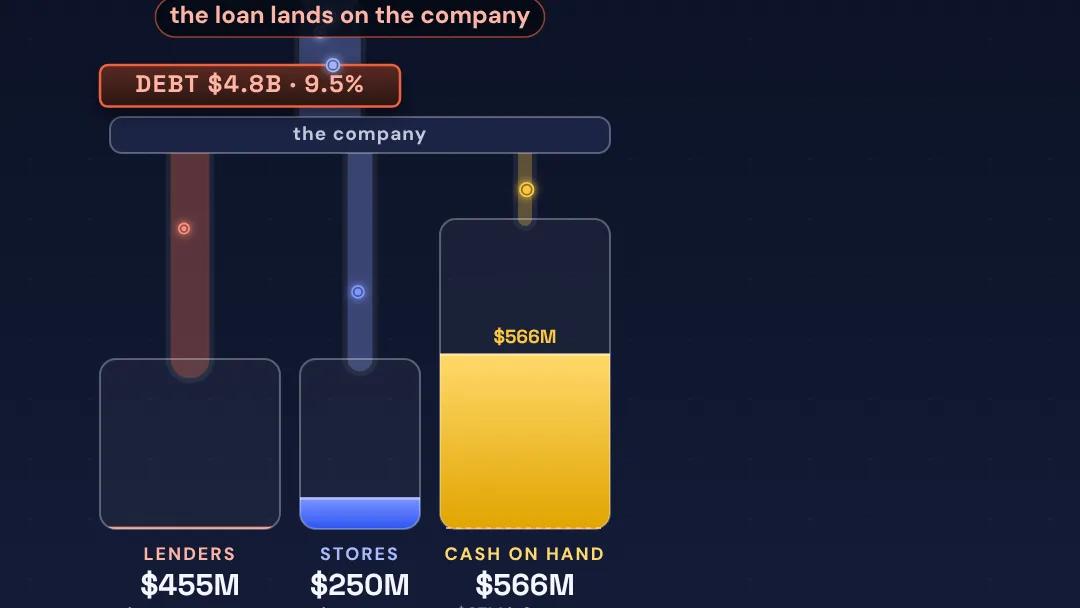 Interactive · Buyout LabHow did $5 billion of debt sink Toys “R” Us?Run Toys “R” Us from its last full year, drop sales by 10% and watch the cash tank drain.
- JournalHow did $5 billion of debt sink Toys “R” Us?In its last full year Toys “R” Us earned $792 million before interest. The 2005 buyout had put about $5 billion of debt on the company, and interest took $457 million of that every year. Drop sales 10% and the arithmetic turns deadly.
Fixed costs in another business
A business that rents out computers has the same shape: the machines cost the same whether anyone uses them.
- VideoThe Neocloud business, explainedA short video on the neocloud business: big fixed costs, and profit that depends on keeping them busy.by Deedy Das
Common questions
Is ten cents a latte realistic?
It is the model at its defaults, chosen so the arithmetic is easy to follow. Real cafés sell food and other drinks, pay different rents, and price lattes anywhere from $4 to $8. The point is the shape: most of the price is spent before the café earns anything, so profit lives in the last few cups.
Why does the café not just raise the price?
In the model it can, and it helps: at $7 the bills are paid before lunch. The model has no demand curve, so nobody stops coming. A real café has to guess how many customers a higher price costs, which is why the price knob is the one to try with care.
Why count rent by the day?
Because the model runs one day at a time. An $8,000 monthly rent is about $267 a day, owed every day the shop is open or not. Counting it daily makes the bills comparable to the cups.
What is break-even?
The number of cups at which the day’s contribution exactly covers the day’s bills. Below it, the café loses money. Above it, every extra cup is nearly all profit, because the bills are already paid.
Where do the New York numbers come from?
From café owners’ own numbers in the footage research behind the film: sales, drink counts, ingredient and labor shares, rents and barista pay. They are rounded and illustrative. The Latte Ledger model notes list the ranges.
Sources and credits
- Wikipedia · Break-even (economics) Contribution margin and the break-even point, as in any managerial-accounting text.
- Wikipedia · Operating leverage Why a business with mostly fixed costs sees profit swing more than sales.
- LB Coffee on Instagram (@lbcoffeenyc) The latte pour that opens the film, used as a short credited excerpt.
- Capstone Properties NY on TikTok A former West Village coffee shop listed at $19,000 a month: the rent in the third step above.
- Latte Ledger · model notesThe cost inputs, the hourly shares behind the clock, the New York ranges and what the model leaves out.
Every creator named here made the work we link to. Listing it does not imply a partnership or endorsement.