Topic guide · Money and government
Why does the national debt snowball?
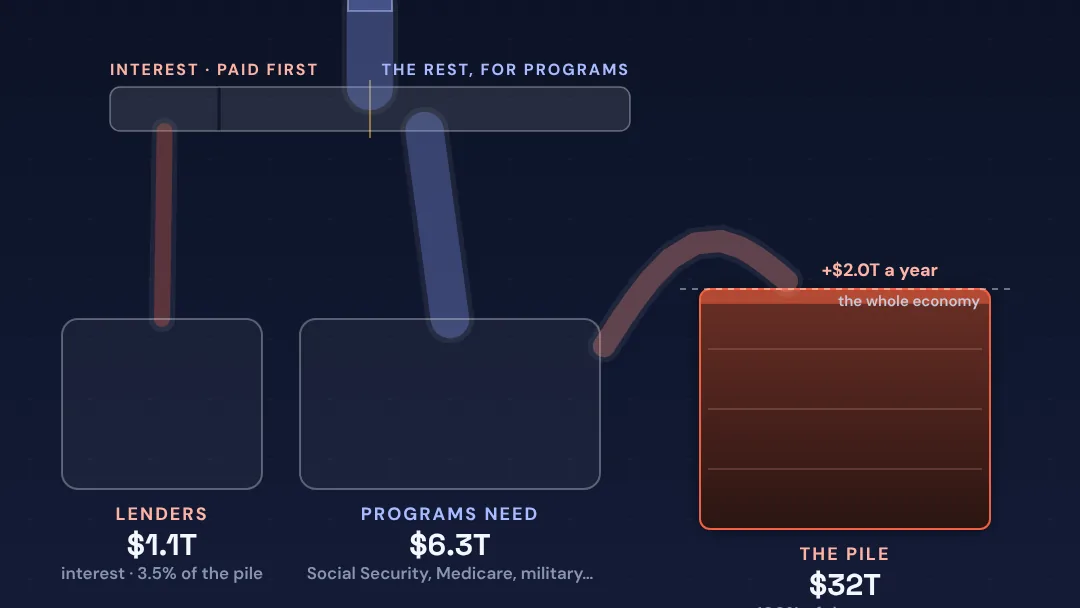
Because the pile charges interest, and the interest is paid before anything else. In fiscal 2026 the United States took in about $5.4 trillion in taxes, the Congressional Budget Office reports, and paid $1.14 trillion of interest on what it already owed, more than it spent on the military. That left $4.3 trillion for programs that cost $6.3 trillion. The $2 trillion shortfall was borrowed and added to the pile. A bigger pile means a bigger interest bill next year, less left for programs, and more borrowing.
- Taxes in
- $5.4T
- Interest, paid first
- $1.1T
- Programs
- $6.3T
- Borrowed
- $2.0T
Fiscal 2026 · CBO and Treasury Receipts $5,403B, net interest $1,143B, outlays $7,396B, deficit $1,993B. Debt held by the public about $32.4T, about the size of the economy.
Interactive · ExplainerTools
Debt Snowball
Turn the interest rate, the growth rate and the spending gap, and run the pile from 2026 to 2056. A ledger shows each year’s sum: taxes in, interest first, left for programs, borrowed.
Model · fiscal 2026, fixed shares of GDP
Why is interest paid first?
Interest is owed on money already borrowed. Programs can be argued over every year; the interest on last year’s bonds cannot. A government that skipped it would be in default, and its next loan would cost far more. So in the Debt Snowball machine, taxes pour into a bar and the first slice, in coral, goes to the lenders before anything reaches programs.
In fiscal 2026 that slice was $1.14 trillion, CBO’s monthly budget review shows, against $916 billion for defense. Interest has been larger than the military budget for two years running.
Where does the $2 trillion come from?
Taxes brought in $5.4 trillion. After interest, $4.3 trillion was left. Programs, from Social Security and Medicare to the military, cost $6.3 trillion. The $2 trillion gap is borrowed by selling Treasury bonds, and every dollar borrowed lands on the pile.
The pile is debt held by the public: about $32.4 trillion at the end of fiscal 2026, roughly the size of the whole economy, the American Action Forum notes from Treasury’s final monthly statement. The number on New York’s debt clock is larger because it also counts what the government owes its own trust funds.
What makes it a snowball?
Two engines run at once. The first is the gap before interest: spend more than you take in, and the pile grows. In the model that gap is about 2.6% of GDP a year.
The second is the interest itself. The pile grows by the gap plus the interest on the pile, so a bigger pile means a bigger first slice next year, less left for programs, and more borrowing. Whether that outruns the economy comes down to one comparison, the debt-dynamics identity: the interest rate on the pile against the growth rate of the economy. Today the average rate on the debt is about 3.5% and the economy grows about 4% a year in dollar terms, which just about holds the ratio steady before the gap is counted.
Raise the rate two points, to 5.5%, and the pile outgrows the economy on its own. In the model, interest reaches nearly $4 trillion by 2036, almost half of all taxes.
Try it: turn the rate, then close the gap
- 1 See
Open Debt Snowball at Today, 2026. The ledger reads taxes $5.4T, interest first $1.1T, left $4.3T, programs $6.3T, borrowed $2.0T.
- 2 Change
Tap Rates up 2 points. By 2036 the first slice is $3.8 trillion, 47% of taxes, and the pile passes 240% of GDP by 2056.
- 3 Understand
Tap Balanced before interest, rate above growth. The gap is gone, and the pile still outgrows the economy. That is the second engine on its own.
Where does this model stop?
Debt Snowball keeps taxes and spending at fixed shares of GDP, so there are no policy changes, recessions or inflation surprises. It applies one average rate to the whole pile at once; in reality new rates reach the pile as old bonds roll over, which takes years. The 2036 and 2056 figures are the model’s projection at the settings you choose, not a forecast.
A country is not a company. It borrows in its own currency, so it cannot run out of dollars the way Toys “R” Us ran out of cash. Its endings are different: higher taxes, less spending, inflation that shrinks the pile in real terms, or lenders demanding higher rates, which feeds the second engine. Ray Dalio’s How the Economic Machine Works, which inspired the trilogy, calls the painful version a deleveraging. The film opens on the National Debt Clock, by @newyorkcityclocks, credited on screen; the numbers come from CBO, Treasury and the model, not from the clip.
Explore by question
A country, a company and a café run the same money machine. Each card answers one part of the question.
Debt Snowball
Model · fiscal 2026, fixed shares of GDP
 Interactive · Debt SnowballWhy does the national debt snowball?Turn the rate, growth and the gap, and run the pile from 2026 to 2056 with a ledger for every year.
- Short · 44 secondsWhy does the national debt snowball?Interest off the top, the shortfall onto the pile, the rate turned up. Narrated and captioned.
- JournalWhy does the national debt snowball?The United States now pays over a trillion dollars a year in interest, more than its entire military. Interest is paid first, what is left goes to programs, and the shortfall is borrowed onto the pile, which charges interest on itself. Two engines drive the snowball, and one of them runs even with a balanced budget.
The same machine, as a company
A company with debt it cannot outgrow runs out of cash. That is the ending a country avoids, at a different cost.
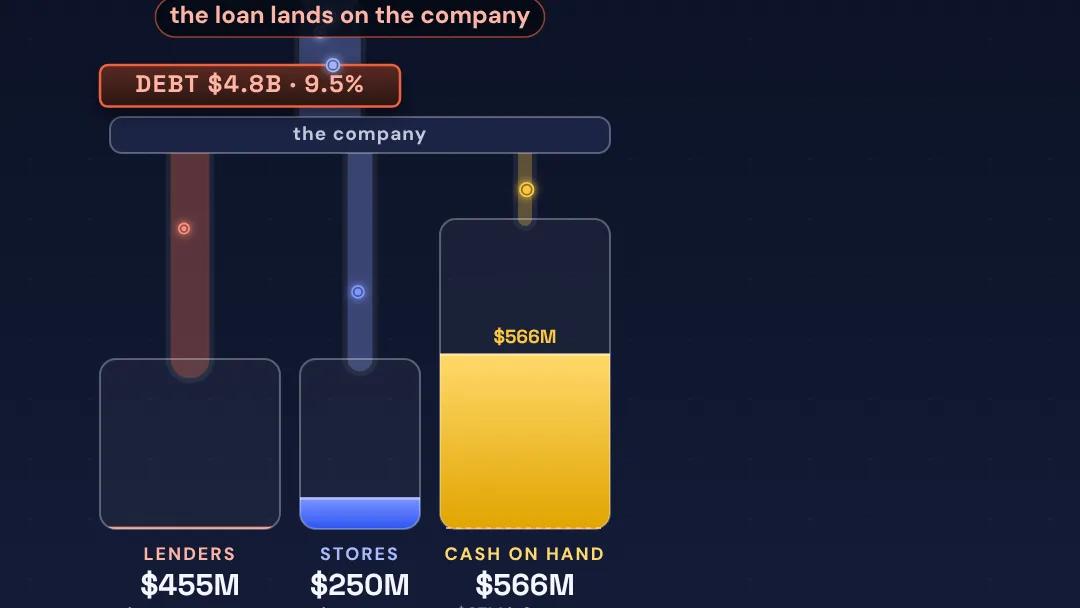 Interactive · Buyout LabHow did $5 billion of debt sink Toys “R” Us?Toys “R” Us earned $792 million before interest and went bankrupt anyway. Move the debt and the sales.
Growth that feeds on itself
Interest on interest is the arithmetic under the second engine, with the sign flipped.
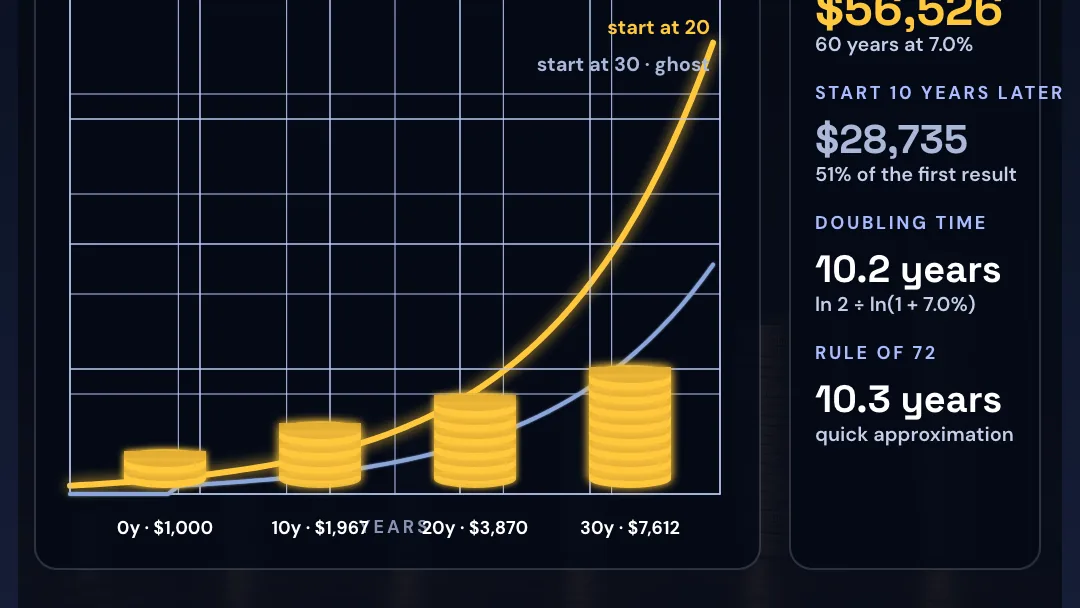 Interactive · Compound GrowthHow much can compound interest really grow?Change the return and the starting age, and see doubling time and the cost of starting ten years late.
What new money does
One ending for a pile is money creation. This explainer follows new money and shows why the order it reaches people matters.
- Interactive articleNew money is never neutralFollow new money as it enters the economy, and see who gets it first.by AMBOSS
Common questions
Is interest really more than the military?
Yes, for fiscal 2026. CBO’s monthly budget review puts net interest at $1,143 billion and defense at $916 billion. Social Security ($1,654 billion) and Medicare ($1,069 billion) are larger than both.
Does the United States have to pay the debt back?
It has to pay the interest and refinance the principal as bonds come due, which it does by selling new bonds. It does not have to pay the pile down to zero, and it never has. What matters for the snowball is whether the pile grows faster than the economy that pays the taxes.
Why is the debt clock’s number bigger than $32 trillion?
The clock shows gross federal debt, which includes what the government owes its own trust funds, such as Social Security’s. The pile in the model is debt held by the public, the part owed to outside lenders, about $32.4 trillion at the end of fiscal 2026.
Would a balanced budget stop the snowball?
Only if the interest rate is at or below the growth rate. With no gap before interest and a rate above growth, the pile still outgrows the economy. Try the “Balanced before interest, rate above growth” preset. With growth above the rate, a balanced budget lets the economy outgrow the pile, and the ratio falls.
What if rates fall instead?
Then the first slice shrinks and more is left for programs. In the model, growth above the rate slows the snowball, but the gap keeps feeding it: at 3% and 5% growth, the pile is still 114% of GDP by 2056. The average rate on the pile moves slowly in reality, because old bonds roll over gradually.
Sources and credits
- Congressional Budget Office · Monthly Budget Review: September 2026 Fiscal 2026: receipts $5,403B, outlays $7,396B, deficit $1,993B, net interest $1,143B, defense $916B, Social Security $1,654B, Medicare $1,069B, Medicaid $723B.
- American Action Forum · U.S. Treasury FY 2026 deficit totaled $2 trillion From Treasury’s final Monthly Treasury Statement: debt held by the public about $32.4T, about 100% of GDP; interest about 19% of revenue.
- Wikipedia · Debt-to-GDP ratio The debt-dynamics identity: the change in debt-to-GDP is about (r − g) × the ratio plus the primary deficit.
- Ray Dalio · How the Economic Machine Works The concept the trilogy is inspired by: the same machine for a person, a company and a country, and the deleveraging that ends a debt cycle.
- New York City Clocks on Instagram (@newyorkcityclocks) The National Debt Clock footage that opens the film, used as a short credited excerpt.
- Debt Snowball · model notesThe fixed shares, the 3.5% default rate, the 5.5% projection and what the model leaves out.
Every creator named here made the work we link to. Listing it does not imply a partnership or endorsement.