Topic guide · Password hashes and cracking
How can opening an email leak your password?
It does not leak the password itself. The flaw Microsoft patched on November 10, 2026 could make Outlook connect to an attacker’s server, and that connection hands over a hash: a scrambled fingerprint computed from your password. A hash cannot be run backwards, but it can be guessed. The attacker scrambles candidate passwords the same way, billions of times a second on a graphics card, until one matches. Eight lowercase letters last under a minute. Twelve mixed characters would take one card millions of years, unless the password is already on a leaked list, in which case it falls at once. In Hash Crack Lab you can change the length yourself.
- 8 lowercase letters
- ≈ 52 seconds
- 12 lowercase letters
- ≈ 9 months
- 12 mixed characters
- ≈ 4 million years
- On a leaked-password list
- under a second
Model · 4 billion guesses a second Time to try every combination on one graphics card at 4 billion guesses a second, an order-of-magnitude figure for NetNTLMv2 from public hashcat benchmarks. The average is half.
Interactive · ExplainerTools
Hash Crack Lab
Turn “Password length” up one character at a time and watch the marker jump along the scale. Then switch on “A common password”.
Model · brute force at 4 billion guesses a second per card
What did the Outlook flaw do?
CVE-2026-124194 is a spoofing vulnerability in Outlook that Microsoft patched on November 10, 2026. It was already being exploited, and CISA added it to its Known Exploited Vulnerabilities catalog the same day. As the advisory was reported, a crafted message file can make Outlook connect to a server the attacker controls without the usual external-content warning, and that connection discloses the user’s NTLMv2 hash. The fix is the Office update.
What is a password hash?
A hash function is a one-way scrambler. The same input always gives the same output, and there is no way to compute the input from the output. Windows uses hashes so that proving who you are to a server never means sending the password. What crosses the network in the scheme this flaw exposed is an NTLMv2 response, computed from the password’s hash and a challenge from the server.
How do you get a password out of a one-way hash?
By running it forwards. Take a guess, scramble it the same way, compare. A match means the guess was the password. Tools such as hashcat do this on graphics cards; for this kind of hash one high-end card manages billions of guesses a second. So the hash protects a password only as well as the number of guesses standing in the way.
Why does one more character matter so much?
The number of combinations is the size of the character set raised to the length:
- 8 lowercase letters
26⁸ ≈ 209 billion combinations: about 52 seconds at 4 billion guesses a second.
- 12 lowercase letters
26¹² ≈ 9.5 × 10¹⁶: about nine months on one card.
- 12 mixed characters
95¹² ≈ 5.4 × 10²³: about 4 million years on one card, about 4,000 years on a thousand.
Hardware divides the time; a character multiplies it. Length wins.
Why do common passwords fall first?
Because nobody starts with brute force. Attackers first try wordlists of billions of passwords leaked in earlier breaches, plus the patterns people use. That takes well under a second. A long password that appears on such a list is as weak as a short one, which is why NIST’s guidance favours length and checking against breached lists over forced symbols.
Try it: add one character
- 1 See
Open Hash Crack Lab: eight lowercase letters, gone in under a minute.
- 2 Change
Turn Password length up one step at a time, then press 12 mixed, then A common password.
- 3 Understand
Each character multiplies the work; a leaked password skips the work entirely.
What should you do about it?
Install the Office update. Use a long, unique password for every account, which in practice means a password manager, and turn on a second factor. Organisations can restrict or disable NTLM, because a captured response can sometimes be relayed to another server without being cracked at all; that is a separate attack and the tool does not show it.
Where does this model stop?
Hash Crack Lab counts combinations and divides by an illustrative guessing speed. Real cracking uses wordlists, rules and patterns long before brute force, and speeds differ enormously between hash types: slow, salted password hashes used by well-built websites are millions of times harder to guess than the fast one shown here. The hash strings on screen are made up, and the tool never asks for a real password.
Explore by question
Hashes, guessing and getting in. Each card answers one part of the question.
Hash Crack Lab
Model · brute force at 4 billion guesses a second per card
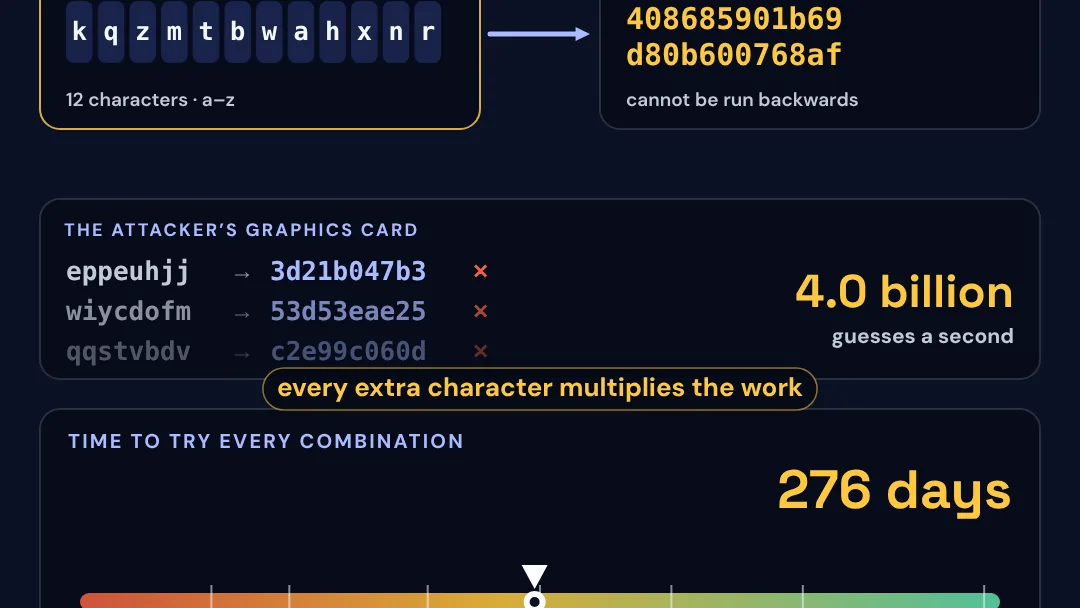 Interactive · Hash Crack LabHow can opening an email leak your password?Make a password longer and watch the time to guess it go from seconds to millions of years.
- ShortHow can opening an email leak your password?The flaw, the hash and the guessing. Narrated and captioned.
- JournalHow can opening an email leak your password?A patched Outlook flaw handed attackers password hashes. What a hash is, how it gets guessed, and why one more character matters more than a faster computer.
How hashing works
The scrambler itself, step by step.
What attackers do next
A password is the first link of a chain.
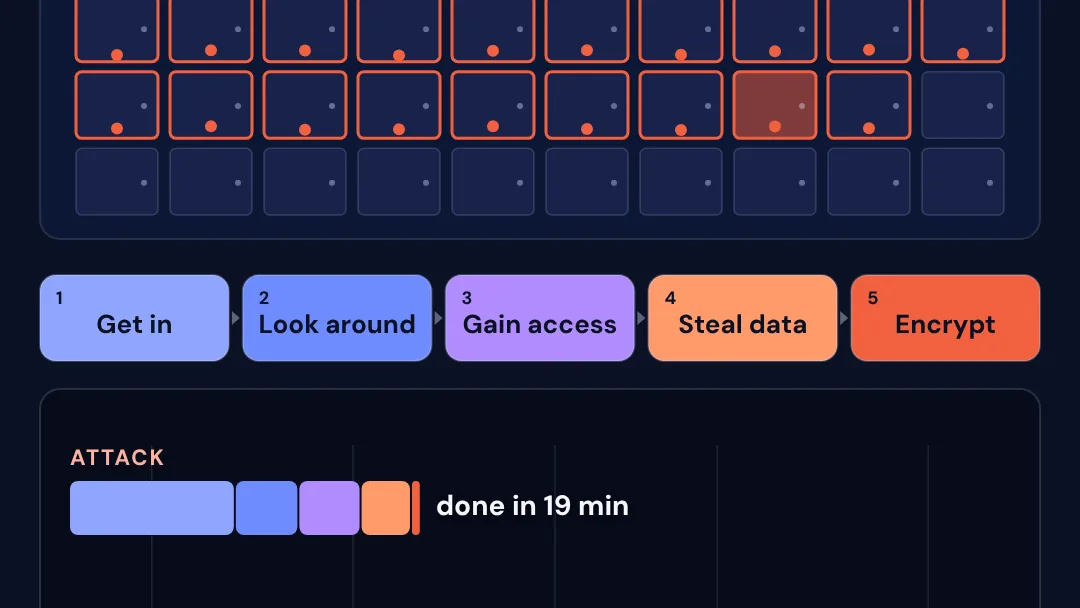 Interactive · Attack Clock LabWhy are AI-run attacks so fast?Why AI-run attacks are fast, and what still stops them.
Common questions
Does opening an email really leak my password?
Not the password itself. The patched Outlook flaw could leak an NTLMv2 hash made from it, after a user opened a crafted message file. A weak password can then be guessed from that hash.
Can a hash be reversed?
No. A hash function has no reverse. Attackers guess: they hash candidate passwords and compare the results.
How long does it take to crack an 8-character password?
For eight lowercase letters and a fast hash like the one in this flaw, under a minute on one graphics card. Slow, salted hashes take far longer.
Is a 12-character password safe?
Twelve random mixed characters would take one card millions of years by brute force. Twelve characters that appear on a leaked-password list fall in under a second.
How do I fix CVE-2026-124194?
Install the Office update Microsoft released on November 10, 2026.
Concepts in this guide
Each one has a plain one-line definition in Concepts A–Z, with every model, film and post where it comes up.
Sources and credits
- Microsoft Security Update Guide · CVE-2026-124194 The Outlook spoofing vulnerability, patched November 10, 2026.
- CISA · alert of November 10, 2026 Added to the Known Exploited Vulnerabilities catalog the same day.
- hashcat The password-recovery tool whose public benchmarks set the order of magnitude used here.
- NIST SP 800-63B · Digital Identity Guidelines Length and breached-list checks over composition rules.
- Hash Crack Lab · model notesThe brute-force arithmetic and what it leaves out.
Every creator named here made the work we link to. Listing it does not imply a partnership or endorsement.