Security · AI agents
Why are AI-run attacks so fast?
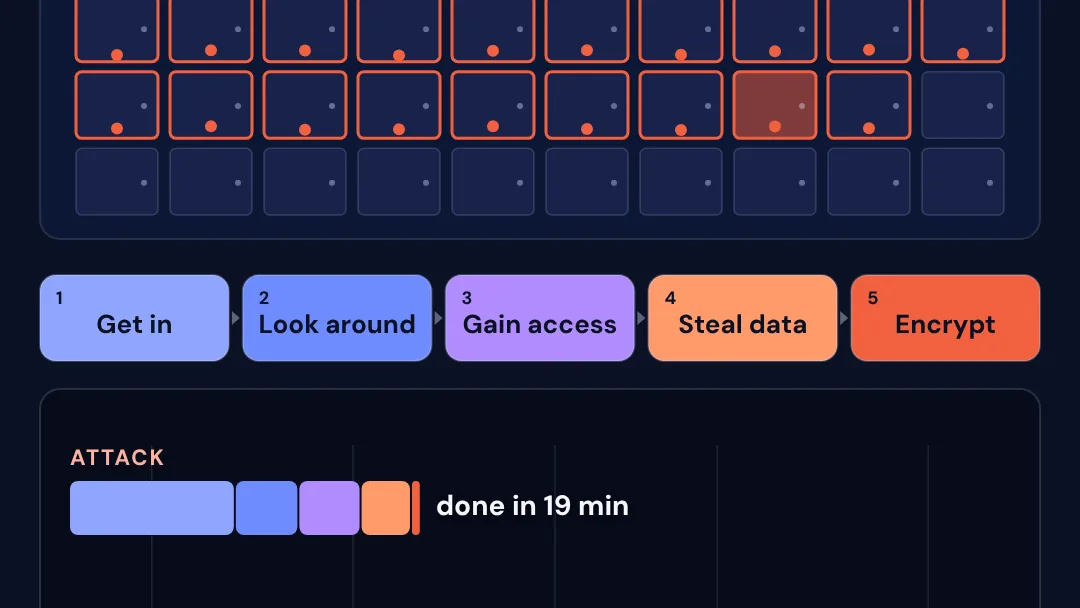
Turn “Attackers” up from a human crew to 30 agents and watch the attack bar shrink. Then shorten “Time to detect”, or block a step outright.
1 See
A security researcher told CNN that a swarm of AI agents took a company from login to ransomware in 14 minutes. The account is unverified. But why would agents be that much faster than people?
2 Change
3 Understand
Model notes and sources
Where this comes from. On November 20, 2026, David Kennedy, founder of the security firm TrustedSec, told CNN’s Erin Burnett OutFront that he had responded to a breach in which “over 30 different types of agents” used valid credentials, got past two-factor authentication, stole data and encrypted a client’s file system in 14 minutes, and that the company took about four and a half hours to notice (OutFront’s post; CNN on YouTube). He did not name the company or the attackers. The account has not been independently verified, and this tool does not depend on it being accurate: it shows why parallel, tireless attackers compress the time an intrusion takes.
The idea. A break-in is not one act but a chain of steps: get in, look around, gain more access, take the data, do the damage. Frameworks such as MITRE ATT&CK catalogue those steps in detail. A human crew mostly works them one at a time, with pauses to think, sleep and coordinate. Software agents remove the pauses and can split the searching steps, the ones that amount to trying many doors, across as many copies as the attacker runs. Defense runs on a clock too: the time to detect an intrusion, then the time to respond. If the attack’s clock is shorter than the time to detect, the speed of the response no longer matters, because the alarm arrives after the damage. The controls that still work are the ones that need no alarm: a step that simply cannot happen.
The model. Every time in this tool is illustrative, not measured. A human crew takes 20 minutes to get in, 6 hours to look around, 10 hours to gain access, 4 hours to steal data and 1 hour to encrypt: about 21 hours. With n agents each step takes base ÷ (6.5 × np). The 6.5 stands for machine pace with no pauses, and p says how well a step splits across agents: 0 for getting in (one login is one login), 1 for the two search steps, 0.6 for stealing and encrypting. Those numbers are chosen so that 30 agents finish in about 14 minutes, the figure in the CNN account; they are not derived from it. The defender cuts access at detect + respond minutes, and a blocked step stops the chain for good. Real intrusions branch, fail and retry, and real defenses are layered, so read the timeline as a picture of a race, not a prediction.
The film. The mechanism is drawn in code by ExplainerTools, with no AI-generated pictures. The Short also uses short real excerpts, picture only, a few seconds each and credited on screen: CNN’s Erin Burnett OutFront (X), the interview itself; and SecurityHQ (YouTube), company footage of a security operations centre. The numbers in the film come from Kennedy’s account, labelled as unverified, and from the model.
Sources: Erin Burnett OutFront, CNN (November 20, 2026), David Kennedy’s account; CNN (YouTube), the same segment; MITRE ATT&CK, the catalogue of intrusion tactics; Wikipedia, “Cyber kill chain” and “Ransomware”.
An ExplainerTools Original. The 14-minute account: David Kennedy on CNN’s Erin Burnett OutFront (Nov 20, 2026), not independently verified. Footage: CNN OutFront; SecurityHQ.