Security · passwords
How can opening an email leak your password?
Turn “Password length” up one character at a time and watch the marker jump along the scale. Then switch on “A common password”.
1 See
In November 2026 Microsoft patched an Outlook flaw that attackers were already using to collect password hashes. What is a hash, and how does anyone get a password out of one?
2 Change
3 Understand
Model notes and sources
Where this comes from. On November 10, 2026 Microsoft patched CVE-2026-124194, a spoofing vulnerability in Outlook that was already being exploited, and CISA added it to its Known Exploited Vulnerabilities catalog the same day (CISA’s alert). As Microsoft’s advisory was reported, a crafted message file can make Outlook connect to a server the attacker controls without the usual external-content warning, and that connection discloses the user’s NTLMv2 hash. Opening the file is required; the preview pane was not reported as a route. The fix is to install the Office update.
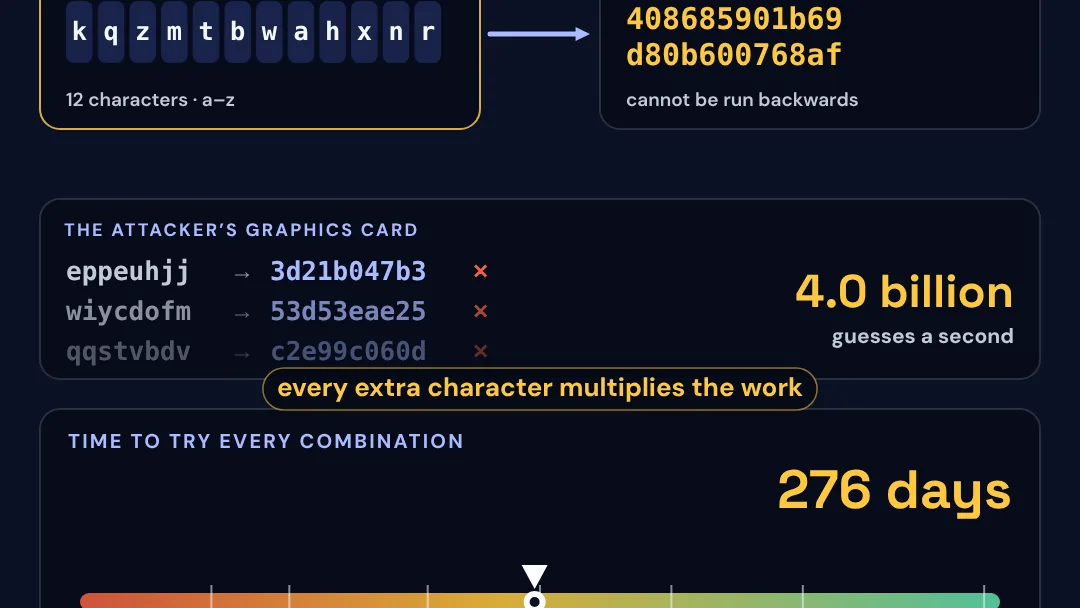
The idea. When Windows proves who you are to a server, it does not send your password. It sends a response computed from it with a hash function, a scrambler that is easy to run forwards and has no way to run backwards. That protects the password from being read, but not from being guessed: an attacker who captures the response can scramble candidate passwords the same way and see which one matches. Tools such as hashcat do this on graphics cards, billions of times a second. So the protection comes down to how many guesses there are. Each extra character multiplies the number, which is why length matters most, and why a password that is already on a leaked list is no protection at all: those lists are tried first. An attacker can also skip the guessing and relay a captured response to another server, which is a separate problem that this tool does not show.
The model. The tool counts combinations, (characters available)length, and divides by 4 billion guesses a second for each graphics card, the order of magnitude of public hashcat benchmarks for NetNTLMv2 on one high-end card. The time shown is for trying every combination; on average a password falls in half that. Eight lowercase letters are 268 ≈ 209 billion combinations, about 52 seconds. Twelve lowercase letters take about nine months. Twelve characters drawn from all 95 printable ones are 9512 ≈ 5.4 × 10²³ combinations, about 4 million years on one card. Real attackers do not start with brute force: they try wordlists of leaked passwords and common patterns first, which is what the “common password” switch stands for. The hash strings on screen are made up for the drawing; nothing here computes or cracks a real hash.
The film. The mechanism is drawn in code by ExplainerTools, with no AI-generated pictures. The Short also uses short real excerpts, picture only, a few seconds each and credited on screen: @SpoogemanGhost (X), a multi-card password-cracking rig; and @theprocracker (X), a hashcat run on a test hash. Neither clip is connected to the Outlook flaw. The numbers in the film come from the model, not from the footage.
Sources: Microsoft Security Update Guide, CVE-2026-124194; CISA alert, November 10, 2026 and the Known Exploited Vulnerabilities catalog; hashcat; NIST SP 800-63B, guidance on password length and checking against breached lists; Wikipedia, “NTLM” and “Cryptographic hash function”.
An ExplainerTools Original. Flaw: Microsoft CVE-2026-124194; CISA Known Exploited Vulnerabilities (Nov 10, 2026). Footage: @SpoogemanGhost; @theprocracker.