Topic guide · The Riemann Hypothesis
What does the Riemann Hypothesis actually say?
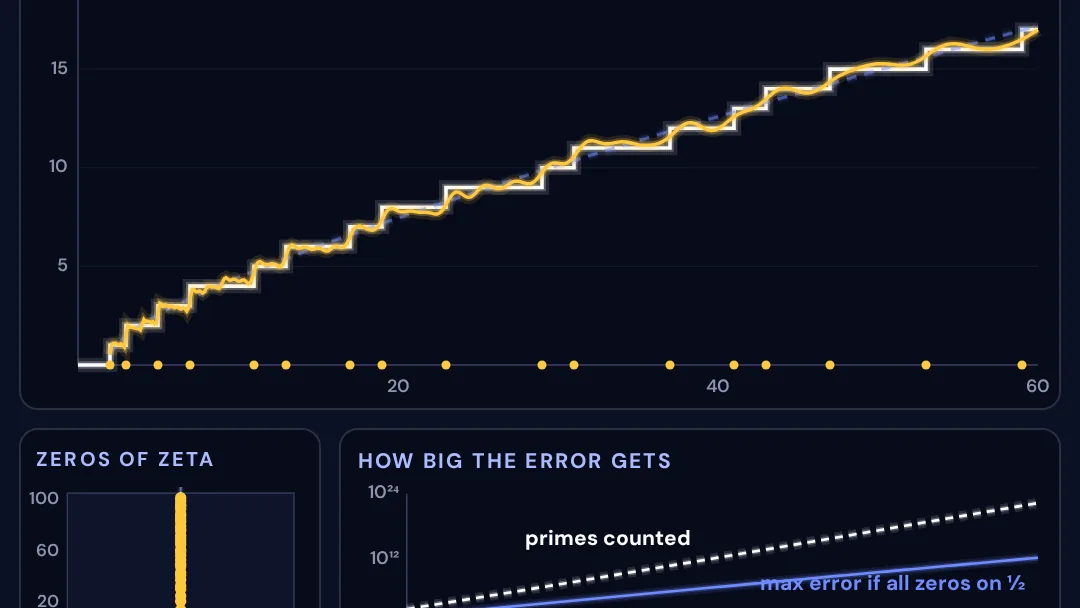
It says the primes are as regular as they can be. Count the primes up to x and you get a jagged staircase; a smooth curve guesses its shape, but the steps wobble around it. Riemann showed in 1859 that the wobble is a sum of waves, one for each zero of his zeta function. The Riemann Hypothesis says every one of those zeros has real part exactly ½, which keeps every wave, and so the error, no bigger than about √x. In November 2026 a computer proof of about 17 million lines of Lean passed every independent check, according to the Lean FRO and Mathlib. In Prime Staircase Lab you can add the waves yourself.
- Primes up to 60
- 17
- First zeta zero
- ½ + 14.134725 i
- Steps right, smooth guess vs 30 zeros (2–60)
- 46 → 58 of 58
- Proof size (Lean FRO / Mathlib)
- ≈ 17 million lines
Model · first 30 zeros Zero heights from Andrew Odlyzko’s tables. The tool keeps the leading term of each zero’s wave; the off-line zero is a hypothetical illustration.
Interactive · ExplainerTools
Prime Staircase Lab
Turn “Number of zeros” to add one wave per zeta zero and watch the curve snap onto the prime staircase. Then move zero number one off the line, hypothetically, and watch the error grow.
Model · first 30 zeros, leading terms
Why do the primes make a staircase?
Count the primes up to a number x and call the answer π(x). It climbs by one at 2, 3, 5, 7, 11 and every prime after, so its graph is a staircase with irregular steps: 4 primes up to 10, 17 up to 60, 78 up to 400. A smooth curve can follow its overall climb. Riemann’s version, R(x), is close to x/ln x, but the real steps wobble above and below it.
What are the wobbles made of?
Waves. Riemann’s zeta function has infinitely many nontrivial zeros, the first at heights 14.13, 21.02 and 25.01. His 1859 explicit formula says π(x) equals the smooth curve R(x) minus one wave for each zero, plus two small terms. A zero at height γ makes a wave that wiggles like cos(γ ln x), so higher zeros add faster wiggles that sharpen the steps. With the first 30 zeros the rebuilt curve rounds to the right count at all 58 checkpoints between 2 and 60. It is the same idea as building a square wave from sine waves, with zeros in place of harmonics.
What does “all zeros on one line” mean?
All the nontrivial zeros lie in a strip of real part between 0 and 1, and a zero with real part σ makes a wave that grows roughly like xσ. The Riemann Hypothesis says every zero has real part exactly ½, so no wave grows faster than about √x. Von Koch showed in 1901 that this is equivalent to the error |π(x) − li(x)| staying below a constant times √x ln x. If one zero sat at real part 0.9 instead, its wave would grow like x0.9, about 290 times past that limit by x = 1012. That is a hypothetical picture of what the hypothesis rules out.
What did the computer proof show?
On November 20, 2026 Levent Alpöge released a Lean library of about 17 million lines that proves the Riemann Hypothesis as stated in Mathlib, Lean’s mathematics library. In a joint statement on November 21, the Lean FRO and Mathlib said it compiles; two independent tools, comparator and con-leche --compare, confirmed the theorem is exactly Mathlib’s RiemannHypothesis statement; and the exported proof was checked by the Lean kernel and by independent checkers (con-leche, con-ron and a third-party checker). A proof checker does not judge whether a proof is elegant, only whether every step follows from the last.
Try it: add the waves yourself
- 1 See
Open Prime Staircase Lab: the white prime staircase and Riemann’s dashed smooth guess.
- 2 Change
Turn Number of zeros from 0 to 30, or press First zero, 10 zeros, All 30 zeros. Each zero adds one wave and the curve climbs in steps.
- 3 Understand
Press One zero off the line: zero number one moves to real part ½ + 0.4, hypothetically, and its wave outgrows the limit the hypothesis sets.
Where does this model stop?
Prime Staircase Lab uses only the first 30 zeros, from Andrew Odlyzko’s tables, and keeps only the leading term of each zero’s wave, 2 Re li(xρ). With 30 waves the curve rounds off each step and gets less sharp the further you count. The off-line zero is a hypothetical illustration, drawn without the mirror twin a real off-line zero would have, and the error chart compares the size of that one wave with Schoenfeld’s limit; it does not compute π(x) at 1012.
Explore by question
Primes, waves and the zeros of zeta. Each card answers one part of the question.
Prime Staircase Lab
Model · first 30 zeros, leading terms
 Interactive · Prime Staircase LabWhat does the Riemann Hypothesis actually say?Rebuild the prime staircase from 30 zeta zeros, then move one off the line.
- Short · 46 secondsWhat does the Riemann Hypothesis actually say?The staircase, the waves and the line every zero sits on. Narrated and captioned.
- JournalWhat does the Riemann Hypothesis actually say?A 17-million-line computer proof just passed every independent check. Here is what it proves: why the primes’ staircase is a sum of waves, and why every wave must sit on one line.
Building shapes from waves
The explicit formula adds waves the way a Fourier series does.
- Interactive demoFourier SeriesAdd sine waves one at a time and watch them build a square or sawtooth wave.by Paul Falstad
 Interactive articleCircles Sines and SignalsAn illustrated introduction to signals, sines and adding waves.by Jack Schaedler · Best on a larger screen
Common questions
What does the Riemann Hypothesis say, in plain words?
That all the nontrivial zeros of Riemann’s zeta function sit on one line, real part ½. Because each zero adds one wave to the count of primes, that keeps the primes as close to a smooth curve as they can possibly be: the error grows no faster than about √x.
What do zeta zeros have to do with prime numbers?
Riemann’s explicit formula writes the count of primes up to x as a smooth curve plus one wave for each zero of the zeta function. The zeros’ heights set how fast each wave wiggles; their real parts set how big each wave can grow.
Has the Riemann Hypothesis been proved?
In November 2026 a Lean library of about 17 million lines, released by Levent Alpöge, was reported by the Lean FRO and Mathlib to prove Mathlib’s RiemannHypothesis statement, with the proof checked by the Lean kernel and independent checker programs.
What would a zero off the line do?
A zero with real part ½ + δ would add a wave growing like x^(½+δ). For large x that wave would swamp the error limit the hypothesis guarantees, so the primes would stray much further from the smooth curve.
How many zeros do you need to see the steps?
Not many for small numbers. With the first 30 zeros the rebuilt curve rounds to the right count at every checkpoint from 2 to 60. Counting further needs more zeros, because the steps get closer together relative to the wiggles.
Concepts in this guide
Each one has a plain one-line definition in Concepts A–Z, with every model, film and post where it comes up.
Sources and credits
- Lean FRO and Mathlib · joint statement (November 21, 2026) The library compiles; comparator and con-leche confirmed the statement; the Lean kernel and independent checkers checked the proof.
- Mathlib · the RiemannHypothesis statement The exact statement the proof was checked against.
- A. Odlyzko · tables of zeros of the Riemann zeta function The zero heights used in the tool.
- Wikipedia · Explicit formulae for L-functions Riemann’s formula for the primes as a sum over zeros.
- Clay Mathematics Institute · The Riemann Hypothesis The problem statement and its history.
- Prime Staircase Lab · model notesThe 30 zeros, the leading terms and the hypothetical off-line zero.
Every creator named here made the work we link to. Listing it does not imply a partnership or endorsement.