Short · Math
What does the Riemann Hypothesis actually say?
This week a computer proof of the Riemann Hypothesis, about 17 million lines of Lean, passed every independent check. So what does it say? Count the prime numbers and you get a jagged staircase. A smooth curve, Riemann’s R(x), guesses its shape, but the steps wobble around it. Riemann found that the wobbles are a sum of waves, one for each zero of his zeta function. Add the waves from the first 30 zeros and the curve snaps onto the staircase. The hypothesis says every one of those zeros sits on the line of real part ½, which keeps the wobbles small. Move one off the line, hypothetically, and the error grows far past that limit.
Opens Prime Staircase Lab. Change the same thing yourself.

Transcript
This week, a seventeen-million-line computer proof of the Riemann Hypothesis passed every independent check. So what does it say? Count the prime numbers, and you get a jagged staircase. A smooth curve guesses its shape, but the steps wobble around it. Riemann found the wobbles are a sum of waves, one for each zero of his zeta function. Now add the waves. The staircase snaps into place. The hypothesis says every one of those zeros sits on a single line, which keeps the wobbles small. Move one off the line, and the error blows up. And the proof? Separate checker programs confirmed every step. Follow for more explainers like this.
Learn more
Learn more about the Riemann Hypothesis
This model rebuilds the prime staircase from 30 zeta zeros. The guide adds what the critical line means, why it keeps the error small and what the Lean FRO and Mathlib said about the computer-checked proof.
- Topic guideWhat does the Riemann Hypothesis actually say?The staircase, the waves, the critical line and the checked proof.
- Interactive demoFourier SeriesThe same trick with sine waves: add them one at a time and watch a square wave appear.by Paul Falstad
 Interactive articleCircles Sines and SignalsAn illustrated introduction to adding waves.by Jack Schaedler · Best on a larger screen
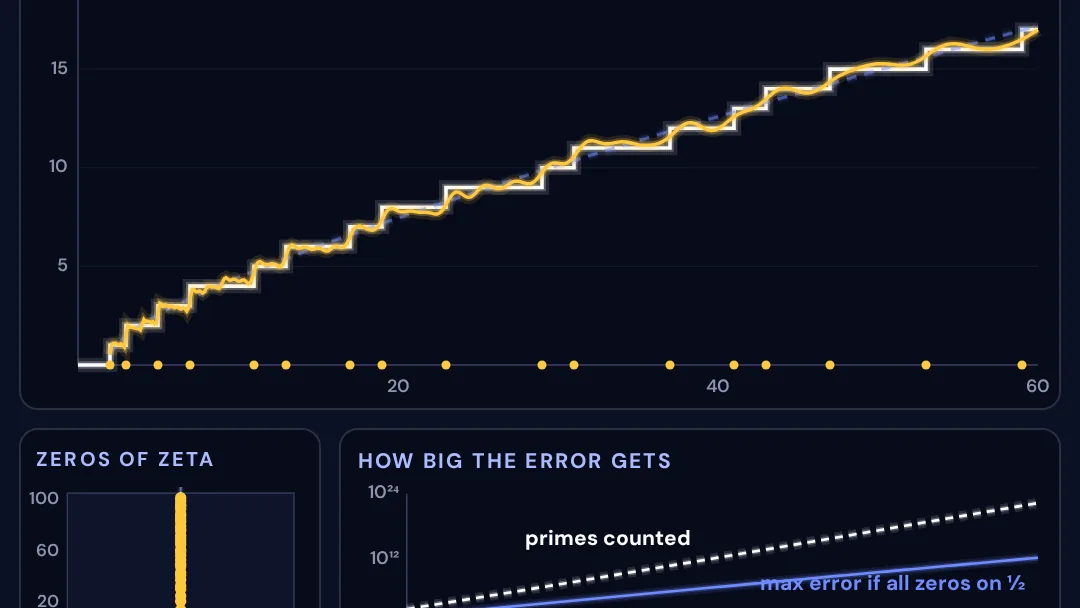 JournalWhat does the Riemann Hypothesis actually say?A 17-million-line computer proof just passed every independent check. Here is what it proves: why the primes’ staircase is a sum of waves, and why every wave must sit on one line.