Math · proof checked
What does the Riemann Hypothesis actually say?
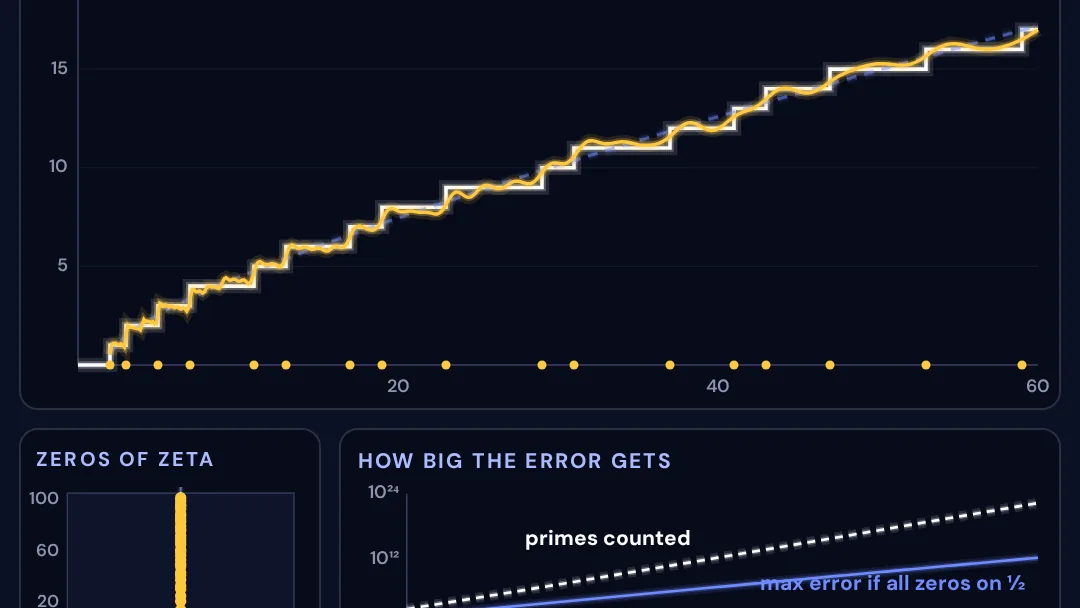
Turn “Number of zeros” to add one wave per zeta zero and watch the curve snap onto the staircase. Then move zero number one off the line, hypothetically, and watch the error grow. Pick a power of ten to see the real prime count and how close each guess comes.
1 See
Count the primes and you get a jagged staircase. A smooth curve guesses its shape, but the steps wobble around it. Riemann found what the wobbles are made of.
2 Change
3 Understand
Model notes and sources
Where this comes from. On November 20, 2026 Levent Alpöge released a Lean library of about 17 million lines that proves the Riemann Hypothesis as it is stated in Mathlib, Lean’s mathematics library. In a joint statement on November 21, the Lean FRO and Mathlib said the library compiles; two independent tools, comparator and con-leche --compare, confirmed that the theorem proved is exactly Mathlib’s RiemannHypothesis statement; and the exported proof was checked by the Lean kernel and by independent checkers (con-leche, con-ron and a third-party checker). This tool is about what that statement says.
The staircase. π(x) counts the primes up to x: it climbs one step at 2, 3, 5, 7, 11 and every prime after. Riemann’s smooth guess is R(x) = Σ μ(n)/n · li(x1/n), close to x/ln x for large x. It follows the climb, but the steps wobble around it.
The waves. In 1859 Riemann showed that the wobble is a sum of waves, one for each nontrivial zero ρ of his zeta function: π(x) = R(x) − Σρ R(xρ) − 1/ln x + arctan(π/ln x)/π. A zero at ½ + iγ and its mirror ½ − iγ add a wave that wiggles like cos(γ ln x) and has a size of about √x/(|ρ| ln x). Add enough of them and the smooth curve snaps onto the staircase.
The hypothesis. The Riemann Hypothesis says every nontrivial zero has real part exactly ½: they all sit on one line. That keeps every wave growing no faster than √x. Von Koch showed in 1901 that it is equivalent to the error |π(x) − li(x)| staying below a constant times √x ln x; Schoenfeld (1976) showed that, if it holds, the error is below √x ln x/(8π) for x ≥ 2657. A zero with real part ½ + δ would add a wave growing like x½+δ, which eventually swamps that limit.
The model and its limits. The tool uses the first 30 zeros, with heights from Andrew Odlyzko’s tables (14.134725, 21.022040, 25.010858, …, 101.317851). Each zero’s wave keeps only the leading term of R(xρ), 2 Re li(xρ), computed with the asymptotic series of the exponential integral; the smaller terms are left out. With only 30 waves the curve rounds off each step and ripples a little, and it gets less sharp the further you count. The off-line zero is a hypothetical illustration: zero number one is moved to real part ½ + δ and its wave grows like x½+δ. A real off-line zero would come with a mirror twin at ½ − δ, whose shrinking wave is left out. The error chart compares the size of that one wave with Schoenfeld’s limit; it is not a computation of π(x) at 1012.
Real counts. The “Real count at 10ⁿ” control and the green dots on the error chart use the exact number of primes up to every power of ten from 10 to 1024 (OEIS A006880, which lists the published computations). For each one, li(x), Riemann’s R(x) and x/ln x were computed to 50 digits with mpmath and stored in the page, so the table is not an estimate. At 1024 there are exactly 18,435,599,767,349,200,867,866 primes; li(x) is about 1.7 × 10¹⁰ too high, R(x) about 1.7 × 10⁹ too low, and x/ln x about 1.8% too low. Every real gap |π(x) − li(x)| sits under Schoenfeld’s limit, as the hypothesis requires. Pointing at the main chart reads the staircase, R(x), li(x) and the rebuilt curve at one x.
Hardy’s Z(t). The green line in the zeros panel is Hardy’s function Z(t), which is real on the line of real part ½ and has the same size as ζ(½ + it). It crosses zero exactly at the zeros. It is computed in the page with the Riemann–Siegel formula and its first correction term, and squashed to fit the panel (its true height reaches about 4.5 here). Its sign changes match the 30 tabulated zero heights to within 0.01.
The film. The mechanism is drawn in code by ExplainerTools, with no AI-generated pictures. The library and checkers are a diagram, not the real code. The Short also uses short real excerpts, picture only, a few seconds each and credited on screen: @mathelirium (X); Niedersächsische Staats- und Universitätsbibliothek Göttingen, Cod. Ms. B. Riemann 3 (photograph via the Clay Mathematics Institute). The numbers in the film come from the model, not from the footage.
Sources: Lean FRO and Mathlib, joint statement on the Riemann Hypothesis formalization (November 21, 2026); B. Riemann, “Ueber die Anzahl der Primzahlen unter einer gegebenen Grösse” (1859); H. M. Edwards, Riemann’s Zeta Function (1974); H. von Koch, “Sur la distribution des nombres premiers”, Acta Math. 24 (1901); L. Schoenfeld, “Sharper bounds for the Chebyshev functions θ(x) and ψ(x). II”, Math. Comp. 30 (1976); A. Odlyzko, tables of zeros of the Riemann zeta function; LMFDB, zeros of ζ(s); OEIS A006880, number of primes below 10n; mpmath (li, riemannr, zetazero); H. M. Edwards, ch. 7, for the Riemann–Siegel formula; Wikipedia, “Prime-counting function” and “Riemann hypothesis”.
An ExplainerTools Original. Proof-check facts from the Lean FRO / Mathlib joint statement (November 21, 2026); zero heights from Andrew Odlyzko’s tables; exact prime counts from OEIS A006880. Footage: @mathelirium; Riemann’s 1859 manuscript, SUB Göttingen.