Topic guide · Single-crystal turbine blades
Why are jet turbine blades grown as a single crystal?
Because grain boundaries are where hot metal gives way. The gas hitting a jet engine’s first turbine blades is hotter than the melting point of their nickel superalloy, about 1,300 °C; cooling air through tiny holes and a ceramic coating keep the metal just below it. Even so, hot metal pulled by the spinning rotor slowly stretches, called creep, and the damage gathers at the boundaries between its grains. So the blade is cast with no boundaries: it freezes upward from a chilled plate, and a corkscrew “pigtail” lets only one crystal through, which grows into the whole blade. In Crystal Blade Lab you can compare the grain structures yourself.
- Nickel superalloy melts at
- ≈ 1,300 °C
- Kept below it by
- Cooling holes · ceramic coat
- Weak spot when hot
- Grain boundaries
- Single-crystal blades since
- 1980s (PWA 1480)
Source · Reed (2006); Cambridge The viral post that sparked interest is treated as a claim; its temperature and load figures are not used here.
Interactive · ExplainerTools
Crystal Blade Lab
Turn “Grain structure” from equiaxed to single crystal, raise the metal temperature and the time under load, and watch where creep damage gathers. Then watch the pigtail pick one crystal.
Model · illustrative creep, schematic grains and casting
Is a jet engine really harder to make than a nuclear weapon?
That was the claim of a viral post on X in November 2026, pointing at the turbine blades. We show it as a claim, not something we have checked, and we don’t use the post’s figures. What is well established is why the hottest blades are made the way they are.
How do blades survive gas hotter than their melting point?
The gas leaving the combustor is hotter than the melting point of the nickel superalloy the first turbine blades are made of, about 1,300 °C. The metal itself is kept below that. Cooling air flows through passages inside each blade and out of rows of tiny holes, laying a cool film over the surface, and a ceramic thermal barrier coating (yttria-stabilised zirconia) insulates the outside (Reed, 2006; Rolls-Royce, The Jet Engine).
Why do grain boundaries matter?
Just below melting, and pulled outward by the spinning rotor, the metal slowly and permanently stretches: creep, which ends in rupture. An ordinary casting is made of many small grains, and at these temperatures the boundaries between them are the weak spots. Grains slide, and small cavities open on boundaries that run across the pull and link into cracks. Long grains along the blade leave few boundaries across the pull; a single crystal has none.
How is a blade grown as one crystal?
By controlling how it freezes (Reed, 2006; Bhadeshia, Cambridge):
- Freeze upward
The mold stands on a chilled plate and is lowered slowly out of the hot furnace, so the metal freezes from the bottom up: directional solidification.
- Pick one crystal
Many crystals start on the plate. A narrow corkscrew called a pigtail blocks all but one.
- Grow the blade
That one crystal grows into the whole blade, with no grain boundaries.
Pratt & Whitney introduced single-crystal blades in the alloy PWA 1480 in the 1980s.
Try it: grow a single crystal yourself
- 1 See
Open Crystal Blade Lab: an ordinary blade of many grains after 1,000 hours of heat and load.
- 2 Change
Press Columnar grains · 1,000 h, then Single crystal · 1,000 h, and watch the cavities and the creep curve.
- 3 Understand
Press Single crystal, 100 °C hotter: even one crystal creeps much faster when hotter, which is why the cooling still matters.
Where does this model stop?
The creep curves and rupture lives are illustrative: only the ordering (single crystal longest, then columnar, then ordinary grains) and the steep fall with temperature are meant. The grains, the temperature profile through the wall and the casting furnace are schematic, the blade’s stretch is exaggerated and the casting is speeded up. Real blades also face bending and vibration, and their crystals are grown in a chosen orientation. It is not data for any alloy or engine.
Explore by question
Heat, metal and engines. Each card answers one part of the question.
Crystal Blade Lab
Model · illustrative creep, schematic grains and casting
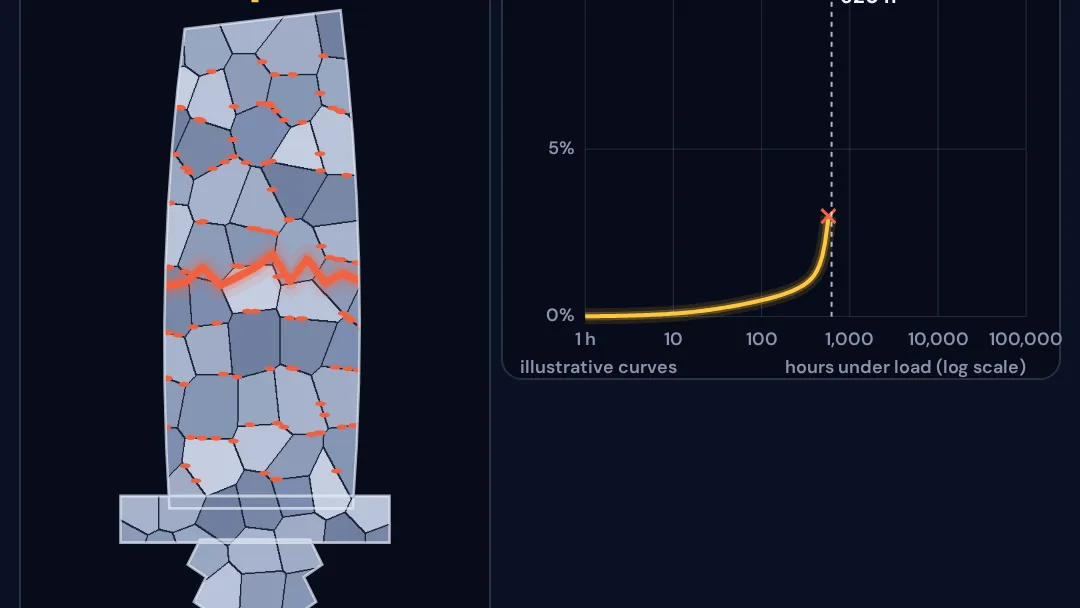 Interactive · Crystal Blade LabWhy are jet turbine blades grown as a single crystal?Switch a blade from many grains to one crystal, heat it and load it for years.
- ShortWhy are jet turbine blades grown as a single crystal?The hot gas, the cooling, creep at grain boundaries and the pigtail. Narrated and captioned.
- JournalWhy are jet turbine blades grown as a single crystal?Turbine blades run in gas hotter than their melting point. Cooling keeps them solid, but hot metal creeps at grain boundaries, so they’re cast as one crystal.
Inside the engine
Where the turbine blades sit.
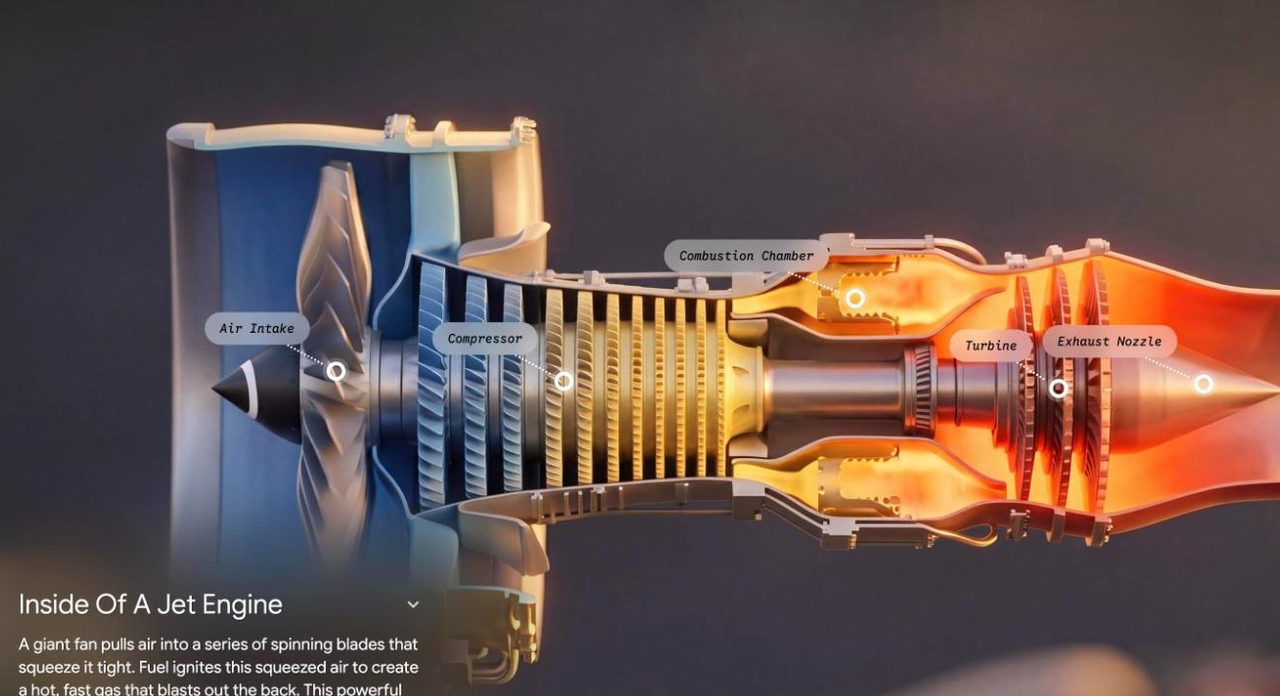 Interactive demoInside Of A Jet EngineInside Of A Jet Engine, a Google Gemini visual exploration (Google sign-in required).by Google Gemini · Opens on the creator’s site
Flight
What the engine is for.
- VideoHow planes fly · 3D book previewHow planes fly: Techartist’s preview of a 3D flight-physics book.by Techartist
Common questions
Why are jet turbine blades made from a single crystal?
At the blades’ working temperature, hot metal under load slowly stretches (creep), and the damage gathers at the boundaries between grains. A blade grown as one crystal has no grain boundaries, so it lasts far longer under heat and load.
How can turbine blades work in gas hotter than their melting point?
Cooling air flows through passages inside the blade and out of tiny holes, laying a cool film over the surface, and a ceramic thermal barrier coating insulates it. Together they keep the metal itself below its melting point of about 1,300 °C.
What is a pigtail grain selector?
A narrow corkscrew passage at the bottom of the mold. Many crystals start growing on the chilled plate below it; its turns block all but one, and that crystal grows into the whole blade.
Is a jet engine harder to make than a nuclear weapon?
That was the claim of a viral post in November 2026. We don’t assess it; this guide covers the well-established reason the blades are grown as single crystals.
Concepts in this guide
Each one has a plain one-line definition in Concepts A–Z, with every model, film and post where it comes up.
Sources and credits
- R. C. Reed · The Superalloys: Fundamentals and Applications (Cambridge University Press, 2006) Superalloy melting point, cooling and coatings, creep and single-crystal casting.
- H. K. D. H. Bhadeshia · Nickel based superalloys (University of Cambridge) Directional solidification, the pigtail selector and single-crystal blades.
- Wikipedia · Single-crystal superalloy History and casting of single-crystal blades.
- Wikipedia · Thermal barrier coating Yttria-stabilised zirconia coatings on turbine blades.
- Crystal Blade Lab · model notesThe illustrative creep curves, schematic grains and casting.
Every creator named here made the work we link to. Listing it does not imply a partnership or endorsement.